What Are B2B Customer Success Strategies?
In the dynamic landscape of modern business, robust B2B customer success strategies are no longer just a support function; they are a fundamental pillar of sustainable growth and competitive advantage. At its core, B2B customer success is a proactive, strategic approach focused on ensuring clients achieve their desired outcomes while using your products or services. This isn’t merely about troubleshooting issues, but about forging strategic partnerships that drive tangible value for both parties, ultimately leading to significant and recurring B2B business growth.
Effective business-to-business client management methods involve understanding client goals, anticipating their needs, and guiding them through their journey to maximize their investment. This encompasses everything from a structured onboarding process and continuous value delivery to proactive engagement and strategic account expansion. By dedicating resources to fostering deep, long-term relationships, businesses can significantly reduce churn, boost customer lifetime value (LTV), and cultivate a powerful advocacy engine.
The transition from a reactive customer service model to a proactive, value-driven enterprise customer success approach marks a crucial evolution in how B2B companies secure and scale their recurring revenue. It transforms clients from mere users into successful partners, creating a symbiotic relationship that fuels market share expansion and sustained profitability.
See our detailed guide on the Definition and Importance of B2B Customer Success: Definition and Importance of B2B Customer Success
What Are the Key Principles of Effective B2B Customer Success?
To truly excel in strategic customer engagement in B2B, organizations must anchor their efforts in a set of core principles that guide every interaction and decision. These principles ensure that customer success initiatives are not just tactical maneuvers but strategic investments in long-term relationships and sustainable B2B business growth.
- Value-Driven Focus: The primary objective is to help clients realize and maximize the value they expected (and more) from your solution. This means understanding their business objectives and aligning your services to help them achieve those goals.
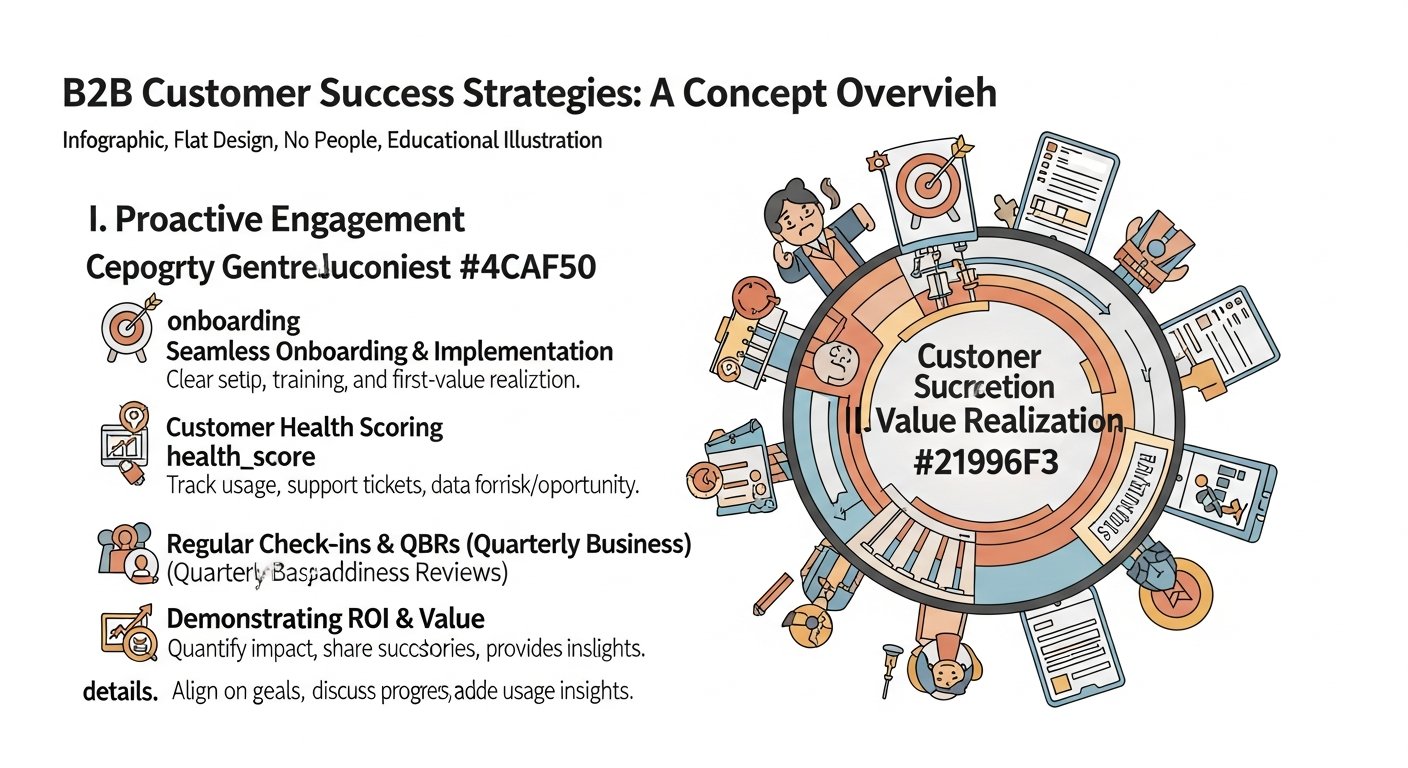
- Proactive Engagement: Rather than waiting for problems to arise, effective strategies involve anticipating client needs, potential roadblocks, and opportunities for growth. This often includes regular check-ins, health scores, and early intervention.
- Relationship-Centric Approach: Building strong, trusted relationships with key stakeholders within the client organization is paramount. A dedicated customer success manager (CSM) often acts as a strategic advisor, fostering rapport and understanding.
- Data-Driven Decisions: Leveraging customer data—from usage analytics to feedback—is crucial for identifying patterns, predicting churn risk, and personalizing the client journey. Measurable insights inform strategic decisions and optimize resource allocation.
- Continuous Improvement & Adaptability: The B2B landscape is always evolving, and so too should customer success efforts. Strategies must be scalable and adaptable to client needs, market shifts, and product updates, ensuring persistent relevance and value delivery.
These principles lay the groundwork for driving B2B client loyalty and ensuring that every effort contributes directly to the client’s success and, by extension, your own organization’s exponential growth.
See our detailed guide on the Core Principles of Customer Success: Core Principles of Customer Success

How Do You Implement Proactive Onboarding for B2B Clients?
The initial phase of the client lifecycle—onboarding and implementation—is arguably the most critical for setting the stage for long-term B2B client retention tactics. A well-structured, proactive onboarding process ensures user adoption, rapid time-to-value, and an early demonstration of commitment to the client’s success. It’s about transforming initial excitement into sustained satisfaction and concrete results.
How Do You Structure an Effective B2B Onboarding Process?
An effective B2B onboarding process is far more than just product training; it’s a personalized journey designed to integrate your solution seamlessly into the client’s operations. This typically involves:
- Discovery & Goal Alignment: Deep dives into the client’s specific business challenges, objectives, and success metrics. This ensures a shared understanding of what success looks like.
- Customized Success Plans: Developing a tailored roadmap with clear milestones, timelines, and responsible parties. This plan outlines specific actions, training modules, and measurable outcomes.
- Early Engagement & Stakeholder Mapping: Identifying and engaging all key stakeholders from day one, from end-users to executive sponsors, to ensure broad organizational buy-in and support.
- Phased Implementation & Training: Breaking down complex deployments into manageable stages, accompanied by comprehensive, personalized training sessions and resources.
- Regular Check-ins & Feedback Loops: Establishing a cadence for communication to monitor progress, address early challenges, and gather feedback, ensuring the client feels supported and heard.
How Does Strong Onboarding Impact B2B LTV?
Strong onboarding has a direct and significant impact on B2B customer lifetime value (LTV). When clients experience a smooth, efficient, and value-driven onboarding, they:
- Achieve Faster Time-to-Value: Quick wins demonstrate the immediate benefit of your solution, solidifying their investment.
- Increase User Adoption: Properly trained and supported users are more likely to fully integrate the product into their daily workflows, leading to higher engagement.
- Reduce Early Churn: Many B2B churn instances occur early in the client lifecycle due to frustration or perceived lack of value. Proactive onboarding mitigates this risk.
- Foster Advocacy: A positive initial experience makes clients more likely to become advocates, driving referrals and positive reviews.
- Lay Groundwork for Expansion: A successful initial implementation builds trust, making it easier to identify and pursue expansion opportunities (upsells, cross-sells) down the line.
A structured, personalized onboarding is a foundational element for optimizing B2B customer experience and maximizing the long-term potential of every client relationship.
See our detailed guide on Proactive Onboarding Best Practices: Proactive Onboarding Best Practices
How Can Data Be Leveraged for Personalized B2B Customer Journeys?
In the realm of enterprise customer success approaches, data is the compass that guides personalized interactions and strategic interventions. Harnessing rich customer data allows businesses to move beyond generic engagement models and tailor experiences that resonate deeply with individual client needs and behaviors. This data-driven approach is essential for scaling B2B client relationships and ensuring every touchpoint adds meaningful value.
How Are CDPs and CRMs Utilized in B2B Customer Success?
Modern B2B customer success teams rely heavily on technology to gather, analyze, and act on customer intelligence. Customer Relationship Management (CRM) systems like Salesforce Service Cloud, combined with Customer Data Platforms (CDPs), serve as central repositories for all client interactions, usage patterns, and communication histories. These platforms enable:
- Unified Customer View: A 360-degree perspective of each client, consolidating data from sales, support, marketing, and product usage.
- Behavioral Tracking: Monitoring how clients interact with your product or service, identifying features they use most, areas of friction, or untapped potential.
- Communication History: Keeping a comprehensive record of all outreach, meetings, and support tickets to ensure consistent and informed engagement.
- Health Scoring: Developing predictive analytics models that assign a “health score” to each client based on a multitude of data points, flagging at-risk accounts before issues escalate.
Platforms like Gainsight and ChurnZero are specifically designed to leverage this data for comprehensive customer success management, enabling teams to automate workflows, personalize outreach, and track key metrics.
How Do You Map Personalized B2B Customer Journeys?
With robust data at hand, customer success teams can meticulously map out personalized customer journeys. This involves:
- Segmentation: Grouping clients based on industry, size, product usage, or strategic importance to tailor communication and support.
- Proactive Triggers: Setting up automated alerts or tasks based on specific client behaviors (e.g., low feature adoption, critical milestone reached, decreased usage) to prompt timely human intervention.
- Content Personalization: Delivering targeted resources, webinars, or best practice guides that are relevant to the client’s current stage in their journey or specific challenges.
- Feedback Integration: Systematically collecting and incorporating customer feedback (e.g., NPS, CES) into ongoing strategic adjustments and product development.
By transforming raw data into actionable insights, B2B companies can optimize their B2B customer experience, ensuring every client feels understood and valued, leading to stronger loyalty and organic growth.
See our detailed guide on Data-Driven Customer Success: Data-Driven Customer Success

How Do You Build Strong Relationships and Foster Advocacy in B2B Customer Success?
Beyond data and processes, the human element remains central to driving B2B client loyalty. Cultivating strong, trust-based relationships is fundamental for customer success, transitioning from transactional interactions to genuine strategic partnerships. These robust relationships naturally lead to advocacy, a powerful engine for B2B business growth.
How Can Strategic Partnerships Be Fostered with B2B Clients?
A B2B customer success manager (CSM) often acts as the client’s internal champion and external advisor. Their role extends beyond product knowledge to deeply understanding the client’s business, industry, and strategic objectives. Key elements for fostering these partnerships include:
- Regular, Value-Focused Business Reviews: Beyond status updates, these meetings should focus on demonstrating achieved value, identifying new opportunities, and aligning on future goals.
- Proactive Problem Solving: Identifying potential issues before they impact the client’s operations and working collaboratively to find solutions.
- Thought Leadership & Guidance: Sharing industry insights, best practices, and innovative ways to leverage your solution, positioning your team as trusted advisors.
- Executive Sponsorship: Ensuring that senior leadership on both sides maintains a relationship, especially for strategic accounts, reinforcing commitment and alignment.
How Do You Cultivate B2B Client Advocacy and Drive Expansion?
Advocacy is the ultimate outcome of exceptional customer success. Satisfied, successful clients become your most credible marketing assets. Strategic customer engagement in B2B should explicitly aim to convert happy clients into vocal champions who refer new business and are open to expansion opportunities.
- Testimonials & Case Studies: Proactively asking successful clients to share their stories through written testimonials, video case studies, or participation in webinars.
- Referral Programs: Establishing formal programs that incentivize clients to refer new business, leveraging their positive experiences.
- Community Building: Creating platforms (e.g., user groups, forums, events) where clients can connect, share insights, and learn from each other and your experts.
- Beta Programs: Inviting loyal clients to participate in beta testing for new features or products, making them feel invested and valued.
- Identifying Expansion Opportunities: Through deep understanding of client needs, identifying natural upsell or cross-sell opportunities that genuinely add more value.
By consistently delivering value and nurturing relationships, businesses can transform their client base into a powerful network of advocates, directly contributing to exponential B2B business growth and market share expansion.
See our detailed guide on Building Customer Relationships: Building Customer Relationships
What Are the Key Metrics for Measuring B2B Customer Success?
To truly understand the impact of your B2B client retention tactics and continuously refine them, robust measurement is non-negotiable. Establishing clear metrics and KPIs allows customer success teams to track performance, demonstrate ROI, and make data-driven decisions that propel B2B business growth. It’s about quantifying the value delivered and optimizing for future success.
What Metrics Truly Define B2B Customer Success?
While many metrics exist, a few are paramount for assessing the health and effectiveness of your enterprise customer success approaches:
| Metric | Definition | Why it Matters for B2B Growth | How to Measure | Target Benchmark (Example) |
|---|---|---|---|---|
| Customer Lifetime Value (CLTV) | The total revenue a business can expect from a single customer account over the entire period of their relationship. | Directly reflects the long-term profitability of client relationships and sustainable B2B growth. | (Average Revenue Per Account x Gross Margin) / Churn Rate | Typically 3-5x Customer Acquisition Cost (CAC) |
| Churn Rate | The rate at which customers stop doing business with a company over a given period. | Indicates customer satisfaction and retention effectiveness; high churn erodes recurring revenue. | (Lost Customers / Total Customers at Start of Period) x 100 | < 5% for SaaS B2B; varies by industry |
| Net Promoter Score (NPS) | Measures customer loyalty and willingness to recommend a company’s products or services to others. | Strong predictor of advocacy and future referrals; gauges overall customer sentiment. | Survey: (Promoters % – Detractors %) | > 30 generally good, > 50 excellent |
| Customer Effort Score (CES) | Measures how much effort a customer has to exert to get an issue resolved, a request fulfilled, or a product question answered. | Highlights friction points in the customer journey; lower effort often leads to higher loyalty. | Survey: “How easy was it to [task]?” (1-7 scale) | Score of 5 or higher (out of 7) |
| Expansion Revenue (Net Revenue Retention – NRR) | Revenue generated from existing customers through upsells, cross-sells, and renewals, minus any churn. | Demonstrates the ability to grow within an existing customer base, crucial for exponential growth. | (Starting MRR + Upsells + Cross-sells – Churn) / Starting MRR | > 100% (indicates growth from existing clients) |
What Tools Are Used for Tracking B2B Customer Success Performance?
Specialized platforms are invaluable for gathering and visualizing these metrics. Tools like Gainsight, ChurnZero, and Vitally provide comprehensive dashboards and reporting capabilities, allowing teams to:
- Monitor Customer Health: Track aggregated health scores across the entire client portfolio.
- Identify Trends: Pinpoint patterns in product usage, support tickets, and feedback.
- Automate Reporting: Generate regular reports on key KPIs for internal stakeholders and executive summaries.
- Segment Data: Analyze metrics by customer segment, product line, or CSM to identify areas of strength and weakness.
By effectively measuring these attributes, businesses can continuously optimize their efforts, ensuring their investment in optimizing B2B customer experience translates directly into tangible returns and sustainable recurring revenue.
See our detailed guide on Key Customer Success Metrics: Key Customer Success Metrics
What Are Common Mistakes to Avoid in B2B Customer Success?
While the potential for strategic customer engagement in B2B is immense, pitfalls can derail even the most well-intentioned efforts. Recognizing and avoiding common mistakes is crucial for ensuring that B2B client retention tactics genuinely contribute to B2B business growth rather than becoming costly, ineffective endeavors.
- Treating CS as Reactive Support: A prevalent error is viewing customer success as merely an extension of customer support, dealing with issues only after they arise. This reactive stance misses the core proactive, value-driven purpose of CS.
- Lack of Defined Success Metrics: Without clear, measurable KPIs (like those discussed above), it’s impossible to quantify the impact of CS efforts, leading to a lack of accountability and difficulty in proving ROI.
- Siloed Teams & Inconsistent Communication: When customer success, sales, marketing, and product teams operate in isolation, vital customer information can be lost. This leads to inconsistent messaging and a fragmented customer experience.
- One-Size-Fits-All Approach: Treating all B2B clients identically, regardless of their size, industry, or strategic importance, often results in neglecting high-value accounts or over-resourcing smaller ones. Personalized approaches are key.
- Ignoring Product Usage Data: Failing to analyze how clients actually use the product (or don’t use it) means missing critical insights into value realization, potential churn risks, and expansion opportunities.
- Over-promising and Under-delivering: Sales teams sometimes set unrealistic expectations during the sales cycle. If customer success cannot deliver on these promises, client dissatisfaction is inevitable.
- Insufficient Investment in Professional Development: Customer success professionals require ongoing training in product knowledge, relationship management, and strategic consulting. Without it, their effectiveness diminishes.
| Strategy Type | Key Focus | Primary Benefits | Potential Challenges | Example Action |
|---|---|---|---|---|
| Onboarding Optimization | Rapid time-to-value, user adoption | Reduced early churn, faster ROI for client, strong foundation | Resource intensive, requires careful planning, customization needs | Develop a phased, personalized 90-day success plan for new clients |
| Continuous Value Delivery | Ongoing client education, feature adoption, strategic alignment | Increased engagement, higher LTV, prevents stagnation | Requires consistent effort, proving incremental value can be hard | Regular (quarterly) business reviews focused on strategic goal attainment |
| Health Scoring & Risk Management | Proactive identification of at-risk accounts, early intervention | Reduced churn, improved retention, optimized resource allocation | Requires robust data infrastructure, accurate scoring model, action plan | Implement an automated alert system for accounts with declining usage or low NPS |
| Advocacy & Expansion Programs | Leveraging satisfied clients for referrals, upsells, cross-sells | Organic B2B growth, lower customer acquisition cost, brand reputation | Requires strong client relationships, clear value proposition for new offers | Launch a formal client referral program with clear incentives |
By being aware of these pitfalls, businesses can refine their approaches, ensuring their efforts in scaling B2B client relationships are both effective and efficient.
See our detailed guide on Common Customer Success Challenges: Common Customer Success Challenges
What Does the Future Hold for B2B Customer Success?
The landscape of B2B customer success is continuously evolving, shaped by technological advancements, changing client expectations, and the increasing demand for demonstrable ROI. As businesses look to further optimize B2B customer experience and drive exponential B2B business growth, several key trends are emerging that will define the future of strategic customer engagement in B2B.
- Hyper-Personalization at Scale: Leveraging AI and machine learning to deliver incredibly tailored experiences and proactive insights, even to vast customer bases, moving beyond basic segmentation.
- Predictive and Prescriptive CS: Advanced analytics will enable customer success teams not only to predict churn risk with higher accuracy but also to recommend specific, automated actions to mitigate those risks before they materialize.
- Integrated Customer Journeys: The lines between sales, marketing, product, and customer success will blur further, with a unified platform and strategy ensuring a seamless, consistent experience across the entire client lifecycle.
- Emphasis on Outcomes, Not Just Features: The focus will intensify on proving tangible business outcomes for clients, with CS teams becoming even more integral to strategic planning and demonstrating measurable impact on client P&L.
- Human-AI Collaboration: While AI will automate routine tasks and provide powerful insights, the human touch of a skilled CSM will remain crucial for building empathy, navigating complex situations, and fostering deep strategic partnerships.
- Professional Development of CS Teams: The role of the CSM will continue to elevate, requiring a broader skill set that includes data analysis, strategic consulting, change management, and technical expertise. Investment in professional development for these teams will be paramount.
The future of customer success is about maximizing client value through a sophisticated blend of technology, empathy, and strategic partnership. Companies that embrace these evolving trends will be best positioned to drive sustainable recurring revenue and market share expansion in a competitive B2B environment.
See our detailed guide on Future Trends in Customer Success: Future Trends in Customer Success
Sources and References for B2B Customer Success Strategies
- Gainsight. (2023). *The Customer Success Economy: Why Every Aspect of Your Business Needs to Be Customer-Focused*. Retrieved from Gainsight.com
- Salesforce. (2024). *The State of the Connected Customer Report*. Retrieved from Salesforce.com
- Forbes. (2023). *Why B2B Customer Experience Is The New Competitive Battleground*. Retrieved from Forbes.com
- Harvard Business Review. (2024). *Customer Lifetime Value: The Ultimate Metric*. Retrieved from HBR.org
Reviewed by Julian Vance, Senior Content Strategist — Last reviewed: March 27, 2024