
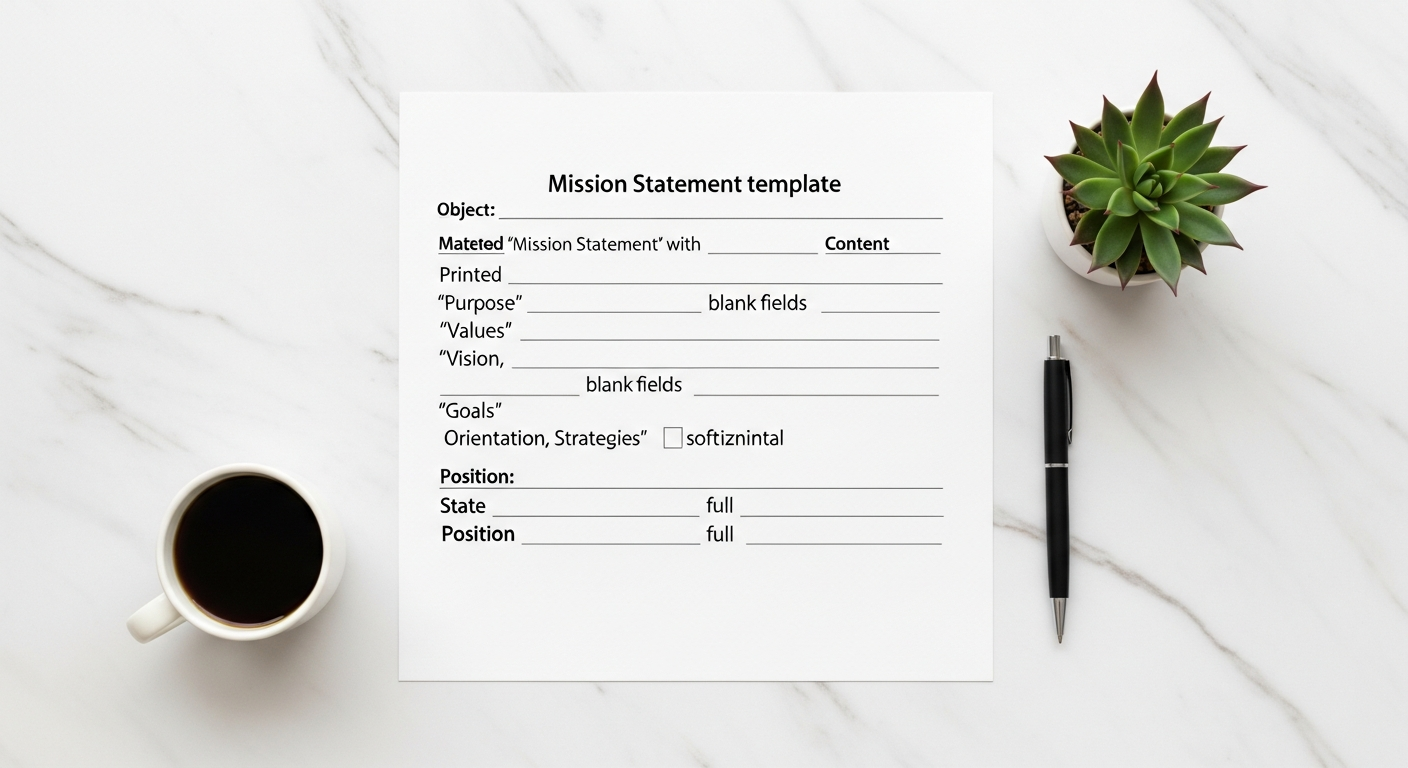
Crafting Your North Star: A Practical Guide to Writing a Powerful Mission Statement
Why a Mission Statement Isn’t Just Corporate Fluff: The Tangible Impact
Let’s cut through the noise: a mission statement isn’t just a feel-good phrase for your “About Us” page. It’s a strategic asset that impacts everything from employee morale to market positioning. Data consistently shows that purpose-driven organizations outperform their peers.
Consider these compelling benefits:
* Strategic Alignment: A clear mission statement provides a filter for all strategic decisions. Does this new initiative, product, or partnership align with our core purpose? If not, it’s likely a distraction. This clarity helps businesses stay focused and avoid resource drain on misaligned ventures.
Employee Engagement & Retention: Employees crave meaning. A study by Gallup revealed that only 33% of U.S. employees are engaged at work, but those who are* engaged often connect deeply with their company’s purpose. When your team understands and believes in the mission, they’re more motivated, productive, and loyal. They see their work as contributing to something larger than themselves, reducing turnover and attracting top talent.
* Brand Differentiation & Marketing Message: In a crowded market, your mission statement helps you stand out. It articulates your unique value proposition and the impact you aim to make. For B2B marketers, this becomes the bedrock of your messaging strategy, allowing you to craft narratives that connect with clients on a deeper, values-based level, beyond just features and benefits. It answers the crucial question: “Why should they choose us?”
* Customer Loyalty & Trust: Consumers and B2B clients alike are increasingly discerning. They want to partner with companies that share their values and demonstrate a commitment beyond the bottom line. A transparent, authentic mission statement builds trust and fosters stronger, more enduring relationships. Research indicates that 63% of consumers prefer to buy from purpose-driven companies.
* Operational Efficiency: When every team member, from sales to product development, understands the overarching mission, it streamlines operations. It empowers employees to make independent decisions that push the company towards its goals, rather than constantly seeking top-down directives.
Without a robust mission statement, you’re essentially sailing without a compass, susceptible to drifting off course and struggling to articulate your true value.
Deconstructing the Anatomy of an Effective Mission Statement
1. What do we do? (Your core business/offerings)
2. How do we do it? (Your unique methods, values, or approach)
3. Who do we do it for? (Your primary target audience/stakeholders)
4. What value do we create/impact do we make? (The ultimate outcome or benefit)
A strong mission statement is typically:
* Concise: Generally 1-3 sentences, 20-50 words. It should be easy to remember and recite.
Action-Oriented: Uses strong verbs that describe what the organization does*.
* Customer/Stakeholder-Focused: Clearly identifies who benefits from your work.
* Unique & Differentiating: Reflects your specific approach and values, not just generic platitudes.
* Inspirational & Motivational: Instills a sense of purpose and pride.
* Timeless: Endures through market changes, though it can be refined over time.
* Realistic & Achievable: While aspirational, it should be grounded in what your organization can genuinely accomplish.
Distinguishing Mission from Vision:
It’s common to confuse mission and vision statements. Here’s the key difference:
Mission Statement: What we do today and why we exist*. It defines the company’s fundamental purpose and scope of operations.
Vision Statement: What we aspire to be* in the future. It paints a picture of the desired future state or impact.
Think of your mission as your current journey and your vision as your ultimate destination. You need both.
The Kacerr Framework: A 5-Step Blueprint for Crafting Your Mission
Now, let’s get practical. This step-by-step framework is designed to guide you through the process of articulating a mission statement that truly captures the essence of your organization.
Step 1: Define Your Core Purpose (The “Why”)
This is the foundation. Go beyond “to make money.” Ask yourself, “Why does our organization genuinely exist?” and “What problem do we solve or need do we fulfill?”
Actionable Questions:
* What fundamental problem are we solving for our customers or the world?
* What unique value do we bring to the market that others don’t, or don’t do as well?
* What would be missing if our organization ceased to exist tomorrow?
* What is the ultimate impact we want to have on our stakeholders (customers, employees, community, industry)?
Example Thought Process:
Initial Idea:* “We sell CRM software.” (Too generic, no purpose)
Deeper Dive:* “We help businesses manage customer relationships.” (Better, but still generic)
Core Purpose:* “We empower businesses to build stronger, more profitable relationships with their customers by providing intuitive, data-driven CRM solutions.” (Getting closer to the ‘why’ and impact)
Step 2: Identify Your Key Stakeholders & Value Proposition (The “Who” & “What”)
Who are you serving, and what specific value are you delivering to them? Be precise.
Actionable Questions:
* Who are our primary customers/clients? (e.g., small business owners, B2B enterprise marketers, individual professionals, non-profits)
What specific products or services do we offer? (Keep it high-level, focus on the type* of offering)
* What unique benefits or outcomes do our offerings provide to these stakeholders? (e.g., increased efficiency, reduced costs, enhanced creativity, improved health, streamlined communication)
Example Thought Process:
Stakeholders:* “B2B tech companies, especially their sales and marketing teams.”
Value Proposition:* “We provide AI-powered analytics to optimize sales funnels and personalize outreach, leading to higher conversion rates and revenue growth.”
Step 3: Articulate Your Unique Approach (The “How”)
This is where your mission statement gains its distinct flavor. How do you deliver your value differently or better than competitors? What are your core values in action?
Actionable Questions:
* What are our guiding principles or values? (e.g., innovation, integrity, customer-centricity, sustainability, collaboration)
* What methodologies or technologies do we employ that are unique or central to our identity?
* What is our organizational culture like, and how does it influence our work?
* How do we ensure quality, foster innovation, or maintain our ethical standards?
Example Thought Process:
Unique Approach:* “Through relentless innovation, ethical data practices, and a commitment to user-friendly design.”
Connecting to Purpose:* “We believe in transparency and empowering our users, ensuring they always have control and understanding of their data.”
Step 4: Draft, Refine, and Test (Iterative Process)
Now, combine the elements from Steps 1-3 into several draft statements. Don’t aim for perfection in the first go.
Drafting Tips:
* Start Broad, Then Condense: Write out long sentences first, then trim aggressively.
* Use Strong Action Verbs: “Empower,” “transform,” “innovate,” “connect,” “enable,” “solve,” “create,” “inspire.”
* Avoid Jargon: Keep it accessible to everyone, inside and outside your organization.
* Focus on Impact: Emphasize the positive change you bring about.
Refinement & Testing:
* Read Aloud: Does it flow well? Is it memorable?
* Get Feedback: Share your drafts with a diverse group – employees from different departments, trusted advisors, even a few key clients. Ask:
* “Does this accurately describe what we do and why we do it?”
* “Is it inspiring?”
* “Is it easy to understand?”
* “Does it differentiate us?”
* Iterate: Be prepared to revise multiple times. The best mission statements are honed through thoughtful iteration.
Example Draft Combinations:
Draft A:* “To empower B2B tech companies to build stronger customer relationships and drive revenue growth through innovative, ethical AI-powered analytics and a commitment to user-friendly design.”
Draft B:* “We provide intuitive, data-driven CRM solutions that transform how businesses connect with customers, fostering loyalty and accelerating growth with integrity and innovation.”
Step 5: Integrate and Live Your Mission (Beyond the Words)
A mission statement is only as powerful as its integration into your daily operations and culture. Don’t just publish it; embody it.
Actionable Integration Strategies:
* Internal Communication: Share it widely. Discuss it in team meetings, onboarding sessions, and internal newsletters.
* Decision-Making Filter: Use it as a litmus test for major decisions, project prioritization, and resource allocation.
* Performance Reviews: Align individual and team goals with the overarching mission.
* Marketing & Branding: Weave it into your marketing materials, website, sales pitches, and public relations. Ensure your brand story consistently reflects your mission.
* Hiring: Use it to attract talent that aligns with your purpose and values. Ask candidates how they resonate with your mission.
Actionable Tools & Templates for Your Mission Statement Workshop
To facilitate this process, especially in a team setting, consider these practical tools and templates.
Brainstorming & Collaboration Tools:
* Whiteboard/Flip Charts & Sticky Notes: The classic, effective way for free-form idea generation.
* Miro or Lucidspark: Virtual whiteboarding tools excellent for remote teams, allowing real-time collaboration on brainstorming sessions, concept mapping, and voting.
* Google Docs/Microsoft Word: For collaborative drafting and feedback loops.
Kacerr Mission Statement Canvas (Template):
Use this template to capture your thoughts before drafting full sentences.
| Section | Guiding Questions | Your Answers
* Mission Statement Template (Fill-in-the-Blanks):
“Our mission is to [action verb] [what you do/offer] for [target audience] by [how you uniquely do it], so that [desired impact/outcome].”
Example Application:
“Our mission is to empower [B2B tech companies] to [build stronger customer relationships and drive revenue growth] by [providing innovative, ethical AI-powered analytics and a commitment to user-friendly design], so that [they can achieve sustainable growth and market leadership].”
Refinement Checklist:
* Is it concise (under 50 words)?
* Is it clear and easy to understand?
* Does it state what you do, for whom, and what value you provide?
* Does it reflect your unique approach or values?
* Is it inspiring and memorable?
* Is it timeless and adaptable?
* Does it differentiate you from competitors?
* Does it make you proud to say it out loud?
Mission Statements in Action: Examples from Leading Businesses
Let’s look at a few examples to see these principles in practice.
* LinkedIn: “To connect the world’s professionals to make them more productive and successful.”
What:* Connect professionals.
How:* To make them more productive and successful.
Who:* The world’s professionals.
Impact:* Increased productivity and success. (Concise, action-oriented, clear target)
* Tesla: “To accelerate the world’s transition to sustainable energy.”
What:* Accelerate transition.
How:* (Implied, through innovative electric vehicles and energy solutions).
Who:* The world.
Impact:* Sustainable energy future. (Bold, aspirational, clear impact)
* Microsoft: “To empower every person and every organization on the planet to achieve more.”
What:* Empower.
How:* (Implied, through technology and innovation).
Who:* Every person and every organization.
Impact:* Achieve more. (Broad, inclusive, focused on enablement)
* Kacerr (Hypothetical B2B Example): “To equip B2B professionals and entrepreneurs with data-backed insights and actionable frameworks, enabling them to navigate complex business challenges and drive measurable growth.”
What:* Equip with insights and frameworks.
How:* Data-backed and actionable.
Who:* B2B professionals and entrepreneurs.
Impact:* Navigate challenges, drive growth. (Specific, value-driven for its audience)
Notice how each example is brief yet powerful, clearly communicating the organization’s core reason for being. They don’t list products; they state purpose.
Beyond the Statement: Integrating Mission into Your Business & Brand Strategy
A mission statement isn’t a static document; it’s a living guide. Its true power emerges when it’s actively integrated into your everyday operations and long-term strategy.
For Business Operations:
* Product Development: Does a new product feature or service offering align with our mission? How does it help us fulfill our purpose more effectively? This ensures your innovation pipeline is always purpose-driven.
* Talent Acquisition & Management: Use your mission statement in job descriptions, interviews, and onboarding. Ask candidates how they envision contributing to your mission. For existing employees, regularly connect their individual roles and projects back to the larger company mission to foster a sense of purpose and collective achievement.
* Operational Decision-Making: When faced with a tough choice—whether to cut costs, expand into a new market, or change a process—refer back to your mission. Which option best serves your core purpose and impact? This provides a consistent framework for strategic choices.
* Partnerships & Alliances: Evaluate potential partners based on mission alignment. Collaborating with organizations that share your purpose can amplify your impact and strengthen your brand reputation.
For B2B Marketing & Branding:
* Content Strategy: Your mission should inform your content pillars. What stories can you tell, what problems can you address, and what insights can you share that reinforce your mission? For example, if your mission is to “simplify complex data analytics for enterprises,” your content should consistently offer clear, actionable insights into data interpretation, not just product features.
* Messaging & Positioning: Every piece of marketing collateral—from your website copy to your sales decks and email campaigns—should echo your mission. It helps you articulate your unique selling proposition (USP) in a way that resonates emotionally and logically with your target audience.
Brand Storytelling: Your mission is the heart of your brand story. It explains why you started, what drives you, and what future* you’re trying to build. This narrative is incredibly powerful for building connection and trust with B2B clients who are looking for more than just a vendor.
* Public Relations & CSR: Your mission provides a framework for your corporate social responsibility initiatives and how you engage with the community and industry. It ensures your PR efforts are authentic and consistent with your core identity.
* Sales Enablement: Arm your sales team not just with product knowledge, but with a deep understanding of the company’s mission. This empowers them to sell the “why” behind your solutions, creating more compelling and persuasive conversations with prospects.
By actively embedding your mission into these facets of your business, you transform it from a mere statement into a powerful engine for growth, culture, and market influence. It ensures that every action, every message, and every employee contributes to a unified, purposeful direction.