
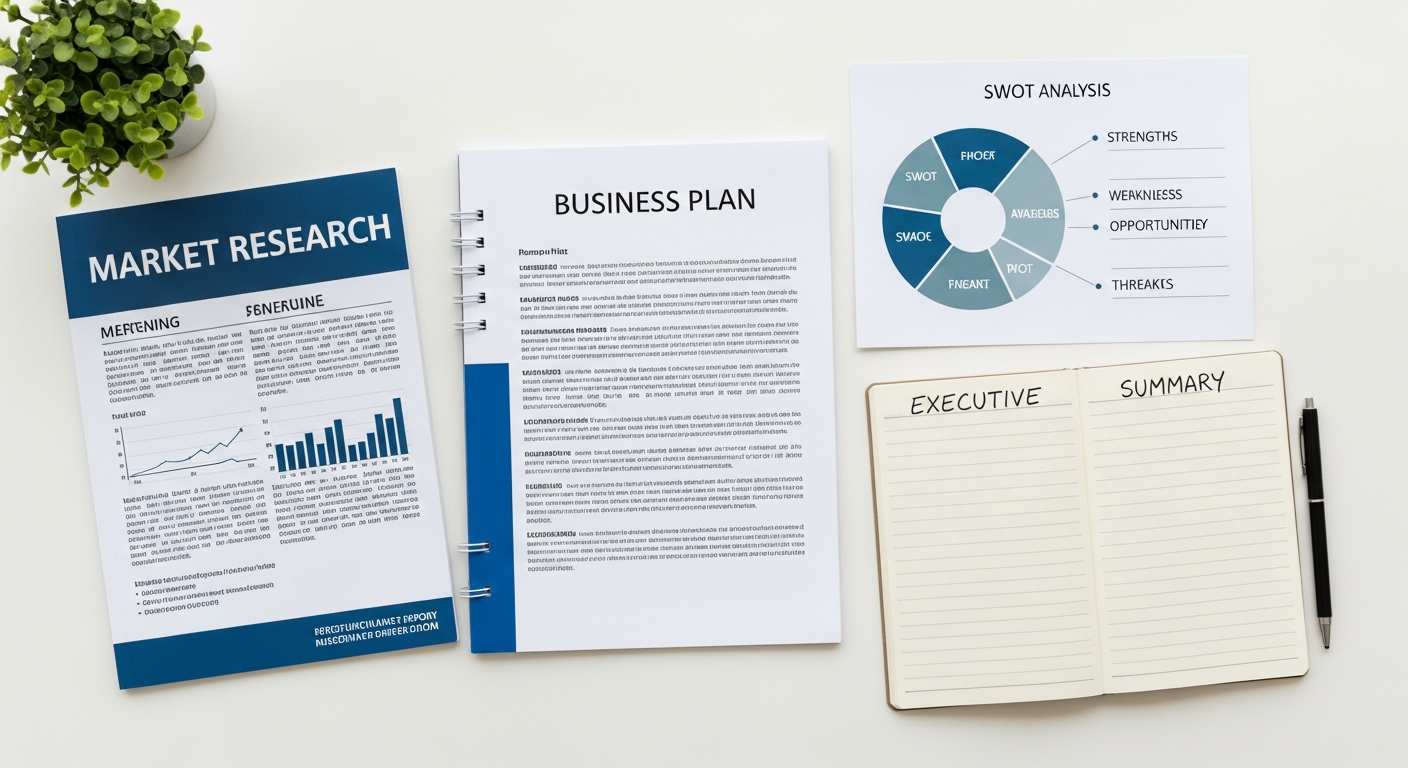
How to Write a Business Plan: The Complete Guide 2026
TL;DR: A 2026 business plan is a dynamic roadmap, not just a funding document. It clarifies your vision, strategy, and financials, helping you adapt to market changes and secure growth. Focus on lean planning, digital integration, and continuous iteration for success.
Why Your Small Business Needs a Business Plan (Even in 2026)
Many small business owners in 2026 might wonder if a formal business plan is still relevant. With agile methodologies and lean startup principles gaining traction, some perceive traditional plans as rigid and time-consuming. However, this perspective often misses the core purpose of a business plan: strategic clarity and a structured approach to growth. A well-crafted plan isn’t a static artifact; it’s a living document that evolves with your business and the market.
Firstly, a business plan forces you to articulate your vision, mission, and long-term objectives. This internal clarity is invaluable for decision-making, ensuring that every operational choice aligns with your overarching goals. For instance, if your plan emphasizes sustainable growth and community engagement, you’ll naturally prioritize eco-friendly suppliers and local partnerships over purely cost-driven alternatives. This foundational understanding helps prevent “shiny object syndrome” and keeps your team focused on what truly matters.
Secondly, a business plan is often indispensable for securing funding. While a compelling pitch deck might get you an initial meeting, serious investors, banks, or even government grant programs (like SBA loans, which often require a detailed plan) will demand a comprehensive document. They want to see your market analysis, financial projections, management team’s expertise, and a clear exit strategy or repayment plan. For example, a bank considering a $50,000 working capital loan will scrutinize your cash flow projections and break-even analysis to assess risk. Without a solid plan demonstrating viability and a clear path to profitability, securing external capital can be an uphill battle.
Thirdly, it serves as an operational blueprint. It outlines your marketing strategies, sales tactics, and operational procedures, providing a framework for execution. In 2026, this means integrating digital strategies like AI-driven marketing automation, robust e-commerce platforms, and data analytics into your plan. For a small e-commerce retailer, the plan might detail a budget allocation of 30% for paid social media ads on platforms like TikTok and Instagram, 20% for SEO optimization, and 15% for email marketing, alongside projections for customer acquisition cost (CAC) and customer lifetime value (CLTV).
The Core Components of a Modern Business Plan
A modern business plan, even for 2026, typically encompasses several key sections, each designed to provide a specific lens into your venture. While flexibility is crucial, adhering to a generally accepted structure ensures clarity and comprehensiveness, especially when presenting to external stakeholders. Here are the fundamental components:
- Executive Summary: This is often written last but read first. It’s a concise overview (1-2 pages) of your entire business plan, highlighting your company, problem it solves, solution, target market, competitive advantage, management team, financial highlights, and funding request. Think of it as your elevator pitch in written form.
- Company Description: Detail your business’s legal structure (sole proprietorship, LLC, S-Corp), mission statement, vision, values, and long-term goals. Explain what makes your business unique and its core competencies.
- Products and Services: Describe what you sell or offer. Explain the benefits to your customers, intellectual property (if any), and your product development roadmap. For a service business, detail your service delivery model and unique value proposition.
- Market Analysis: This section is critical. Identify your target market, its size, demographics, and psychographics. Conduct a thorough industry analysis, including market trends (e.g., AI adoption, sustainability demands, remote work shifts in 2026). Analyze your competition, their strengths and weaknesses, and how you plan to differentiate yourself. A SWOT analysis (Strengths, Weaknesses, Opportunities, Threats) is highly recommended here.
- Organization and Management: Outline your organizational structure, key personnel (founders, management team), their roles, responsibilities, and relevant experience. Include an organizational chart. Highlight any advisory board members.
- Marketing and Sales Strategy: Detail how you will reach your target customers, generate leads, and convert them into sales. This includes your branding, pricing strategy, distribution channels, and promotional activities. In 2026, this will heavily feature digital marketing channels (SEO, social media, content marketing, email marketing) and potentially AI-driven personalization.
- Funding Request (if applicable): If you’re seeking capital, clearly state the amount you need, how you plan to use the funds (e.g., equipment, marketing, working capital), and your proposed repayment or equity structure.
- Financial Projections: This section typically includes historical financial data (if applicable), startup costs, revenue forecasts (3-5 years), profit and loss statements, cash flow statements, and a balance sheet. Also include a break-even analysis and key financial ratios.
- Appendix: This is where you include supporting documents that are too detailed for the main body but add credibility. Examples include resumes of key personnel, market research data, permits, licenses, letters of intent, and detailed product specifications.
Each component plays a vital role in painting a complete picture of your business’s potential and operational viability. The depth of detail will vary depending on your business’s complexity and the audience for your plan, but ensuring all these elements are addressed provides a robust foundation.
Crafting a Compelling Executive Summary and Company Description
The Executive Summary is arguably the most crucial part of your business plan. It’s the hook that determines whether a potential investor, lender, or partner reads further. Think of it as a 1-2 page synthesis of your entire plan, designed to capture attention and convey the essence of your business’s opportunity and potential. It must be clear, concise, and compelling, highlighting the most exciting aspects of your venture. Start with your mission and vision, then quickly introduce the problem you’re solving, your unique solution, and the size of the market opportunity. Follow this with a brief overview of your competitive advantage, your management team’s expertise, key financial highlights (e.g., projected revenue Year 1, break-even point), and finally, your funding request and how the funds will be used. For instance, an executive summary might state: “XYZ Tech aims to revolutionize local service delivery with an AI-powered platform connecting vetted professionals to consumers within a 10-mile radius, tapping into a $50 billion local service market. With a projected Year 1 revenue of $750,000 and a 12-month break-even, we seek $150,000 to scale our platform and expand our marketing efforts.”
Once you’ve hooked them with the Executive Summary, the Company Description provides the foundational context. This section delves deeper into who you are, what you stand for, and your legal and operational structure. Begin by clearly stating your business name, legal structure (e.g., “XYZ Solutions LLC, a limited liability company incorporated in Delaware”), and the industry you operate in. Your mission statement should be a concise declaration of your purpose and values, while your vision statement outlines your long-term aspirations. For example, a mission statement could be: “To empower small businesses with accessible, data-driven marketing tools,” with a vision: “To be the leading marketing automation platform for SMBs across North America by 2030.”
Next, describe your company’s history (if applicable), including key milestones achieved. What are your core values that guide your decisions and culture? Detail your primary business objectives for the next 1-3 years. Are you aiming for 20% year-over-year revenue growth, expanding into two new markets, or launching a new product line? Crucially, articulate your unique selling proposition (USP) – what makes your business different and better than the competition? This could be superior customer service, proprietary technology, a niche market focus, or a unique business model. For a boutique coffee shop in 2026, this might be “sourcing direct-trade, sustainable beans from small farms and utilizing AI-driven personalized recommendations for loyal customers, alongside a zero-waste operational model.” This section sets the stage, giving readers a clear understanding of your identity and strategic direction before diving into the more detailed operational and financial aspects.
Mastering Market Analysis and Competitive Strategy
A thorough Market Analysis is the bedrock of any successful business plan in 2026. It demonstrates your understanding of the landscape you’re entering or operating within and validates the demand for your products or services. Start by defining your target market with precision. Don’t just say “everyone”; segment your audience by demographics (age, income, location, education), psychographics (values, interests, lifestyle), and behaviors (purchasing habits, online activity). For instance, a B2B SaaS company might target “small-to-medium sized e-commerce businesses in the retail sector, with 5-50 employees and annual revenues between $500,000 and $5 million, currently using manual inventory management.”
Next, quantify your market. What is the total available market (TAM), serviceable available market (SAM), and serviceable obtainable market (SOM)? Use reliable sources like industry reports (e.g., IBISWorld, Statista, Gartner), government data (Census Bureau), and reputable trade associations. For example, if the TAM for your industry is $100 billion, and your SAM (the portion you can realistically serve) is $10 billion, your SOM might be a more modest $500 million, representing a realistic share you can capture in the first 3-5 years. In 2026, consider the impact of macro trends such as the gig economy, sustainability initiatives, the continued rise of AI and automation, and evolving remote work models on your market size and customer behavior.
A crucial part of this section is your competitive analysis. Identify your direct and indirect competitors. For each, analyze their strengths, weaknesses, pricing strategies, market share, and customer base. Tools like SEMrush or Ahrefs can help analyze competitors’ online presence and traffic. Google Trends can reveal search interest for specific products or services. Conduct a detailed SWOT analysis for your own business, identifying internal Strengths and Weaknesses, and external Opportunities and Threats. For instance, a strength might be your proprietary AI algorithm, a weakness could be limited brand recognition, an opportunity might be an emerging niche market, and a threat could be a new regulatory framework. Beyond SWOT, consider a simplified Porter’s Five Forces analysis to understand industry attractiveness: threat of new entrants, bargaining power of buyers, bargaining power of suppliers, threat of substitute products or services, and intensity of rivalry.
Finally, articulate your competitive strategy. How will you differentiate yourself? Will it be through cost leadership (e.g., offering the lowest price, difficult for SMBs), differentiation (unique features, superior quality, exceptional service), or a niche strategy (targeting a specific, underserved segment)? In the 2026 landscape, differentiation often hinges on personalized customer experiences, ethical sourcing, technological innovation (e.g., using blockchain for supply chain transparency), or a strong community-driven brand. For example, a small organic food delivery service might differentiate by offering hyper-local produce, carbon-neutral delivery, and a subscription model that allows customers to directly support specific local farms, creating a unique value proposition that larger competitors struggle to replicate.
Developing Robust Financial Projections and Funding Requests
Financial projections are the quantitative heart of your business plan, translating your strategic vision into tangible numbers. This section typically covers startup costs, operating expenses, revenue forecasts, and key financial statements for the next 3-5 years. Accuracy and conservative estimates are paramount, as these figures will be heavily scrutinized by potential investors or lenders.
Start with a detailed breakdown of your Startup Costs. These are the one-time expenses required to get your business off the ground. Examples include legal fees (e.g., $500-$2,000 for LLC formation), permits and licenses ($100-$1,000+ depending on industry), equipment purchases (e.g., $10,000 for a commercial espresso machine, $3,000 for office tech), initial inventory ($5,000-$20,000), website development ($2,000-$15,000), initial marketing campaigns ($1,000-$5,000), and leasehold improvements. Always include a contingency fund, typically 15-20% of total startup costs, for unforeseen expenses.
Next, project your Operating Expenses. These are your recurring costs of doing business. Categorize them into fixed costs (rent, insurance, salaries for administrative staff, software subscriptions like QuickBooks at ~$30-70/month) and variable costs (cost of goods sold, sales commissions, marketing spend per customer acquisition). Be specific: project utility bills, payroll for specific roles, marketing budget breakdown (e.g., $500/month for Google Ads, $300/month for social media management), and professional services. Use industry benchmarks where possible; for instance, payroll typically accounts for 25-40% of gross revenue in many service-based SMBs.
Your Revenue Forecasts should be realistic and well-supported. Don’t just pull numbers out of thin air. Base them on market research, pricing strategy, sales volume projections, and your marketing plan. For a new product, you might project sales of 100 units in month 1, growing to 500 units by month 12, with an average selling price of $50, leading to a Year 1 revenue of around $250,000. For an existing business, use historical data and apply a conservative growth rate. Project monthly for the first year, then quarterly for year 2, and annually for years 3-5.
The core financial statements include:
- Profit and Loss (P&L) Statement: Shows your revenues, costs, and profits over a period (e.g., monthly, quarterly, annually). It culminates in net profit or loss.
- Cash Flow Statement: Crucial for SMBs, it tracks the actual movement of cash in and out of your business. It identifies periods of cash surplus or deficit, which is vital for managing working capital. Many profitable businesses fail due to poor cash flow.
- Balance Sheet: Provides a snapshot of your business’s assets, liabilities, and owner’s equity at a specific point in time.
Finally, if you’re seeking funding, clearly articulate your Funding Request. State the exact amount needed, how each dollar will be allocated (e.g., 40% for marketing, 30% for R&D, 20% for working capital, 10% for equipment), and the expected return on investment for the lender/investor. Specify the type of funding (debt, equity, convertible note) and your proposed terms. A typical funding request for an SMB might range from $25,000 for a microloan to $250,000 for a seed round, depending on the industry and growth potential. Always include a break-even analysis to show when your business is projected to cover all its costs and become profitable. Tools like QuickBooks, Xero, or even robust Excel templates can help you generate these projections, but understanding the underlying assumptions is key.
Marketing, Sales, and Operational Strategies for Growth
In the dynamic business environment of 2026, your marketing, sales, and operational strategies must be agile, data-driven, and customer-centric. This section of your business plan outlines how you will attract, convert, and retain customers, and how you will efficiently deliver your products or services.
Your Marketing Strategy should detail your approach to reaching your target audience. In 2026, digital channels are paramount.
- SEO (Search Engine Optimization): How will you rank higher on Google? Outline keyword research, content strategy (e.g., 2 blog posts/month, 1 pillar page/quarter), and local SEO tactics (Google My Business optimization).
- Social Media Marketing: Which platforms (TikTok, Instagram, LinkedIn, Facebook) are most relevant to your audience? What content types (video, infographics, live streams) will you use, and how often? Specify engagement goals.
- Content Marketing: Beyond blogs, consider podcasts, webinars, and whitepapers. How will this content educate your audience and establish your authority?
- Email Marketing: How will you build your email list? What types of campaigns (welcome series, promotions, newsletters) will you run? Platforms like Mailchimp or ConvertKit can cost $20-$100/month depending on list size.
- Paid Advertising: Budget for Google Ads, social media ads (e.g., Meta Ads), and potentially influencer marketing. Define your target CPA (Cost Per Acquisition) – for many SMBs, a healthy CPA might be 10-20% of the customer’s lifetime value.
- PR & Partnerships: How will you generate media coverage or collaborate with complementary businesses?
Define your brand messaging, unique selling proposition (USP), and how you will communicate it consistently across all channels.
Your Sales Strategy describes how you will convert leads into paying customers.
- Sales Funnel: Map out the stages from awareness to purchase. How will leads move through it?
- Pricing Strategy: Detail your pricing model (e.g., subscription, per-unit, tiered) and justification. Are you using value-based pricing, cost-plus, or competitive pricing?
- Sales Channels: Will you sell direct-to-consumer (DTC) via e-commerce, through a sales team, distributors, or retail partners?
- Customer Acquisition Cost (CAC): Calculate how much it costs to acquire a new customer. Aim for a CAC that is significantly lower than your Customer Lifetime Value (CLTV). For SaaS businesses, a good CLTV:CAC ratio is often 3:1 or higher.
- CRM System: Mention tools like HubSpot CRM (free tier available, paid plans start ~$50/month) or Salesforce Essentials (~$25/user/month) for managing customer relationships and tracking sales progress.
Operational Strategy focuses on how your business will function day-to-day.
- Production/Service Delivery: Detail your processes, equipment, and technology. For a product-based business, outline manufacturing, inventory management (e.g., using a system like Shopify with integrated inventory), and supply chain logistics. In 2026, consider supply chain resilience and diversification, given recent global disruptions.
- Facilities: Describe your physical location, its suitability, and any necessary upgrades.
- Technology Stack: List essential software and hardware (e.g., cloud accounting with Xero or QuickBooks, project management with Asana or Trello, communication with Slack).
- Legal & Regulatory: Outline necessary licenses, permits, and compliance requirements.
- Key Performance Indicators (KPIs): Define the metrics you’ll track to measure operational efficiency and success (e.g., customer satisfaction scores, order fulfillment time, employee retention rates).
By clearly articulating these strategies, you demonstrate a holistic understanding of how your business will operate, grow, and adapt to market demands in 2026 and beyond.
Iteration, Review, and Keeping Your Business Plan Alive
A common misconception is that a business plan is a one-time document, created and then filed away. In reality, especially in the fast-paced environment of 2026, your business plan should be a living, breathing document that you revisit, review, and revise regularly. The market is constantly shifting, new technologies emerge, competitors adapt, and your own business goals may evolve. A static plan quickly becomes obsolete, leading to missed opportunities or misguided decisions.
The first step in keeping your plan alive is to schedule regular review cycles. Many successful small businesses opt for a quarterly review of their plan, with a more comprehensive annual overhaul. During these reviews, compare your actual performance against your projections. Are your sales meeting targets? Is your customer acquisition cost (CAC) in line with expectations? Are your operational expenses within budget? Identify variances and analyze the reasons behind them. For example, if your projected online sales growth was 15% but you only achieved 5%, investigate whether it was due to ineffective marketing campaigns, website issues, or a shift in consumer preferences.
Use key performance indicators (KPIs) to track progress. Beyond financial metrics like revenue and profit margin, consider operational KPIs such as customer satisfaction (NPS scores), website traffic and conversion rates, inventory turnover, or employee retention. Tools like Google Analytics, your CRM system (e.g., HubSpot), or even simple spreadsheets can help you monitor these metrics. For instance, if your plan set a KPI of 20% lead-to-customer conversion rate, but your current rate is 12%, it signals a need to refine your sales process or lead qualification.
Adaptability is key. Based on your reviews, be prepared to adjust your strategies. If a particular marketing channel isn’t performing, reallocate your budget. If a new competitor enters the market with a disruptive product, revisit your competitive advantage and differentiation strategy. In 2026, this might mean integrating new AI tools into your customer service, exploring blockchain for supply chain transparency, or pivoting to a more sustainable business model based on evolving consumer values. Your business plan should reflect these changes, demonstrating your business’s resilience and forward-thinking approach.
Moreover, involve your team in the review process. Their insights from daily operations can be invaluable for identifying challenges and opportunities. This fosters a sense of ownership and aligns everyone towards common goals. When you make significant changes to your plan, communicate them clearly to your team, investors, and other stakeholders. This transparency builds trust and ensures everyone is working from the same playbook.
Finally, consider using lean planning methodologies where you focus on a concise, actionable plan that you constantly test and iterate. Instead of a 50-page document, you might start with a 10-page “lean plan” or even a business model canvas, and then expand sections as needed. This approach, advocated by many startup founders, encourages continuous learning and adaptation, ensuring your business plan remains a relevant and powerful tool for guiding your small business through the opportunities and challenges of 2026 and beyond.
Business Plan Tools & Resources Comparison
Crafting a comprehensive business plan doesn’t have to be a daunting solo task. Numerous tools and platforms exist to streamline the process, offer guidance, and even provide templates. Choosing the right one depends on your budget, technical comfort, and the depth of detail you require. Here’s a comparison of popular options for small business owners in 2026:
| Tool/Resource | Key Features | Target User | Cost/Pricing | Pros | Cons |
|---|---|---|---|---|---|
| LivePlan | Step-by-step guidance, financial forecasting, investor-ready templates, performance tracking dashboard, pitch deck builder. | Startups, Small Businesses seeking funding or detailed planning. | $20/month (annual), $40/month (monthly) | User-friendly interface, robust financial tools, integrates with QuickBooks, great for presentations. | Subscription cost, may be overkill for very simple plans. |
| Bizplan.com | Drag-and-drop builder, financial model templates, collaboration features, investor matching (via StartupOS). | Entrepreneurs, Startups, businesses looking for investor connections. | $29/month (annual), $79/month (monthly) | Modern design, good for visual learners, integrates with Gusto for payroll. | Higher monthly cost, less focus on detailed operational planning. |
| SBA.gov (U.S. Small Business Administration) | Free business plan templates, step-by-step guide, local assistance (SCORE mentors, SBDCs). | New entrepreneurs, small businesses on a tight budget. | Free | Authoritative, comprehensive, free access to expert advice, good for traditional plans. | Templates can be generic, no built-in financial modeling tools. |
| Microsoft Word/Google Docs (Templates) | Basic document creation, numerous free templates available online. | Any business owner comfortable with document software. | Free (with M365/Google account) | Highly flexible, widely accessible, no learning curve for software. | Requires manual financial calculations, easy to get lost without structure, no collaboration tools built-in. |
| Business Model Canvas | Single-page visual framework covering key aspects: customer segments, value propositions, channels, revenue streams, etc. | Lean startups, businesses in early ideation, quick strategy overview. | Free (template downloads) | Extremely concise, excellent for quick iteration and high-level strategy, fosters collaboration. | Lacks detailed financial projections, not suitable for formal funding requests alone. |
When selecting a tool, consider your primary objective. If you’re seeking external funding, a tool like LivePlan or Bizplan might be a worthwhile investment for their professional output and financial modeling capabilities. If you’re simply outlining your strategy for internal use or on a shoestring budget, the SBA resources or a well-structured Word/Google Docs template, perhaps combined with a Business Model Canvas for initial ideation, can be highly effective. Remember, the tool is secondary to the thought and research you put into the content of your plan.
Conclusion and Actionable Next Steps
In the evolving landscape of 2026, writing a comprehensive business plan remains an indispensable exercise for any small business owner or operator committed to growth, clarity, and resilience. It’s not merely a document to secure funding; it’s your strategic compass, a living blueprint that guides every facet of your venture, from market positioning to financial health. By meticulously crafting each section – from a compelling Executive Summary to robust Financial Projections – you gain unparalleled insight into your business’s potential and its path forward.