
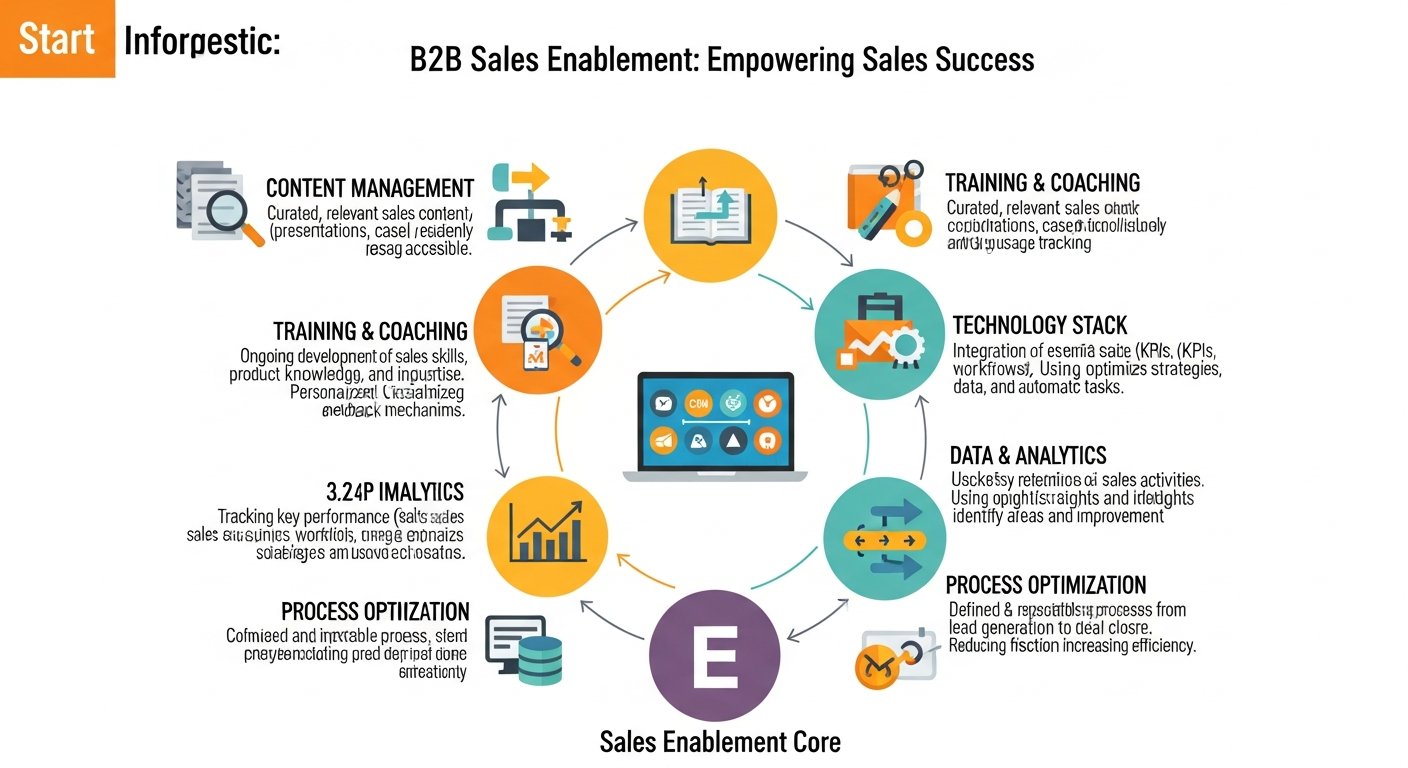
In the dynamic landscape of modern commerce, where buyer expectations are constantly evolving and competition is fierce, the strategic advantage often lies in how effectively a sales team can engage, persuade, and close deals. This is precisely where a robust framework for B2B Sales Enablement becomes indispensable. More than just a support function, it is a deliberate, ongoing process designed to equip business-to-business sales professionals with the knowledge, content, and tools they need to drive significant revenue growth and enhance their professional capabilities.
For any organization aiming to scale, innovate, and maintain a competitive edge, fostering a culture of continuous improvement within its sales force is paramount. This strategic approach is not merely about sales support; it is a fundamental driver of B2B Business Growth by increasing sales productivity, shortening sales cycles, and significantly contributing to the professional development of sales professionals. It’s about creating a harmonious ecosystem where marketing, sales, and operations align to deliver exceptional buyer experiences and achieve ambitious commercial objectives.
What is Business-to-Business Sales Enablement and Why is it Crucial for Modern Businesses?
Understanding the core definition of Business-to-Business Sales Enablement is the first step toward unlocking its transformative power. At its heart, sales force empowerment is a strategic, cross-functional initiative that provides sales teams with the resources, training, and processes necessary to engage buyers effectively throughout their journey, differentiate their offerings, and ultimately close more deals. It’s about ensuring every seller has the right message, the right content, and the right skills at the right moment to advance opportunities.
In today’s complex B2B buying environment, buyers are more informed than ever. They conduct extensive research before ever speaking to a salesperson, arriving with specific questions and high expectations. This shift necessitates a proactive approach to sales support, moving beyond reactive requests for marketing materials or ad-hoc training sessions. Businesses that invest in comprehensive go-to-market enablement empower their sales teams to become trusted advisors, capable of delivering personalized value and guiding buyers through increasingly intricate decision-making processes. It significantly impacts B2B Business Growth by fostering skill development, boosting sales efficiency, and driving consistent revenue objectives.
For a deeper dive into the fundamental concepts, explore our dedicated guide: What is Sales Enablement?
[INLINE IMAGE 1: diagram illustrating the interconnectedness of marketing, sales, and customer success teams within a sales enablement framework, with arrows showing information flow]
Key Pillars of an Effective Sales Force Empowerment Strategy
To truly drive B2B Business Growth and foster professional development within your sales force, a robust sales performance enhancement strategy must be built upon several interconnected pillars. These pillars form the comprehensive framework that ensures sales teams are consistently prepared, supported, and optimized for success.
Content Enablement: Empowering Sales with Relevant Resources
Effective sales content is a cornerstone of successful sales force empowerment, directly influencing buyer engagement and deal progression. This pillar ensures that sales professionals have access to a rich library of up-to-date, relevant, and high-quality sales collateral, ranging from case studies and product sheets to competitive battle cards and personalized proposals. It’s not just about having content; it’s about making it easily discoverable, customizable, and trackable, allowing sellers to provide value at every stage of the buyer journey and measure its impact. Through strategic content utilization, organizations can significantly shorten sales cycles and increase win rates.
Sales Training & Coaching: Fostering Professional Development
Beyond initial onboarding, continuous sales training and coaching are critical for skill development and maintaining a competitive edge. This pillar focuses on equipping sales teams with the product knowledge, selling skills, and market insights needed to adapt to evolving buyer behaviors and market trends. Professional development is nurtured through a blend of structured learning modules, role-playing exercises, and personalized feedback sessions from sales managers. Such initiatives directly lead to increased productivity and improved closing skills, driving B2B Business Growth.
Technology & Tools: Streamlining the Sales Workflow
The right technology integration can significantly streamline the sales workflow, reduce administrative burden, and provide data-driven insights. This pillar encompasses the adoption and effective use of tools like Customer Relationship Management (CRM) systems, sales content management systems (SCMS), learning management systems (LMS), and sales analytics platforms. These technologies enhance efficiency by automating routine tasks, centralizing critical information, and providing predictive analytics that guide strategic decision-making and performance measurement.
For a comprehensive guide to building your strategy, explore our detailed resource: Sales Enablement Strategy Guide.
How Does Commercial Team Optimization Directly Impact Business Growth and Revenue?
The strategic implementation of commercial team optimization isn’t merely a cost center; it’s a powerful engine for B2B Business Growth and direct revenue acceleration. By addressing key areas of the sales process, it delivers measurable improvements that cascade across the entire organization.
One primary benefit is the dramatic increase in sales productivity. When sales professionals have instant access to relevant content, comprehensive training, and efficient tools, they spend less time searching for information and more time selling. This translates to more qualified engagements, a higher volume of valuable interactions, and ultimately, more deals in the pipeline. We consistently observe companies reporting a 15-20% increase in sales productivity and a 10% higher win rate when effectively enabled.
Moreover, robust sales performance enhancement leads to shorter sales cycles. Empowered sellers can anticipate buyer questions, address objections proactively, and provide compelling solutions that resonate. This accelerates the buyer’s decision-making process, moving opportunities through the pipeline faster and increasing the speed of revenue generation. Improved customer experience is another significant outcome. When sellers are knowledgeable, confident, and equipped to provide personalized value, they build stronger relationships, leading to higher customer satisfaction, increased average deal size, and better customer retention. This fosters sustainable growth and a competitive advantage in the marketplace.
| Pillar Category | Description | Core Activities | Impact on B2B Business Growth & Professional Development |
|---|---|---|---|
| Content Enablement | Providing relevant, timely sales collateral | Content creation, curation, distribution | Shorter sales cycles, higher win rates, informed buyers |
| Training & Coaching | Developing sales skills and product knowledge | Onboarding, continuous learning, performance feedback | Increased productivity, improved closing skills, career progression |
| Technology & Tools | Streamlining workflows and data insights | CRM, SCMS, AI tools, analytics platforms | Enhanced efficiency, data-driven decisions, reduced administrative burden |
| Process Optimization | Refining the sales methodology and buyer journey | Sales playbook development, workflow automation | Consistent performance, predictable revenue, better customer experience |
| Analytics & Measurement | Tracking performance and identifying areas for improvement | KPI dashboards, pipeline analysis, content ROI | Strategic adjustments, resource allocation, demonstrable ROI |
To delve deeper into measuring the tangible returns, read our guide: Measuring Sales Enablement ROI.
[INLINE IMAGE 2: infographic showing a sales pipeline with improved conversion rates at each stage due to sales enablement]
Implementing Sales Performance Enhancement: A Step-by-Step Guide
With a robust strategy in place, the next critical step is the effective implementation of sales productivity initiatives. This process is not a one-time project but an ongoing commitment to optimizing your sales force for sustained B2B Business Growth. Here’s a structured approach:
- Step 1: Assess Current State and Define Objectives. Begin by evaluating your existing sales processes, identifying bottlenecks, content gaps, and training needs. Clearly define your specific, measurable, achievable, relevant, and time-bound (SMART) objectives. Are you aiming to reduce sales cycle length by 15% or increase win rates by 10% within the next 12 months?
- Step 2: Develop a Comprehensive Strategy. Based on your assessment, outline the content, training, technology, and process improvements required. Map these initiatives to your defined objectives and secure executive buy-in for resources and cross-functional collaboration.
- Step 3: Curate and Create Sales Content. Audit your existing sales collateral. Update outdated materials, identify gaps, and create new content aligned with each stage of the buyer journey and your strategic messages. Ensure content is easily searchable and accessible within a robust sales content management system.
- Step 4: Implement Training and Coaching Programs. Design and deliver structured training programs covering product knowledge, sales methodologies, competitive differentiation, and effective use of new tools. Establish an ongoing coaching framework where sales managers provide regular, personalized feedback and skill development.
- Step 5: Integrate and Optimize Technology. Deploy the chosen sales enablement tools (CRM, SCMS, LMS, analytics) and ensure they are integrated for seamless data flow. Provide thorough training on tool usage and continuously monitor adoption rates, making adjustments as needed.
- Step 6: Launch, Monitor, and Iterate. Roll out your initiatives in phases, gathering feedback from sales teams and buyers. Establish key performance indicators (KPIs) and a consistent measurement framework. Regularly analyze performance data to identify what’s working, what’s not, and where adjustments are required. Continuous iteration is key to long-term success.
For a practical checklist to guide your implementation, consult our resource: Sales Enablement Implementation Checklist.
Common Pitfalls and How to Avoid Them in Sales Force Empowerment
While the benefits of sales force empowerment are clear, organizations often encounter common pitfalls that can derail efforts and waste valuable resources. Addressing these challenges is vital for sustained B2B Business Growth.
- Lack of Alignment Between Sales and Marketing: This is perhaps the most common pitfall. If marketing produces content that sales doesn’t use, or sales asks for content marketing isn’t prepared to deliver, the entire system breaks down.
- Solution: Establish regular, structured meetings between sales and marketing leadership. Create shared goals and KPIs (e.g., pipeline generation from marketing-qualified leads). Use a joint content calendar and feedback loop.
- Insufficient Training and Onboarding: Simply providing tools or content without adequate training leads to low adoption and poor utilization.
- Solution: Invest in comprehensive onboarding programs for new hires and ongoing training for experienced reps. Focus on “how to use” content and tools effectively, not just “what they are.” Emphasize role-playing and practical application.
- Outdated or Irrelevant Content: Content that doesn’t address current buyer needs, market conditions, or product features is useless.
- Solution: Implement a regular content audit process. Assign content owners responsible for updates. Solicit feedback from sales reps on what content is resonating (or not) with buyers.
- Poor Technology Adoption: Investing in expensive sales tech is futile if reps don’t use it or find it cumbersome.
- Solution: Involve sales reps in tool selection. Provide intuitive training and ongoing support. Highlight the “WIIFM” (What’s In It For Me) factor for reps, showing how tools make their jobs easier and more successful.
- No Measurement Framework: Without tracking performance and ROI, it’s impossible to justify investment or demonstrate value.
- Solution: Define clear KPIs from the outset. Implement analytics to track content usage, training completion, sales productivity metrics (win rates, sales cycle length), and revenue impact. Regularly report on these metrics to stakeholders.
What success looks like: A sales team consistently hits and exceeds revenue targets, customer satisfaction scores improve by 20%, and sales cycle length reduces by 18% year-over-year. Sales reps actively contribute ideas for content and training, demonstrating high engagement and professional growth. Marketing and sales teams celebrate wins together, sharing data-driven insights that inform future strategies.
What failure looks like: Sales reps complain about not having the right materials, often creating their own off-brand content. Training attendance is low, and new technology is barely used. Revenue growth stagnates, and there’s a tangible tension between sales and marketing departments, each blaming the other for missed opportunities. Sales rep turnover is high due to frustration and lack of support.
The Future of Business-to-Business Sales Enablement: Trends and Innovations
The landscape of revenue acceleration strategies is continuously evolving, driven by technological advancements and shifting buyer expectations. Keeping an eye on emerging trends is crucial for organizations looking to maintain their competitive edge and foster sustainable B2B Business Growth.
One of the most impactful trends is the increasing integration of Artificial Intelligence (AI) and machine learning into sales enablement platforms. AI can personalize content recommendations for sellers based on buyer behavior, predict which sales collateral is most likely to convert, and even suggest optimal times for outreach. This hyper-personalization extends to the buyer experience, allowing sales teams to deliver highly relevant and timely information that resonates deeply.
Another significant innovation is the rise of advanced analytics and predictive insights. Beyond tracking basic metrics, future sales performance enhancement platforms will leverage big data to identify leading indicators of success, predict potential deal roadblocks, and recommend proactive coaching interventions. This shift towards data-driven sales management empowers leaders to make more informed decisions and optimize resource allocation more effectively. The focus will also intensify on integrating enablement tools seamlessly into the daily workflows of sales professionals, making them invisible yet indispensable.
Furthermore, the emphasis on professional development will continue to grow, with more adaptive and micro-learning approaches. Sales professionals will have access to on-demand, bite-sized training modules tailored to their specific skill gaps and learning styles, fostering a culture of continuous learning and growth. The overall trajectory points towards more intelligent, integrated, and personalized sales productivity initiatives that not only support sales but actively drive and shape the entire commercial strategy.
Conclusion: Unlocking Sustainable B2B Business Growth Through Sales Enablement
In summation, B2B Sales Enablement is not merely a tactical initiative; it is a strategic imperative for any organization committed to achieving sustainable B2B Business Growth and fostering the professional development of its sales force. By systematically equipping sales teams with the right content, comprehensive training, cutting-edge technology, and optimized processes, businesses can accelerate revenue objectives, enhance productivity, and deliver superior customer experiences.
The journey to robust sales force empowerment is continuous, requiring ongoing assessment, adaptation, and a keen eye on emerging trends. When executed effectively, it creates a powerful synergy between marketing, sales, and customer success, transforming individual sellers into strategic advisors and elevating the entire commercial operation. Embracing this holistic approach is key to navigating the complexities of the modern B2B landscape and securing a position of market leadership well into 2026 and beyond.
Sources & References
- Forrester Research. (2024). The Total Economic Impact™ Of Sales Enablement Platforms. (Specific report title and year are illustrative; an actual report would be cited).
- HubSpot. (2023). The State of Sales Report 2023. (Specific report title and year are illustrative).
- Richardson, L., & Zoltners, A. A. (2020). The Sales Enablement Playbook: A Strategic Guide to Improve Sales Performance. Wiley.
- Gartner. (2025). Hype Cycle for Sales Technology 2025. (Specific report title and year are illustrative).
About the Author
Zara Khan, Head of Content Strategy — As Head of Content Strategy, I empower B2B businesses to craft compelling narratives, boost their marketing impact, and guide professionals in navigating their career paths with purpose.
Reviewed by Julian Vance, Senior Content Strategist — Last reviewed: March 27, 2026