
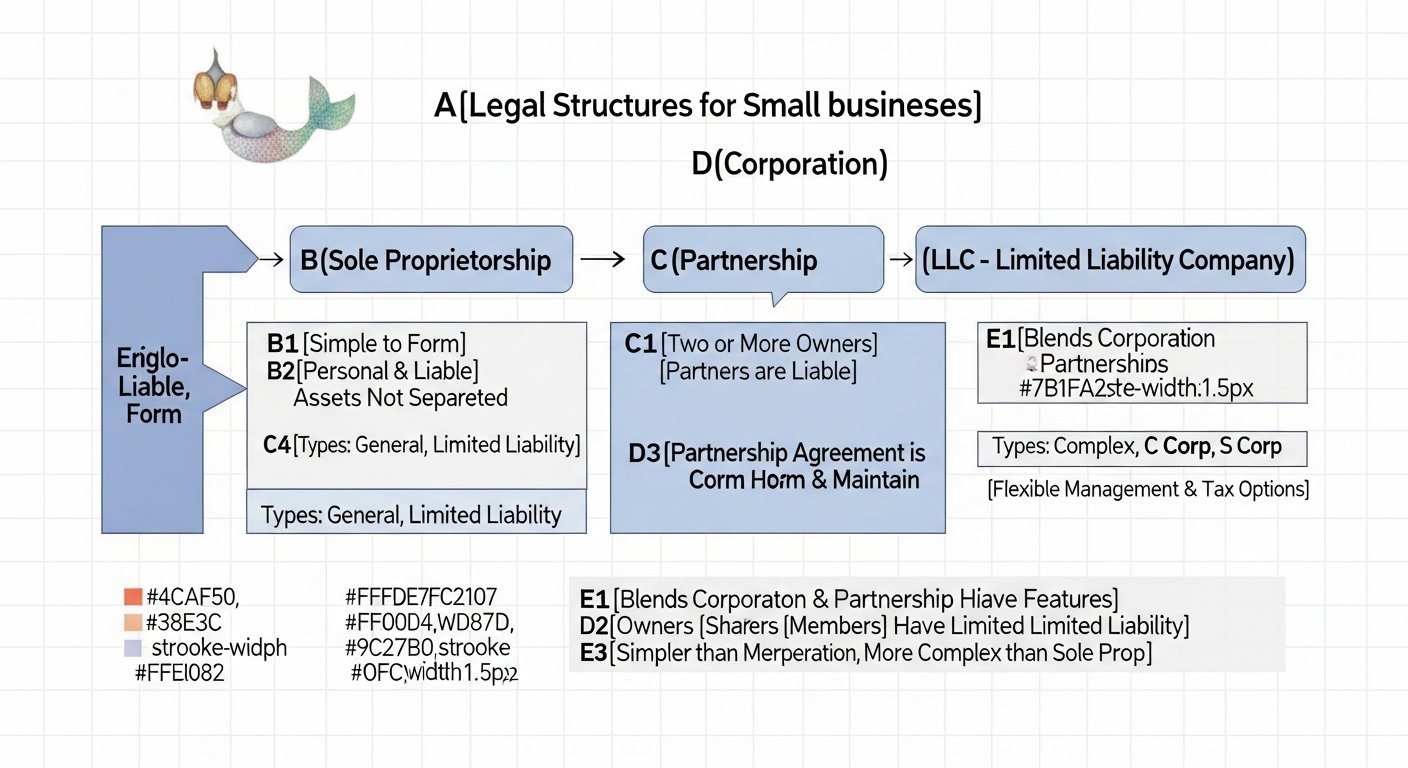
What Are Business Entity Types and Why Do They Matter for B2B Growth?
When launching or scaling a venture, understanding the fundamental organizational frameworks available is paramount. These frameworks, commonly known as **small business legal structures**, define the legal and tax standing of your company, dictating everything from owner liability to administrative complexity and fundraising capabilities. Choosing the right legal structure is a foundational decision that profoundly impacts your **B2B business growth** trajectory, influencing everything from personal liability protection to attracting investment and streamlining operational efficiency. A well-selected corporate structure can facilitate smoother contracts, enhance credibility with partners, and provide a clear path for expansion, while a mismatched one can create unnecessary hurdles, limit growth potential, and expose owners to undue risk.
[INLINE IMAGE 1: diagram showing the interconnectedness of legal structure choice with liability, taxation, and growth potential for a B2B business]
Zara Khan:
From our experience advising B2B startups, choosing the right structure early can save significant legal fees later and prevent costly restructuring down the line. It’s not just about compliance; it’s about strategic alignment with your growth ambitions.
Understanding Key Business Entity Types
Navigating the various options for company formation can feel overwhelming, but each legal entity structure offers distinct advantages and disadvantages tailored to different business needs. For B2B ventures, these choices directly influence how you interact with clients, secure funding, and manage internal governance. Let’s explore the most common organizational frameworks for businesses.
What is a Sole Proprietorship?
A *sole proprietorship* is the simplest and most common form of business entity, where an individual owns and operates the business. There is no legal distinction between the owner and the business itself.
- **Pros:**
- **Simplicity of Setup:** Minimal paperwork and legal requirements to establish.
- **Complete Control:** The owner retains full decision-making authority.
- **Pass-Through Taxation:** Business income and losses are reported on the owner’s personal tax return, avoiding double taxation.
- **Cons:**
- **Unlimited Personal Liability:** The owner is personally responsible for all business debts and liabilities.
- **Limited Growth Potential:** Can be challenging to raise capital from investors who prefer more formalized structures.
- **Perceived Lack of Credibility:** May be viewed with less formality by some B2B clients or partners.
**B2B Relevance:** While simple, the unlimited liability of a sole proprietorship can hinder a B2B’s ability to secure large contracts or attract sophisticated partners who require greater assurances of stability and risk mitigation. It suits freelancers or very small consultancies before significant scaling.
Learn more about Sole Proprietorships in our dedicated guide. [CLUSTER LINK: Sole Proprietorship]
What is a Partnership (General & Limited)?
A *partnership* is a business structure involving two or more individuals who agree to share in the profits or losses of a business. There are two primary types: *General Partnerships (GPs)* and *Limited Partnerships (LPs)*.
- **General Partnership (GP):** All partners share in the management and liability of the business.
- **Pros:**
- **Easy to Form:** Generally requires a partnership agreement but less formal than corporations.
- **Shared Responsibilities:** Partners can pool resources, skills, and workload.
- **Pass-Through Taxation:** Profits and losses are passed through to partners’ personal income.
- **Cons:**
- **Unlimited Personal Liability:** All partners are personally liable for business debts, including those incurred by other partners.
- **Potential for Disputes:** Disagreements among partners can significantly disrupt operations.
- **Less Attractive to Investors:** Similar to sole proprietorships, GPs struggle to attract external equity.
- **Pros:**
- **Limited Partnership (LP):** Consists of at least one *general partner* with unlimited liability and management control, and at least one *limited partner* whose liability is limited to their investment and who has no management authority.
- **Pros:**
- **Attracts Investors:** Limited partners can invest without incurring unlimited liability.
- **Flexibility:** Allows for varied roles and risk levels among partners.
- **Pass-Through Taxation:** Avoids corporate double taxation.
- **Cons:**
- **Complex Setup:** Requires a formal filing with the state and a comprehensive partnership agreement.
- **General Partner Liability:** The general partner still faces unlimited personal liability.
- **Limited Partner Restrictions:** Limited partners cannot actively participate in management without risking their limited liability status.
- **Pros:**
**B2B Relevance:** Partnerships can facilitate **B2B growth** by pooling expert skills and capital, particularly for professional services firms. However, the shared liability in a GP can be a significant deterrent for businesses seeking to minimize personal risk in high-stakes B2B contracts. LPs offer a mechanism for attracting passive investment while maintaining operational control.
Learn more about Partnerships in our dedicated guide. [CLUSTER LINK: Partnership]
What is a Limited Liability Company (LLC)?
A *Limited Liability Company (LLC)* combines elements of both partnerships/sole proprietorships and corporations, offering personal liability protection to its owners (members) while maintaining the flexibility of pass-through taxation.
- **Pros:**
- **Personal Liability Protection:** Owners’ personal assets are generally shielded from business debts and lawsuits.
- **Flexible Taxation:** Can be taxed as a sole proprietorship, partnership, S-Corporation, or C-Corporation.
- **Operational Flexibility:** Fewer compliance requirements than corporations, making management simpler.
- **Cons:**
- **Self-Employment Taxes:** Profits are subject to self-employment taxes (Social Security and Medicare) for active members.
- **Limited Lifespan (Historically):** Some states previously required LLCs to dissolve upon the departure of a member, though this is less common now.
- **Less Familiar to Investors:** While growing in acceptance, some venture capitalists prefer C-Corporations for their investment structures.
**B2B Relevance:** An *LLC’s* liability protection makes it highly attractive for B2B contracts, as it separates business and personal assets, offering a layer of security that clients and partners appreciate. Its flexibility streamlines operations, allowing B2B firms to focus on client acquisition and service delivery without excessive administrative burden.
Learn more about Limited Liability Companies (LLCs) in our dedicated guide. [CLUSTER LINK: Limited Liability Company (LLC)]
What is an S-Corporation?
An *S-Corporation* is not a distinct legal structure but rather a tax designation granted by the IRS that allows a corporation (or sometimes an LLC) to pass corporate income, losses, deductions, and credits through to its shareholders for federal tax purposes, avoiding double taxation.
- **Pros:**
- **Avoids Double Taxation:** Income is taxed only at the shareholder level, not at both the corporate and individual levels.
- **Self-Employment Tax Savings:** Owners who work for the business can pay themselves a “reasonable salary” (subject to payroll taxes) and take the remaining profits as distributions, which are not subject to self-employment taxes.
- **Enhanced Credibility:** Operates as a corporation, which can be beneficial for B2B perceptions and fundraising.
- **Cons:**
- **Strict Eligibility Requirements:** Limited to 100 shareholders, all U.S. citizens or residents, and only one class of stock.
- **Increased Administrative Burden:** Requires more formal compliance, meetings, and record-keeping than an LLC.
- **Scrutiny of Salary:** The IRS closely monitors the “reasonable salary” requirement; an insufficient salary can lead to penalties.
**B2B Relevance:** An S-Corp election can significantly reduce the tax burden for profitable B2B service companies with active owner-employees, freeing up capital for reinvestment into growth initiatives like marketing, talent acquisition, or product development. It offers corporate-level credibility without the full double taxation.
Learn more about S-Corporations in our dedicated guide. [CLUSTER LINK: S-Corporation]
What is a C-Corporation?
A *C-Corporation* is a legal entity entirely separate from its owners, offering the strongest liability protection and the most robust framework for fundraising.
- **Pros:**
- **Unlimited Growth Potential:** No restrictions on the number or type of shareholders, making it ideal for attracting venture capital and going public.
- **Robust Personal Liability Protection:** Owners (shareholders) are fully shielded from corporate debts and lawsuits.
- **Familiar to Investors:** The standard structure for large companies and venture-backed startups, simplifying investment processes.
- **Cons:**
- **Double Taxation:** Corporate profits are taxed at the corporate level, and then again when profits are distributed to shareholders as dividends.
- **High Administrative Burden:** Extensive compliance requirements, including regular board meetings, detailed record-keeping, and complex tax filings.
- **Complex Setup:** Requires Articles of Incorporation, bylaws, and strict adherence to corporate formalities.
**B2B Relevance:** A *C-Corporation’s* ability to issue various classes of stock and attract unlimited investors is vital for attracting venture capital for scaling B2B operations. For B2B companies with ambitious growth plans, particularly those in tech or manufacturing seeking significant external funding, the C-Corp is often the preferred and most logical choice, despite its higher administrative and tax complexities.
Learn more about C-Corporations in our dedicated guide. [CLUSTER LINK: C-Corporation]
[INLINE IMAGE 2: infographic comparing liability and taxation differences between LLCs, S-Corps, and C-Corps]
Brief Note on Non-Profit Structures
While typically not focused on “B2B growth” in the traditional sense of profit generation, *non-profit corporations* (often 501(c)(3) organizations) serve a public benefit and are exempt from federal income tax. They operate with boards of directors and can engage in B2B activities for fundraising, partnerships, or service delivery. For businesses whose mission includes social impact or community service, understanding this organizational framework can be relevant, especially when considering corporate social responsibility initiatives or hybrid models.
Comparing Small Business Legal Structures: A Quick Reference
To simplify the decision-making process for your **B2B venture**, this table summarizes the key attributes of the primary legal entity structures.
| Legal Structure | Owner Liability | Taxation | Setup Complexity | Compliance Burden | Growth Potential | Funding Access |
|---|---|---|---|---|---|---|
| Sole Proprietorship | Personal (Unlimited) | Pass-Through | Low | Minimal | Limited | Debt Only |
| General Partnership | Shared Personal (Unlimited) | Pass-Through | Low-Medium | Minimal-Moderate | Moderate | Debt Only |
| Limited Partnership | General: Unlimited; Limited: Investment | Pass-Through | Medium-High | Moderate | Moderate | Some Equity |
| LLC | Limited | Flexible (Pass-Through default) | Medium | Moderate | Moderate-High | Some Equity |
| S-Corporation | Limited | Pass-Through | High | High | High | Some Equity |
| C-Corporation | Limited | Double Taxation | High | Extensive | Unlimited | Venture Capital Ready |
This quick reference highlights the trade-offs. For a B2B, balancing liability protection with tax efficiency and future fundraising needs is crucial. Often, an LLC is a great starting point, with the flexibility to evolve into an S-Corp or C-Corp as the business scales and attracts more investment.
Key Considerations When Choosing Your Business Legal Structure
Selecting the optimal legal framework for your enterprise is a strategic decision that shapes its long-term viability and growth trajectory. Several factors should guide your choice, ensuring alignment with your business goals and operational realities.
Liability Protection and Risk Management
The extent to which your personal assets are protected from business debts and lawsuits is a critical factor. For B2B businesses, which often engage in significant contracts and carry substantial risk, robust liability protection is essential. Structures like LLCs, S-Corps, and C-Corps shield owners, whereas sole proprietorships and general partnerships do not, exposing personal wealth to business liabilities. Assessing your industry’s inherent risks and your personal comfort level with financial exposure is a foundational step.
Tax Implications and Planning
The tax treatment of different company formation options can significantly impact your bottom line. Pass-through entities avoid corporate-level taxation, benefiting owners who report profits and losses on their personal returns. C-Corporations, however, face “double taxation,” where profits are taxed at the corporate level and again when distributed to shareholders. Understanding these differences and consulting with a tax professional can optimize your financial strategy and free up capital for **B2B growth**.
Administrative Burden and Compliance
The complexity of setting up and maintaining a legal entity structure varies widely. Simpler structures like sole proprietorships have minimal administrative and compliance requirements. In contrast, corporations, especially C-Corps, demand stringent adherence to corporate formalities, including regular board meetings, detailed record-keeping, and complex regulatory filings. Evaluate your capacity to manage these ongoing obligations, as non-compliance can lead to penalties and loss of liability protection.
Funding and Investor Appeal
Your ability to attract external capital is heavily influenced by your organizational framework. For B2B ventures aiming for rapid scaling through venture capital or angel investment, a C-Corporation is often preferred due to its ability to issue various classes of stock and its familiarity to investors. LLCs are gaining acceptance but can sometimes require conversion for major funding rounds. Sole proprietorships and partnerships typically rely on debt financing or personal funds.
Future Growth and Scalability
Consider your long-term vision. Do you plan to expand rapidly, potentially bringing in many partners or investors, or eventually go public? Some legal entity structures are inherently more scalable than others. A C-Corporation provides the most flexible framework for significant expansion and ownership changes, while simpler structures might require costly and complex conversions as your business matures. Anticipating future growth allows you to select a structure that can evolve with your B2B operations.
Common Mistakes When Selecting a Business Legal Structure
Choosing an inappropriate organizational framework can lead to significant operational hurdles, financial penalties, and even personal liability for business owners. Being aware of these common pitfalls can help you make a more informed decision for your B2B entity.
- **Failing to Separate Personal and Business Finances:** This is a crucial error, especially for LLCs and corporations. Commingling funds can lead to “piercing the corporate veil,” where courts disregard the legal separation of the business and owner, risking personal assets of up to *100%* of business debt in a lawsuit.
- **Ignoring Future Growth Plans:** Many startups choose the simplest structure (e.g., sole proprietorship or LLC) without considering future investor needs or plans for public offerings. Converting later can be expensive, complex, and may deter early-stage investors.
- **Underestimating Tax Implications:** Selecting a structure solely based on setup ease without understanding its long-term tax consequences (e.g., unexpected self-employment taxes or inefficient profit distribution) can erode profitability.
- **Neglecting Formalities:** Corporations and LLCs require adherence to specific formalities (e.g., annual meetings, maintaining records, signing operating agreements). Ignoring these can weaken liability protection and lead to legal challenges.
- **Not Consulting Legal and Tax Professionals:** Relying solely on online research or advice from non-experts can lead to critical oversights. Legal entity structures are complex and jurisdiction-specific.
- **Over-complicating Unnecessarily:** Conversely, some small businesses opt for highly complex structures like C-Corps when an LLC or S-Corp would suffice, incurring excessive administrative costs and burdens that outweigh any perceived benefits for their current scale.
What success looks like: A B2B tech startup chooses a C-Corporation from day one, attracting $5M in seed funding within its first year thanks to an investor-friendly structure and clear equity allocation.
What failure looks like: A rapidly growing B2B consulting firm remains a sole proprietorship, leading to a personal lawsuit that depletes the owner’s retirement savings when a client contract goes south. The lack of liability protection cost them everything.
Making the Right Choice for Your B2B Venture
The journey to choosing the ideal organizational framework for your **B2B business growth** involves a thoughtful assessment of various factors. Here’s a structured approach to guide your decision-making process:
- **Assess Your Risk Tolerance:** Evaluate the level of personal liability you are willing to assume. High-risk industries or ventures with significant potential for legal disputes typically benefit from structures offering personal asset protection.
- **Understand Your Tax Situation:** Consult with a tax advisor to project your business’s profitability and how different legal entity structures will impact your overall tax burden, including income tax, self-employment tax, and potential double taxation.
- **Consider Your Investor Strategy:** If attracting external equity investment is part of your **B2B growth** plan, structures like C-Corporations are often the most appealing to venture capitalists and angel investors.
- **Estimate Administrative Capacity:** Be realistic about the time and resources you can dedicate to legal compliance and administrative tasks. Simpler structures require less oversight, while corporations demand rigorous adherence to formalities.
- **Plan for Scalability and Future Growth:** Choose a structure that can comfortably accommodate your anticipated expansion, addition of partners, and potential changes in ownership without requiring costly and disruptive reorganizations.
Ultimately, the best choice aligns with your immediate operational needs while providing flexibility for long-term **B2B growth** and strategic evolution.
Conclusion: Paving Your Path to B2B Success
Choosing the right **small business legal structure** is more than just a procedural step; it’s a strategic decision that underpins your company’s stability, tax efficiency, and potential for sustainable **B2B business growth**. From the simplicity of a sole proprietorship to the investor-ready framework of a C-Corporation, each legal entity structure offers distinct advantages and trade-offs. By carefully considering factors such as personal liability, tax implications, administrative burden, and future funding needs, you can select the organizational framework that best positions your B2B venture for success in 2026 and beyond. A well-chosen structure acts as a robust foundation, enabling you to focus on innovation, client relationships, and scaling your operations with confidence and clarity.
Sources & References
- Cornell Law School Legal Information Institute. (2026). *Corporation*. Retrieved from [https://www.law.cornell.edu/wex/corporation](https://www.law.cornell.edu/wex/corporation)
- U.S. Small Business Administration. (2026). *Choose your business structure*. Retrieved from [https://www.sba.gov/business-guide/plan-your-business/choose-your-business-structure](https://www.sba.gov/business-guide/plan-your-business/choose-your-business-structure)
- Internal Revenue Service. (2026). *S Corporations*. Retrieved from [https://www.irs.gov/businesses/s-corporations](https://www.irs.gov/businesses/s-corporations)
- Nolo. (2026). *Legal Guide to Starting a Business*. Retrieved from [https://www.nolo.com/legal-encyclopedia/legal-guide-starting-business-30245.html](https://www.nolo.com/legal-encyclopedia/legal-guide-starting-business-30245.html)
About the Author
Zara Khan, Head of Content Strategy — As Head of Content Strategy, I empower B2B businesses to craft compelling narratives, boost their marketing impact, and guide professionals in navigating their career paths with purpose.
Reviewed by Julian Vance, Senior Content Strategist — Last reviewed: March 27, 2026