
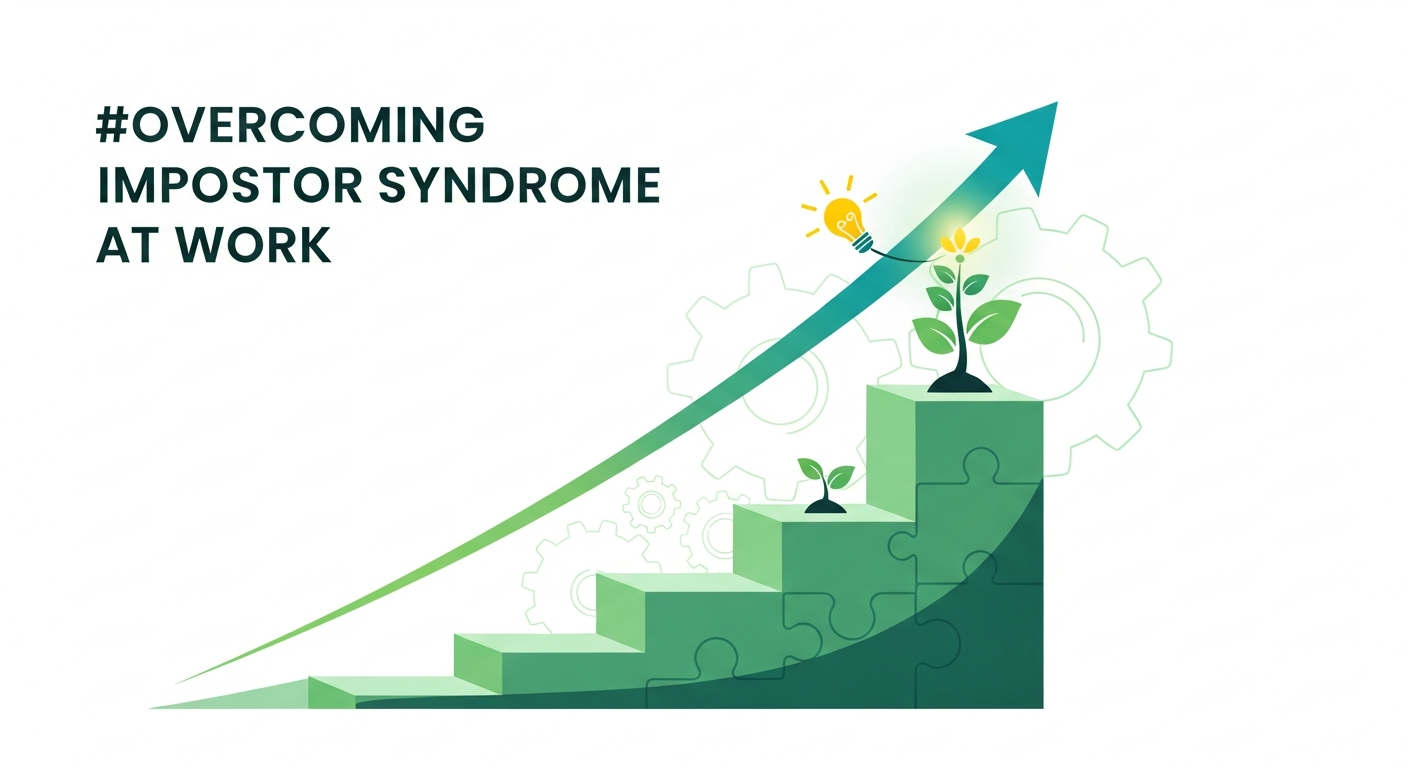
Overcoming Impostor Syndrome at Work: A Guide for Young Professionals in 2026
You are sitting in a high-stakes boardroom or a virtual strategy meeting, surrounded by colleagues who seem to possess an effortless command of the subject matter. As they speak, a cold knot forms in your stomach. You’re convinced that at any moment, the door will swing open, and a “real” professional will point a finger at you and declare you a fraud. This is the hallmark of impostor syndrome, a psychological pattern where individuals doubt their accomplishments and have a persistent internalized fear of being exposed as a “fake.”
For young adults navigating the complexities of the 2026 workforce, these feelings are more than just a nuisance; they are a barrier to financial independence and career satisfaction. When you feel like an impostor, you are less likely to negotiate for the salary you deserve, less likely to raise your hand for high-visibility projects, and more likely to experience burnout. Overcoming this mental hurdle is a foundational life skill. In this guide, we will explore how to dismantle these limiting beliefs, reclaim your confidence, and ensure your mindset matches your professional potential.
1. Understanding the Psychology of the “Fraud” Feeling
Impostor syndrome was first identified in the 1970s by psychologists Pauline Clance and Suzanne Imes, but its relevance has skyrocketed in the hyper-competitive, social-media-driven landscape of 2026. It isn’t a clinical diagnosis, but rather a collection of feelings that affect everyone from entry-level interns to Fortune 500 CEOs. Understanding that this is a shared human experience—not a unique personal failing—is the first step toward mitigation.
Psychologists often categorize impostor syndrome into five distinct types:
* **The Perfectionist:** Sets excessively high goals and feels like a failure if they meet 99% of them.
* **The Natural Genius:** Believes that if they have to work hard at something, they must not be “naturally” talented or competent.
* **The Soloist:** Feels that asking for help is a sign of weakness or proof that they don’t know what they’re doing.
* **The Expert:** Constantly seeks more certifications or training because they feel they’ll never know “enough” to be qualified.
* **The Superhero:** Pushes themselves to work harder than everyone else to cover up their perceived inadequacies.
By identifying which “type” resonates with you, you can begin to see your self-doubt as a predictable pattern rather than an objective truth. Recognizing these archetypes allows you to detach your identity from the intrusive thoughts that suggest you aren’t enough.
2. The Link Between Impostor Syndrome and Your Net Worth
For the young adult focused on financial literacy and life skills, impostor syndrome is more than a mental health issue—it is a financial one. There is a direct, measurable correlation between self-perception and earning potential. When you feel like a fraud, you are essentially experiencing a “confidence tax.”
Think about the last time you considered asking for a raise. If your internal monologue was screaming that you were lucky just to be employed, you likely stayed silent. In 2026, where inflation and the cost of living demand proactive salary management, staying silent can cost you hundreds of thousands of dollars over the course of your career. Furthermore, those suffering from impostor syndrome often over-prepare or over-work (the “Superhero” complex), leading to burnout. Burnout leads to medical bills, forced career breaks, and decreased productivity, all of which take a toll on your savings and investment goals.
Mastering your mindset is just as important as mastering your budget. When you overcome the feeling that you don’t belong, you gain the “audacity” to apply for roles that are a slight stretch, to advocate for equity during performance reviews, and to network with mentors who can open doors to high-income opportunities. Realizing your worth is the ultimate catalyst for increasing your net worth.
3. Practical Tools to Reframe Your Inner Critic
To move past impostor syndrome, you must learn to “re-parent” your inner critic. This involves shifting from a mindset of self-judgment to one of objective observation. One of the most effective tools in 2026 is Cognitive Behavioral Reframing. When a thought like *”I only got this job because they were desperate”* enters your mind, stop and subject it to a “fact check.”
Ask yourself: What is the evidence for this thought? What is the evidence against it? Usually, you’ll find that the evidence against it—your degree, your successful interview, the positive feedback from your manager—is much stronger than the vague feeling of being a lucky amateur.
Another powerful technique is the “Power of Yet.” Instead of saying “I don’t know how to manage a team,” try saying “I don’t know how to manage a team *yet*.” This small linguistic shift moves the situation from a permanent character flaw to a temporary skill gap. In the modern economy, adaptability is the most valuable currency. Admitting you are in a state of growth doesn’t make you a fraud; it makes you a learner, which is exactly what top-tier employers are looking for.
4. Building a “Hype File” for Professional Validation
Memory is notoriously biased. When we are feeling low, our brains tend to filter out our successes and highlight our mistakes. To combat this biological glitch, you need to create a “Hype File” (sometimes called a “Brag Sheet”). This is a physical or digital folder where you collect every piece of evidence that proves you are competent and valued.
What should go in your Hype File?
* **Screenshots of Praise:** Every time a client, boss, or colleague sends a Slack message or email saying “Great job,” save it.
* **KPI Successes:** If you exceeded a sales target, cut costs by 15%, or managed a project that finished ahead of schedule, write down the specific numbers.
* **Certifications and Rewards:** Don’t let your diplomas gather dust; keep a list of your formal qualifications.
* **Thank You Notes:** Even small gestures of gratitude from teammates show that you are a vital part of the workplace culture.
When the “fraud” feelings start to creep in, open your Hype File. It is much harder for your inner critic to argue with a mountain of objective data. Beyond its psychological benefits, this file is an invaluable resource during your annual performance review or when updating your resume for a new opportunity. It ensures that when it comes time to talk about your value, you have the receipts.
5. Communicating with Confidence Even When You’re Uncertain
A major driver of impostor syndrome is the misconception that “experts” always have the answers. In reality, the most successful people in 2026 are not the ones who know everything, but the ones who know how to navigate uncertainty. You can build confidence by changing how you communicate during moments of doubt.
Instead of using minimizing language—like “I’m sorry, this might be a dumb question” or “I just think maybe we should…”—practice assertive inquiry. Try: “I’d like to understand the rationale behind this strategy,” or “Based on my research, I recommend we move in this direction.”
Additionally, learn the art of the “confident pivot.” If you are asked a question you don’t know the answer to, don’t panic or apologize. Instead, say, “That’s an excellent point. I want to give you the most accurate data on that, so let me pull those figures and get back to you by EOD.” This response shows that you are diligent, professional, and composed—the exact opposite of a fraud. By modeling the behavior of a confident professional, you eventually begin to feel like one. This is the “fake it until you make it” philosophy, but grounded in actual competence and professional etiquette.
6. Cultivating a Growth Mindset for Long-term Career Resilience
Finally, overcoming impostor syndrome requires a fundamental shift from a “fixed mindset” to a “growth mindset.” A person with a fixed mindset believes that intelligence and talent are static; therefore, any mistake is proof that they lack the “right stuff.” A person with a growth mindset, a concept popularized by psychologist Carol Dweck, views challenges and failures as essential opportunities for development.
In the rapidly evolving job market of 2026, where AI and new technologies are constantly shifting the goalposts, a growth mindset is your greatest asset. If you view your career as a laboratory where you are constantly experimenting and learning, the pressure to be “perfect” evaporates. You can’t be a fraud if your goal is simply to be better than you were yesterday.
Embrace the discomfort of the “learning curve.” When you start a new role or take on a difficult project, tell yourself: “I am feeling this way because I am growing, not because I am failing.” By reframing the physiological symptoms of anxiety (racing heart, butterflies) as “excitement” or “readiness,” you can harness that energy to fuel your performance rather than let it paralyze you.
Frequently Asked Questions (FAQ)
#
1. Is there a difference between impostor syndrome and simply being underqualified for a job?
Yes. Impostor syndrome is an internal psychological experience where your feelings of inadequacy persist *despite* external evidence of your success. If you lack the basic technical skills required for a role, that is a skill gap, which can be fixed with training. If you have the skills and the track record but still feel like a “fake,” that is impostor syndrome.
#
2. How can I handle impostor syndrome during a job interview?
Focus on your “Hype File” facts. Before the interview, review your specific achievements. During the interview, remember that the recruiters have already seen your resume and deemed you qualified enough to talk to. They want you to succeed because it solves their hiring problem. View the interview as a collaborative conversation about how your skills can solve their challenges.
#
3. Does impostor syndrome ever truly go away?
For many, it doesn’t disappear entirely, but it becomes much quieter. As you gain more experience and build a history of overcoming challenges, you develop “earned confidence.” You might still feel like an impostor when you enter a new level of leadership, but you will have the tools to recognize the feeling and move forward regardless.
#
4. Can impostor syndrome actually be a good thing?
In small doses, it can be a sign that you are challenging yourself and stepping out of your comfort zone. High-achievers often experience it because they are constantly pushing into new territory. Use the feeling as a signal that you are growing, and let it motivate you to stay curious and diligent—just don’t let it become the driver of your self-worth.
#
5. How do I support a friend or colleague who is struggling with these feelings?
The best way to help is by providing objective, specific feedback. Instead of saying “You’re doing great,” say “The way you handled that difficult client today showed a lot of emotional intelligence and saved the account.” Highlighting specific “wins” helps them build their own internal Hype File and grounds their self-perception in reality.
Conclusion
Overcoming impostor syndrome is not a one-time event, but a continuous practice of self-awareness and courage. As a young adult in 2026, the stakes for your career and financial health are high, but your potential is even higher. By understanding the psychology of self-doubt, linking your confidence to your financial growth, and using practical tools like the Hype File and assertive communication, you can dismantle the “fraud” narrative.
Remember, you weren’t “lucky” to get where you are. You worked, you learned, and you earned your seat at the table. The next time that voice in your head tells you that you don’t belong, look at your achievements, look at your growth, and remind yourself that the only person you need to convince of your worth is you. Once you do that, the rest of the world—and your bank account—will surely follow.