

Updated April 2026. Navigating the modern marketplace requires more than just a stellar product or a charismatic service team; it demands strategic foresight. Establishing robust intellectual property protection for small businesses is often the deciding factor between long-term professional growth and rapid commoditization by larger, better-funded competitors. Founders frequently underestimate the value of their intangible creations, assuming legal safeguards are exclusively the domain of multinational tech conglomerates. This oversight leaves core innovations, brand identities, and proprietary methodologies entirely vulnerable to exploitation.
Understanding how to shield your commercial assets transforms everyday business operations into a sustainable competitive advantage. Whether you are developing a revolutionary software algorithm or simply building a loyal local customer base under a unique banner, the legal frameworks surrounding your creations dictate your ultimate valuation. By taking proactive steps to identify and secure these assets early on, entrepreneurs lay a solid foundation for scaling their operations confidently. The following comprehensive guide explores the multifaceted landscape of safeguarding commercial innovations, detailing strategic approaches, common pitfalls to avoid, and the direct correlation between secured assets and long-term market dominance.
What Exactly Does Intellectual Asset Management Mean for Startups?
Securing an organization’s proprietary output involves identifying, registering, and defending the creations of the mind that give a company its competitive edge. Establishing firm legal boundaries prevents rapid market replication because competitors are forced to invest their own capital and time into independent research and development rather than simply copying a proven, successful model. This friction slows down rivals and extends a startup’s lead in the market.
Consider a boutique design agency that develops a highly efficient, proprietary workflow software to manage client deliverables. If leadership allows independent contractors to access the source code without strictly enforced non-disclosure agreements, they leave the door wide open for theft. A departing contractor could easily launch a nearly identical tool six months later, drastically undercutting the agency’s pricing because they absorbed zero development costs. This specific scenario plays out daily across the digital landscape, fracturing competitive moats that took years to build.
Taking a structured approach to your intangible assets directly impacts corporate valuation. According to a 2026 World Intellectual Property Organization (WIPO) small enterprise survey, early-stage ventures holding registered legal rights report a 35% higher average funding valuation compared to those relying solely on speed-to-market. When exploring various paths for securing capital, founders must present defensible portfolios to investors. Institutional lenders and venture capitalists view secured innovations as tangible collateral that mitigates investment risk. To delve deeper into building a foundation for these assets, explore our comprehensive guide on [CLUSTER LINK: Developing a Robust IP Strategy: A Small Business Playbook].
The Core Categories of Commercial Property Rights
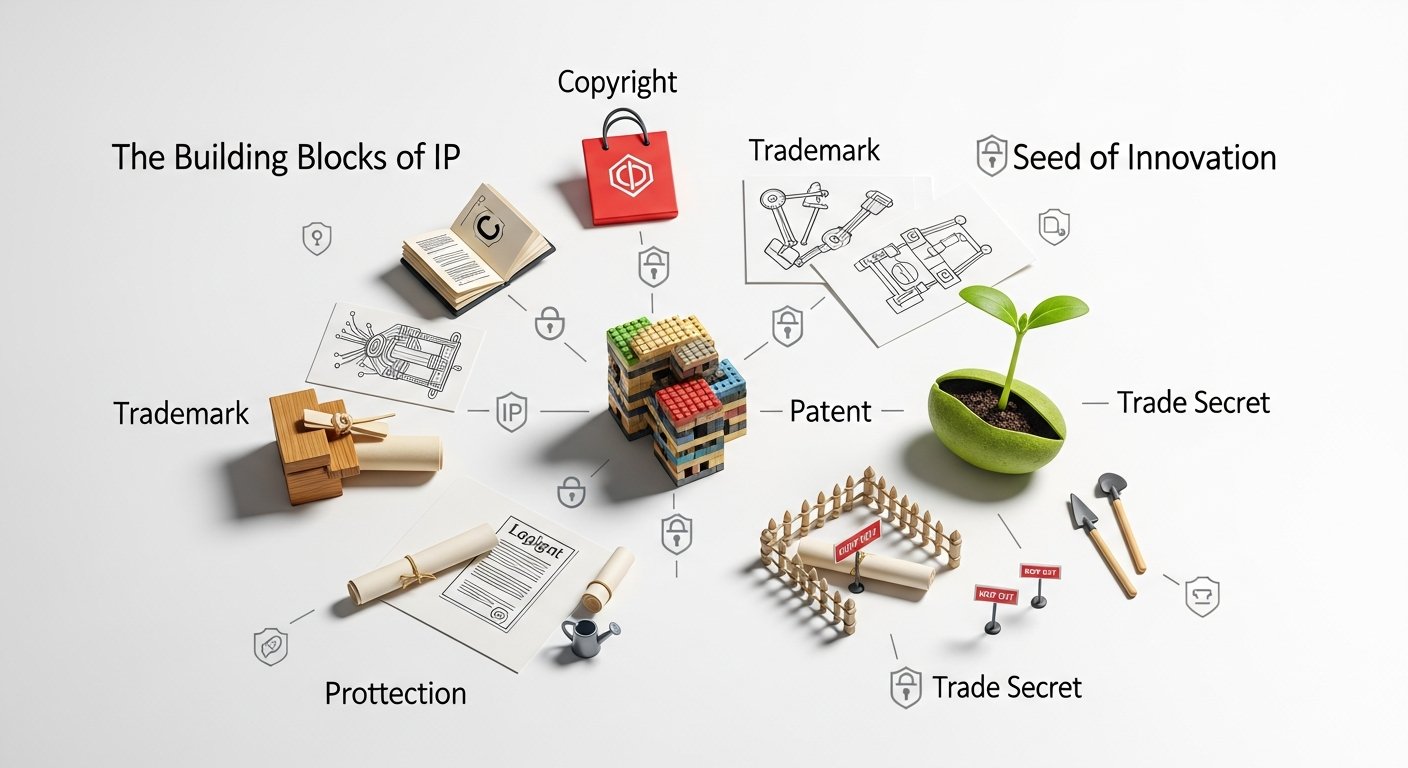
According to a 2026 European Patent Office (EPO) study, companies that actively maintain a portfolio across multiple rights categories experience a 33% higher median revenue growth rate than single-category businesses. Distinct categories of rights operate under entirely different legal frameworks because they protect fundamentally different economic aspects of a business. Patents shield the functional utility of an invention, whereas trademarks protect consumer recognition and commercial origin.
Imagine an emerging apparel brand that designs a radically new type of moisture-wicking fabric. They secure a patent for the chemical treatment process, but they also register their unique logo to build brand loyalty and copyright their striking textile patterns. If a competitor attempts to mimic the fabric, the brand can attack the infringement from multiple legal angles, creating an overwhelming barrier to entry. This multi-layered approach requires a clear understanding of the specific instruments available.
| Category | What It Shields | Key Requirements | Typical Duration |
|---|---|---|---|
| Patents | Functional inventions, processes, or unique designs. | Must demonstrate absolute novelty and non-obviousness over existing public knowledge. | 20 years from the filing date (utility), preventing others from making or selling. |
| Trademarks | Brand identifiers like logos, slogans, and product names. | Must be distinctive and actively used in commerce to identify a source of goods. | Indefinite, provided the mark remains in continuous commercial use and is renewed. |
| Copyrights | Original artistic, literary, and musical expressions. | Must be fixed in a tangible medium of expression; protects the form, not the idea. | Life of the creator plus 70 years, restricting unauthorized reproduction. |
| Trade Secrets | Confidential formulas, client lists, and internal processes. | Must derive independent economic value from remaining unknown to the public. | Perpetual, as long as reasonable measures are actively taken to maintain secrecy. |
Understanding these distinct pillars is crucial before taking legal action. For specific execution steps on registering brand identifiers, review our [CLUSTER LINK: Comprehensive Guide to Trademark Registration for Small Businesses]. If your focus leans toward physical or technical innovations, see our [CLUSTER LINK: Patent Application Strategies for Small Business Innovators]. Content creators should reference [CLUSTER LINK: Copyright Basics for Small Business Owners and Creators], while service businesses can benefit heavily from [CLUSTER LINK: Protecting Trade Secrets: A Guide for Small Businesses].
[INLINE IMAGE 2: An infographic matrix comparing patents, trademarks, copyrights, and trade secrets with distinct icons representing duration and registration requirements.]
Developing a Robust Safeguarding Strategy Drives Valuation
A reactive approach to commercial rights often leads to missed opportunities and catastrophic operational liabilities. Imagine a fast-growing tech firm distributing teams across different jurisdictions to lower overhead. The founders fail to implement standardized invention assignment agreements for their international contractors. When the firm attempts to sell a flagship software suite, a former contractor steps forward claiming partial ownership of the foundational code. The ensuing legal gridlock paralyzes the company’s sales pipeline for over a year.
Systematic documentation converts informal institutional knowledge into verifiable corporate property because legal frameworks require unbroken chain-of-title evidence to resolve ownership disputes. Without a clear paper trail explicitly stating that the corporation owns employee-generated innovations, the default legal presumption often favors the individual creator. Conducting a comprehensive IP audit ensures that every creative asset is documented, evaluated, and assigned appropriately before disputes arise.
The United States Patent and Trademark Office (USPTO) reported in a 2026 briefing that proactive audits identify at least two previously unrecorded, highly monetizable assets in 68% of established small and medium enterprises. What success looks like: A founder easily passes rigorous due diligence during a Series B funding round, presenting a clean, undisputed portfolio of registered marks alongside watertight employee invention assignments, which ultimately justifies a 20% premium on the final valuation offer. By treating legal compliance as a growth driver rather than an administrative burden, leadership teams can drastically improve their market positioning. Integrating these practices into your corporate compliance framework is essential. Learn the exact steps to formalize your internal processes in our [CLUSTER LINK: Developing a Robust IP Strategy: A Small Business Playbook].
Common Pitfalls in Securing Creative Works and Brands

Even well-intentioned entrepreneurs frequently make critical errors that permanently compromise their market exclusivity. Prematurely sharing an invention destroys patent eligibility because global patent systems require absolute novelty; sharing the mechanics of an invention publicly removes the societal benefit of newly disclosed knowledge, which is the foundational trade-off required to justify granting a temporary monopoly. A staggering amount of innovation is lost simply through enthusiastic early marketing.
According to a 2026 Hiscox small business risk report, 41% of early-stage branding disputes stem from failing to conduct preliminary clearance searches before launching a product line. When mapping out your annual promotional expenditures, allocating upfront funds for comprehensive legal clearance prevents catastrophic downstream losses. The most frequent missteps generally fall into predictable patterns:
- Premature Public Disclosure: Discussing a novel technical process on a podcast or at a trade show before filing a provisional application, instantly invalidating future patent claims.
- Confusing LLC Formation with Brand Protection: Assuming that registering a corporate name with the state grants federal rights to stop others from using a similar brand name.
- Neglecting Contractor Agreements: Paying for logo design or code development without a written “work for hire” agreement, leaving the copyright with the freelancer.
- Inadequate Internal Security: Failing to use basic password protection or non-disclosure agreements, completely nullifying any legal claim to trade secret theft.
What failure looks like: A consumer goods startup heavily markets a new product name, achieves viral success on social media, and suddenly receives a cease-and-desist letter from a legacy brand operating in a related category. Because they skipped a clearance search, they are forced into an immediate, complete rebrand. This destroys all accumulated customer goodwill and incurs over $50,000 in immediate legal and marketing replacement costs. Recognizing these dangers is the first step toward avoidance. To understand how to rectify these errors, read our deep dive on [CLUSTER LINK: IP Enforcement and Monitoring for Small Businesses].
[INLINE IMAGE 4: A flowchart illustrating the timeline of common small business errors, highlighting the irreversible impact of public disclosure before filing an application.]
Proactive Enforcement Secures Long-Term Competitive Advantage
Securing a registration certificate is merely the opening move in a broader commercial strategy; the true value of these assets lies in their rigorous enforcement. Consistent policing of brand assets maintains legal validity because trademark law inherently operates on a usage and enforcement mandate. Allowing unchallenged infringement to proliferate signals abandonment to the courts, stripping the owner of future enforcement capabilities and diluting the brand’s distinctiveness in the marketplace.
Consider an e-commerce brand that sets up a highly successful online storefront but ignores marketplace knockoffs to focus solely on product development. Within a year, lower-quality clones utilizing confusingly similar packaging flood the search results. The original brand’s customer satisfaction scores plummet as confused buyers mistakenly associate the authentic company with the inferior counterfeit products arriving in the mail. When executing digital acquisition campaigns, this brand dilution severely throttles conversion rates because consumer trust has been irrevocably fractured.
A 2026 Gartner survey of digital merchants found that implementing automated marketplace scanning tools reduces counterfeit-driven revenue leakage by an average of 22% within the first six months. What success looks like: An entrepreneur sets up automated trademark watch alerts, catches a confusingly similar application during its mandatory publication window, and successfully files a notice of opposition before the rival mark registers, preserving their exclusive market positioning without ever stepping into a courtroom. For actionable strategies on monitoring your industry landscape, review our guide on [CLUSTER LINK: IP Enforcement and Monitoring for Small Businesses].
How Can Entrepreneurs Leverage These Assets for Sustainable Growth?
Beyond mere defensive posturing, a well-curated portfolio of commercial rights serves as a powerful engine for exponential revenue growth. Monetizing through strategic partnerships generates high-margin recurring revenue because the foundational asset requires no additional manufacturing overhead. The marginal cost of authorizing existing knowledge to a third party is virtually zero, allowing a company to scale geographically or across different verticals without matching the usual operational expenditures.
Take the example of a regional organic fertilizer producer that develops a highly effective, patented chemical formulation. Rather than attempting to raise millions of dollars to build nationwide manufacturing facilities, they engage in licensing agreements with established national distributors. The producer provides the scientific know-how and brand rights in exchange for a 7% royalty on all gross sales. A recent 2026 Harvard Business Review study demonstrated that product lines driven by licensed innovations yield average gross margins 85% higher than traditionally manufactured physical goods, owing to the absence of direct production costs for the licensor.
Ultimately, comprehensive intellectual property protection for small businesses transforms raw creativity into enduring commercial power. It shifts a company from merely selling temporary labor or fleeting commodities into owning an unassailable piece of the market landscape. By identifying core innovations, securing them through the appropriate legal channels, aggressively monitoring for infringement, and creatively leveraging them for expansion, founders guarantee that their hard work compounds in value over time. Continue your journey by exploring our full suite of resources linked throughout this hub to master every facet of safeguarding your enterprise.
Sources & References

- World Intellectual Property Organization (WIPO). (2026). Global Innovation Index: The Role of Intangible Assets in Early-Stage SME Valuation. WIPO Publications.
- European Patent Office (EPO). (2026). Intellectual Property Rights and Firm Performance in the European Union. EPO Research Division.
- United States Patent and Trademark Office (USPTO). (2026). Annual Report on Small Business Innovation and Asset Auditing. Department of Commerce.
- Hiscox Ltd. (2026). Small Business Risk and Legal Liability Report. Hiscox Business Insurance Analytics.