

Understanding the Foundation: Why a Realistic Business Budget Matters
A business budget is far more than a simple compilation of numbers; it is a living document that underpins every strategic decision your company makes. At its core, a realistic budget provides a detailed forecast of your income and expenses over a specific period, typically a fiscal year, though many businesses also create quarterly or even monthly budgets for closer monitoring. The ‘realistic’ aspect is crucial here. An overly optimistic budget can lead to cash flow crises, overspending, and unachievable targets, while an excessively conservative one might stifle growth and prevent necessary investments.
The primary importance of a realistic business budget lies in its ability to offer clarity and control. It acts as a financial blueprint, helping you understand your financial health, identify potential challenges before they become crises, and allocate capital to areas that promise the highest return on investment. For instance, knowing your precise operational costs allows you to set competitive pricing, manage inventory effectively, and plan for expansion with confidence. It transforms abstract financial goals into concrete, measurable objectives.
Furthermore, a well-crafted budget serves as a powerful accountability tool. It sets benchmarks against which actual performance can be measured, enabling managers and teams to track progress, identify variances, and take corrective actions promptly. This continuous feedback loop is essential for agility in a fast-evolving market. When employees understand the financial parameters within which they operate, they are better equipped to make fiscally responsible decisions, aligning their efforts with the company’s broader financial objectives. This collective financial awareness fosters a culture of efficiency and prudent resource management throughout the organization.
Beyond internal management, a realistic budget is also vital for external stakeholders. Lenders, investors, and potential partners often require a detailed budget to assess a company’s viability, financial discipline, and growth potential. A well-presented budget demonstrates foresight, strategic planning, and a deep understanding of your business model, instilling confidence in those considering investing in or lending to your enterprise. In essence, a realistic business budget is not merely a financial exercise; it is a strategic imperative that lays the groundwork for sustained success, stability, and informed decision-making in the competitive business arena.
Step 1: Gather Your Financial Data and Historical Performance
The cornerstone of any realistic business budget is accurate, comprehensive financial data. You cannot effectively plan for the future without a clear understanding of your past and present financial standing. This initial step requires a meticulous collection and analysis of your company’s historical financial records, providing the empirical foundation upon which your budget will be built.
Begin by compiling your core financial statements from at least the past two to three years. These include:
- Income Statements (Profit & Loss Statements): These documents show your revenues, costs, and profits over a period. They are crucial for understanding your sales trends, cost of goods sold (COGS), operating expenses, and net profitability. Analyze revenue streams, gross profit margins, and operating income to identify patterns and trends.
- Balance Sheets: A snapshot of your company’s assets, liabilities, and owner’s equity at a specific point in time. The balance sheet helps you understand your financial position, liquidity, and solvency. It provides insight into your existing cash reserves, accounts receivable, inventory levels, and outstanding debts.
- Cash Flow Statements: These statements track the movement of cash into and out of your business, categorized into operating, investing, and financing activities. A cash flow statement is indispensable for understanding your liquidity and ensuring you have enough cash to meet short-term obligations. It reveals seasonal fluctuations in cash and highlights potential future cash shortages or surpluses.
Beyond these primary statements, delve into more granular data. Review detailed expense reports, sales figures by product line or service, customer acquisition costs, and historical marketing spend. Look at your payroll records, utility bills, rent agreements, and insurance premiums. The more detailed your historical data, the more precise your future projections can be.
When analyzing this historical data, look for trends, anomalies, and seasonal variations. Did revenue consistently grow year-over-year? Were there specific months where expenses spiked or dipped? Did a particular marketing campaign yield significant returns, or did another prove to be a costly misstep? Understanding these patterns will enable you to make more informed assumptions for your future budget. For example, if you consistently see a dip in sales during Q3, your budget for 2026 should account for this seasonality rather than assuming flat growth.
It’s also important to consider any significant changes that have occurred or are expected to occur in your business operations. Have you launched new products or services? Expanded into new markets? Experienced a change in your supply chain or operational structure? These factors will influence how you interpret past data and project future performance. The goal of this initial step is to create a robust historical baseline that accurately reflects your business’s financial journey, setting the stage for credible and realistic financial forecasting.
Step 2: Project Your Revenue Accurately
Start by leveraging the historical sales data you gathered in the previous step. Analyze past revenue trends, looking at year-over-year growth, average transaction values, customer retention rates, and sales volumes for different products or services. This historical performance provides a baseline, but it shouldn’t be your sole determinant.
Next, integrate forward-looking factors. Consider current market conditions and economic outlooks. Are there industry trends that might impact demand for your offerings? What do economic forecasts for 2026 suggest regarding consumer spending or business investment? Is your target market expanding or contracting? Research reports, industry analyses, and government economic data can provide valuable insights.
Your business’s strategic initiatives must also heavily influence revenue projections. Are you planning to launch new products or services? Expand into new geographic markets? Increase your sales team? Enhance your marketing efforts? Each of these initiatives will have a direct impact on potential revenue growth. For instance, if you’re investing heavily in a new product line, you’ll need to project its sales trajectory, taking into account launch costs and market adoption rates.
Segment your revenue projections where possible. Break down sales by product line, service offering, customer segment, or geographic region. This granular approach allows for more accurate forecasting and helps identify which areas are driving growth and which might be lagging. Don’t forget to account for seasonality, if applicable to your business. If your sales peak during holidays or specific times of the year, ensure your monthly or quarterly revenue projections reflect these fluctuations.
Finally, consider different scenarios. What if sales exceed expectations? What if they fall short? Creating best-case, worst-case, and most-likely scenarios for your revenue projections can provide a more robust and flexible budget that can adapt to varying market conditions. This foresight helps in contingency planning and ensures your budget remains realistic even when circumstances change.
Step 3: Itemize and Categorize Your Expenses (Fixed vs. Variable)
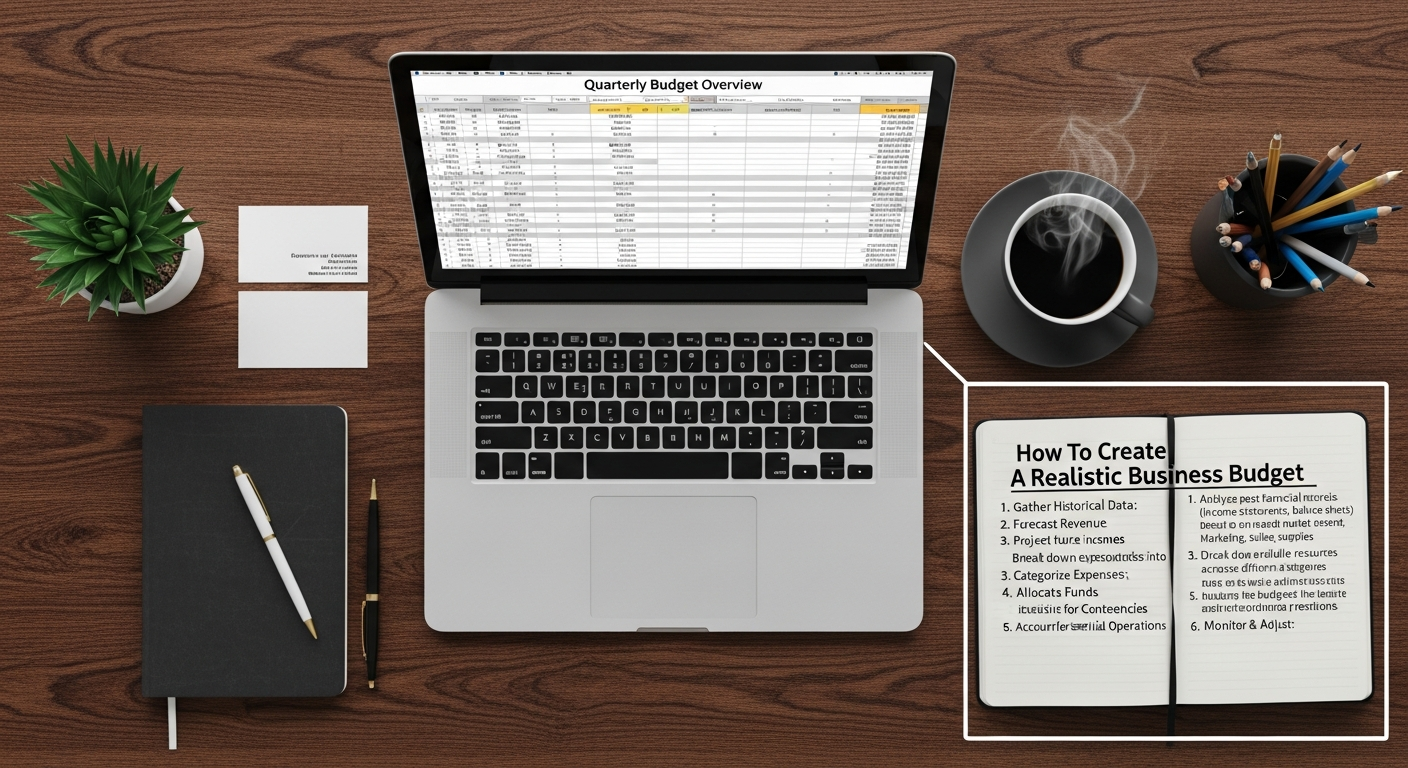
After projecting your revenue, the next critical step in creating a realistic business budget is to meticulously itemize and categorize all your anticipated expenses. This process provides a clear picture of where your money will be going and allows you to identify areas for optimization and control. Expenses are typically classified into two main categories: fixed costs and variable costs. Understanding the distinction between these two is fundamental for effective budgeting and financial management.
Fixed Costs
Fixed costs are expenses that do not change significantly with the level of business activity or sales volume within a relevant range. These costs are generally predictable and must be paid regardless of how much you produce or sell. Examples include:
- Rent or Lease Payments: For office space, manufacturing facilities, or retail locations.
- Salaries and Benefits (Administrative & Management): Compensation for employees whose roles are not directly tied to production volume.
- Insurance Premiums: Business liability, property, and health insurance.
- Depreciation: The systematic expensing of the cost of tangible assets over their useful life.
- Loan Payments: Principal and interest payments on business loans.
- Software Subscriptions: Essential business software (CRM, ERP, accounting).
When budgeting for fixed costs, gather all relevant contracts, agreements, and historical invoices. Look for any scheduled increases in rent, insurance, or salaries for 2026. Fixed costs often represent a significant portion of a business’s overhead, making their accurate projection vital.
Variable Costs
Variable costs are expenses that fluctuate in direct proportion to changes in your business activity or sales volume. The more you produce or sell, the higher these costs will be. Examples include:
- Cost of Goods Sold (COGS): The direct costs attributable to the production of the goods sold by a company. This includes raw materials, direct labor, and manufacturing overhead.
- Sales Commissions: Payments to sales staff based on sales performance.
- Production Supplies: Materials consumed in the manufacturing process that are not part of raw materials.
- Shipping and Packaging Costs: Expenses incurred for delivering products to customers.
- Utilities (Production Related): Electricity, water, and gas expenses that increase with higher production levels.
- Marketing and Advertising Expenses: Costs associated with promoting products or services (though some marketing costs can be fixed, like agency retainers).
Budgeting for variable costs requires careful consideration of your projected sales volume. If you anticipate a 10% increase in sales, you should generally expect a proportional increase in your variable costs, especially COGS. Analyzing historical COGS as a percentage of revenue is a good starting point for projecting these costs for 2026.
Strategic Considerations for Expense Management:
This is also an excellent opportunity to consider how strategic business decisions can impact your expense structure. By outsourcing functions like customer service, HR, IT support, or accounting, you might transform what were once fixed internal salaries and benefits into more flexible, variable service fees. This can lead to cost efficiencies, access to specialized expertise, and greater scalability, allowing your budget to adapt more readily to fluctuating demands.
Similarly, for small businesses, a keen understanding of efficient supply chain management is crucial for controlling variable costs. Efficient supply chain management minimizes inventory holding costs, reduces waste, optimizes logistics, and ensures timely delivery of materials. By streamlining your procurement, production, and distribution processes, you can directly impact your COGS and other operational expenses. For instance, negotiating better terms with suppliers, implementing just-in-time inventory practices, or optimizing shipping routes can lead to substantial savings that must be reflected in your budget. Poor supply chain management, conversely, can lead to increased costs through expedited shipping, storage fees, and lost sales due to stockouts, all of which will negatively impact your budget and profitability.
Once you have a detailed list of all fixed and variable expenses, categorize them logically (e.g., salaries, marketing, operations, administration, utilities, COGS). This organization makes it easier to track and analyze spending, identify areas for cost reduction, and make informed decisions about resource allocation. Be as granular as possible, as broad categories can obscure important details.
Step 4: Account for One-Time Costs and Contingencies
While fixed and variable costs cover the predictable operational aspects of your business, a realistic budget must also explicitly account for expenses that fall outside the regular rhythm of daily operations. These include one-time costs and, crucially, a dedicated contingency fund for unforeseen circumstances. Neglecting these elements is a common pitfall that can derail even the most meticulously planned budget.
One-Time Costs (Capital Expenditures)
One-time costs are significant expenses that occur infrequently but are essential for business growth, efficiency, or compliance. These are often capital expenditures (CapEx), meaning they are investments in assets that will benefit the business for more than one year. Examples include:
- Equipment Purchases: New machinery, vehicles, computer hardware, or specialized tools.
- Software Licenses or Implementations: Major upgrades to ERP systems, CRM platforms, or industry-specific software that involve substantial upfront costs.
- Office Renovations or Expansions: Costs associated with improving or enlarging your physical workspace.
- Website Redesign or Development: Significant investments in your digital presence.
- Legal or Consulting Fees: For specific projects like mergers, acquisitions, intellectual property registration, or strategic planning.
- Major Marketing Campaigns: A large-scale brand launch or a significant advertising blitz that is not part of your regular marketing budget.
When budgeting for one-time costs for 2026, identify any planned investments or projects. Research their estimated costs thoroughly, including installation, training, and potential maintenance. If you’re unsure about specific figures, obtain quotes from multiple vendors to ensure your budget is based on competitive and accurate estimates. These costs should be clearly separated from your recurring operational expenses, as they have a different financial impact and often require specific funding sources.
The Critical Contingency Fund
Perhaps the most overlooked yet vital component of a realistic budget is the contingency fund. No business operates in a vacuum, and unexpected events are an inevitable part of the journey. A contingency fund is a reserve set aside to cover unforeseen expenses, revenue shortfalls, or emergencies that could otherwise destabilize your financial position.
What constitutes an unforeseen expense? It could be anything from a sudden equipment breakdown, an unexpected legal fee, a natural disaster impacting your operations, a sudden increase in raw material costs, or an economic downturn that temporarily reduces demand. Without a contingency fund, such events can force businesses to cut essential services, delay growth initiatives, take on high-interest debt, or even face insolvency.
How much should you allocate for contingencies? A common recommendation is to set aside 10% to 15% of your total projected expenses as a contingency fund. For businesses in volatile industries or those just starting out, a higher percentage might be prudent. This percentage provides a buffer that allows your business to absorb shocks without derailing your core budget or operations.
It’s crucial that this fund is treated as a dedicated reserve, not as an extra pool of money to be spent if available. Accessing the contingency fund should be a deliberate decision, ideally with approval from key stakeholders, and only for truly unexpected and necessary expenditures.
By proactively accounting for one-time costs and establishing a robust contingency fund, your budget transforms from a static projection into a dynamic and resilient financial plan. This foresight not only protects your business from financial surprises but also instills confidence in your ability to navigate challenges and seize opportunities as they arise, ensuring stability and adaptability as you plan for 2026.
Step 5: Monitor, Analyze, and Adjust Your Budget Regularly
Creating a budget is not a one-time annual exercise; it is an ongoing process that requires continuous monitoring, analysis, and adjustment to remain relevant and effective. A budget is a living document, and its value lies in its ability to adapt to changing circumstances, market dynamics, and internal performance. Neglecting this crucial step renders even the most meticulously prepared budget obsolete within months, if not weeks.
Regular Monitoring and Variance Analysis
The first step in ongoing budget management is to regularly compare your actual financial performance against your budgeted figures. This is known as variance analysis. Typically, businesses conduct this comparison monthly or quarterly, depending on their operational rhythm and the volatility of their industry.
- Revenue Variance: Is your actual revenue meeting, exceeding, or falling short of your projections? If revenue is consistently lower than budgeted, investigate the reasons. Is it due to market shifts, ineffective marketing strategies, competitive pressures, or issues with product/service delivery?
- Expense Variance: Are your actual expenses aligning with your budgeted amounts? Identify areas where spending is significantly over or under budget. Overspending on variable costs might indicate inefficiencies in production or procurement, while fixed costs exceeding budget could point to unexpected increases in rent, utilities, or insurance. Underspending, while seemingly positive, can sometimes signal missed opportunities for investment or growth.
The goal of variance analysis is not just to identify discrepancies but to understand the underlying causes. A 10% variance in a small expense category might be negligible, but the same variance in COGS or revenue could have significant implications for profitability. Drill down into the details to pinpoint specific items or departments contributing to the variance.
Analysis and Interpretation
Once variances are identified, the next step is to analyze their impact and interpret what they mean for your business.
- Identify Trends: Are certain variances consistently occurring? For example, if marketing expenses are always higher than budgeted, it might indicate an unrealistic initial projection or inefficient campaign management.
- Assess Impact: How do these variances affect your overall profitability and cash flow? A negative revenue variance combined with an positive expense variance can quickly erode your bottom line.
- Seek Explanations: Engage with department heads and team members to understand why actuals deviated from the budget. Their insights are invaluable for uncovering operational issues, market changes, or unforeseen events.
Strategic Adjustments and Re-forecasting
Based on your monitoring and analysis, it’s crucial to make timely adjustments to your budget. This doesn’t necessarily mean rewriting the entire budget every month, but rather making informed decisions to bring performance back on track or to adapt to new realities.
- Cost Control Measures: If expenses are consistently over budget, explore ways to reduce costs without compromising quality or essential operations. This might involve renegotiating supplier contracts, optimizing processes, or scrutinizing discretionary spending.
- Revenue Enhancement Strategies: If revenue is underperforming, consider adjusting sales strategies, enhancing marketing efforts, or introducing new pricing models.
- Re-forecasting: For significant and persistent variances, it may be necessary to re-forecast your budget for the remainder of the fiscal year. Re-forecasting involves updating your original budget with new, more accurate projections based on actual performance and current market conditions. This ensures your financial roadmap remains realistic and actionable for the months ahead. For example, if an economic downturn in Q1 2026 led to significantly lower sales than anticipated, re-forecasting for Q2, Q3, and Q4 with revised, more conservative revenue projections would be a prudent step.
- Strategic Pivots: In some cases, persistent variances might signal a need for more fundamental strategic pivots, such as adjusting your business model, exploring new markets, or re-evaluating your core offerings.
A budget’s true power lies in its flexibility and responsiveness. By committing to regular monitoring, thorough analysis, and proactive adjustments, you ensure your business budget remains a dynamic and invaluable tool that guides your organization towards its financial objectives, adapting to challenges and capitalizing on opportunities throughout 2026 and beyond.
Step 6: Leveraging Technology and Expert Insights for Budgeting Success
In today’s fast-paced business environment, creating and managing a realistic business budget can be complex and time-consuming, especially for growing enterprises. Fortunately, a wealth of technological tools and expert insights are available to streamline the process, enhance accuracy, and provide deeper financial intelligence. Embracing these resources can significantly improve your budgeting efficiency and effectiveness, transforming it from a burdensome task into a strategic advantage.
Utilizing Budgeting Software and Financial Tools
Gone are the days when budgeting was solely reliant on spreadsheets. While Excel and Google Sheets remain powerful tools, dedicated budgeting software offers enhanced features specifically designed for business financial planning. These platforms can automate data integration, facilitate scenario planning, improve collaboration, and generate sophisticated reports.
- Automated Data Integration: Many budgeting software solutions can integrate directly with your accounting software (e.g., QuickBooks, Xero, Sage), ERP systems, and even bank accounts. This automation eliminates manual data entry, reduces errors, and ensures your budget is always based on the most current financial information.
- Scenario Planning and Forecasting: Advanced software allows you to easily create multiple budget scenarios (e.g., best-case, worst-case, most-likely). This capability is invaluable for understanding the potential impact of different decisions or market conditions on your financial outlook for 2026. You can quickly adjust variables like sales growth rates or expense increases to see their effects on profitability and cash flow.
- Real-time Tracking and Reporting: These tools provide dashboards and customizable reports that offer real-time insights into your actual vs. budgeted performance. This facilitates quick variance analysis and helps identify issues or opportunities promptly, making the “monitor and adjust” phase of budgeting much more efficient.
- Collaboration and Version Control: For larger teams, budgeting software enables multiple stakeholders to contribute to the budget process simultaneously, with built-in version control to prevent conflicts and ensure everyone is working with the latest figures.
- Expense Management Platforms: Beyond overall budgeting, specific expense management software can help track, categorize, and approve employee spending, ensuring compliance with budget limits and company policies.
Seeking Expert Financial Insights
While technology provides the tools, expert human insight adds the strategic depth and experience that can be invaluable for creating a truly realistic and effective budget.
- Financial Advisors or Consultants: For small and medium-sized businesses, engaging a financial advisor or a fractional CFO can provide access to high-level financial expertise without the cost of a full-time executive. These professionals can help you:
- Interpret complex financial data and identify key trends.
- Develop robust forecasting models, particularly for unique business situations or new ventures.
- Identify potential risks and opportunities that you might overlook.
- Advise on tax implications and compliance related to your budget.
- Benchmark your financial performance against industry standards.
A good consultant can challenge your assumptions, offer an objective perspective, and guide you through the intricacies of financial planning, ensuring your budget is not only realistic but also strategically aligned with your long-term goals.
By combining the power of modern financial technology with the strategic wisdom of financial experts, businesses can elevate their budgeting process from a necessary chore to a powerful strategic advantage. These resources not only simplify the mechanics of budgeting but also enhance the quality of financial decision-making, ensuring your budget is not just a collection of numbers, but a dynamic and insightful plan for sustainable growth.
Frequently Asked Questions
Recommended Resources
For more on how to create, see Best Ecommerce Platforms Comparison 2026 on E-ComProfits.
You might also enjoy How To Stop Living Paycheck To Paycheck from Fin3go.
From Our Network
- how to redeem points for maximum value (en Goldpoints)
- how to get out of credit card debt (en Tradingcosts)