Understanding Your Foundation: Market, Customers, and Value Proposition
Before you can even begin to outline specific sales tactics, the bedrock of any successful B2B sales strategy lies in a deep, granular understanding of your market, your ideal customers, and the unique value you bring to the table. This foundational work informs every subsequent decision, from lead generation to sales enablement. Without this clarity, your sales efforts risk being unfocused, inefficient, and ultimately, ineffective.
The first step in this critical phase is comprehensive market research. This involves analyzing industry trends, competitive landscapes, and identifying white space opportunities. What are the prevailing economic conditions influencing your target sectors? Who are your direct and indirect competitors, and what are their strengths and weaknesses? Understanding the broader ecosystem helps you position your offerings strategically and anticipate potential challenges or shifts.
Following market analysis, the next crucial component is defining your Ideal Customer Profile (ICP). Unlike consumer sales, B2B sales often involve intricate organizational structures and multiple decision-makers. Your ICP should go beyond basic demographics to include firmographics (industry, company size, revenue), technographics (technology stack used), geographic location, and specific pain points or challenges they face that your solution addresses. For instance, an ICP might be a mid-sized manufacturing company in the automotive sector experiencing inefficiencies in its production line due to outdated legacy systems.
Building upon the ICP, you must then develop detailed buyer personas. These are semi-fictional representations of your key decision-makers and influencers within the ICP. A buyer persona encompasses roles, responsibilities, daily challenges, career aspirations, preferred communication channels, and the criteria they use to evaluate solutions. For our manufacturing example, personas might include the Head of Operations (focused on efficiency and cost reduction), the IT Director (concerned with integration and security), and the CFO (prioritizing ROI and long-term value). Understanding these diverse perspectives allows your sales team to tailor their messaging and approach to resonate with each stakeholder, making your B2B sales strategy significantly more impactful.
Finally, with a clear understanding of your market and customers, you must articulate a compelling value proposition. This is not simply a list of features; it’s a concise statement explaining how your product or service solves your customers’ specific problems or improves their situation, delivering quantifiable benefits. It should clearly differentiate you from competitors. For the manufacturing company, your value proposition might be: “Our integrated SaaS platform reduces production downtime by 20% and cuts operational costs by 15% within the first year, by modernizing legacy systems and providing real-time operational insights, enabling manufacturers to achieve peak efficiency and profitability.” A well-defined value proposition is the cornerstone of all your sales messaging and a critical element in how to build a successful B2B sales strategy that truly resonates.
Crafting Your B2B Sales Process and Funnel
Once your foundational understanding of the market, customers, and value proposition is firmly in place, the next critical step in designing a successful B2B sales strategy is to formalize your sales process and visualize it as a sales funnel. A well-defined sales process provides a repeatable, scalable roadmap for your sales team, ensuring consistency, predictability, and efficiency in customer acquisition. Without a structured process, sales efforts can become disjointed, leading to missed opportunities and inconsistent results.
The B2B sales process typically involves several distinct stages, though the specifics may vary depending on your industry and offering complexity. A common framework includes:
- Prospecting: Identifying potential customers (leads) that fit your Ideal Customer Profile. This involves research, list building, and initial outreach.
- Qualification: Determining if a prospect has a genuine need for your product/service, the budget to acquire it, the authority to make a purchasing decision, and a defined timeline (BANT or similar frameworks). This stage is crucial for prioritizing efforts and avoiding wasted time on unsuitable leads.
- Needs Assessment/Discovery: Engaging with qualified prospects to thoroughly understand their specific challenges, goals, and requirements. This is where active listening and insightful questioning are paramount to uncovering pain points that your solution can address.
- Solution Presentation/Demonstration: Tailoring your product or service presentation to directly address the prospect’s identified needs and demonstrating how your solution provides tangible value. This stage often involves customized proposals and product demos.
- Objection Handling: Addressing any concerns, questions, or reservations the prospect may have. Skillful objection handling turns potential roadblocks into opportunities to reinforce value and build trust.
- Negotiation and Closing: Discussing terms, pricing, and finalizing the deal. This requires a clear understanding of your value and the ability to navigate commercial discussions effectively.
- Onboarding and Post-Sale Follow-up: Ensuring a smooth transition for new clients, providing excellent customer service, and nurturing the relationship for future upsell or cross-sell opportunities. This stage is vital for customer retention and advocacy.
Mapping these stages to a sales funnel provides a visual representation of a prospect’s journey from initial awareness to becoming a paying customer. Each stage of the funnel has specific goals, activities, and metrics associated with it. For example, the top of the funnel (TOFU) focuses on lead generation and awareness, the middle of the funnel (MOFU) on nurturing and qualification, and the bottom of the funnel (BOFU) on closing deals.
A crucial aspect of optimizing your sales process is to define clear entry and exit criteria for each stage. What constitutes a “qualified lead”? What needs to happen for a prospect to move from “discovery” to “presentation”? Establishing these benchmarks ensures that your sales team is consistently moving prospects forward and that your sales pipeline accurately reflects the health of your B2B sales strategy.
Moreover, the B2B sales process is rarely linear. Prospects may move back and forth between stages, or even re-enter the funnel after a period. Your strategy should account for these complexities, providing pathways for re-engagement and nurturing. Regularly reviewing and refining your sales process based on performance data is essential for continuous improvement. By standardizing and optimizing your sales funnel, you gain greater control over your sales outcomes, making it a cornerstone of how to build a successful B2B sales strategy that delivers consistent results.
Lead Generation Strategies: Inbound, Outbound, and Beyond
Inbound Marketing focuses on attracting prospects to your business organically by creating valuable content and experiences tailored to their needs. Instead of pushing your message out, inbound marketing draws customers in. Key tactics include:
- Content Marketing: Developing high-quality blog posts, whitepapers, e-books, case studies, and infographics that address your target audience’s pain points and provide solutions. This establishes your company as a thought leader and trusted resource.
- Search Engine Optimization (SEO): Optimizing your website and content to rank highly in search engine results for relevant keywords. This ensures that when prospects search for solutions to their problems, your business appears prominently.
- Social Media Marketing: Engaging with prospects on professional platforms like LinkedIn, sharing valuable insights, and participating in industry discussions.
- Webinars and Virtual Events: Hosting educational sessions that offer deep dives into industry challenges and showcase your expertise, often serving as powerful lead capture mechanisms.
- Email Marketing: Nurturing leads gathered through content downloads or event registrations with targeted, value-driven email campaigns.
The primary advantage of inbound marketing is its cost-effectiveness over time and the higher quality of leads it often produces, as prospects are actively seeking solutions.
Conversely, Outbound Marketing involves actively reaching out to potential customers. While sometimes perceived as less subtle, it remains a powerful and often necessary component of a B2B sales strategy, especially for new markets, niche industries, or complex enterprise sales. Outbound tactics include:
- Cold Calling: Directly contacting prospects via phone to introduce your offering and qualify their interest. While challenging, skilled cold calling can be highly effective for initiating conversations.
- Email Outreach (Cold Emailing): Sending personalized emails to prospects who haven’t explicitly opted in, with the goal of generating interest and booking meetings.
- Trade Shows and Industry Events: Participating in or attending events to network, showcase products, and generate leads face-to-face.
- Paid Advertising: Utilizing platforms like Google Ads, LinkedIn Ads, or programmatic advertising to target specific B2B audiences with tailored messages.
- Direct Mail: While less common, targeted direct mail campaigns can still be effective for reaching specific high-value prospects, particularly in traditional industries.
Outbound marketing offers immediate reach and allows for precise targeting, making it ideal for launching new products or penetrating specific accounts.
Beyond these two main categories, a successful B2B sales strategy often leverages additional lead generation avenues:
- Referral Programs: Encouraging existing satisfied customers to refer new business, often through incentives. This generates high-quality, pre-qualified leads.
- Partnerships: Collaborating with complementary businesses to cross-promote services and access new customer bases.
- Account-Based Marketing (ABM): A highly targeted strategy where marketing and sales teams collaborate to engage specific high-value accounts with personalized campaigns, treating each account as a market of one.
The key is to integrate these different approaches into a cohesive strategy, optimizing your lead generation funnel. Measure the performance of each channel, refine your messaging, and continuously experiment to discover what works best for your specific target audience. A balanced approach that combines the pull of inbound with the push of outbound, complemented by strategic partnerships and referrals, is fundamental to how to build a successful B2B sales strategy for sustained growth in 2026 and beyond.
Building and Empowering Your B2B Sales Team

Even the most meticulously crafted B2B sales strategy, replete with brilliant market insights and innovative lead generation tactics, will fall short without a highly skilled and empowered sales team to execute it. Your sales professionals are the front line, the human connection that translates strategy into revenue. Therefore, investing in their recruitment, training, and enablement is paramount for how to build a successful B2B sales strategy.
The first step is recruitment. B2B sales roles demand a specific skill set: strong communication, active listening, problem-solving abilities, resilience, strategic thinking, and a deep understanding of business challenges. Look for candidates who are not just charismatic, but also analytical, empathetic, and driven to understand and solve complex customer problems. Cultural fit is also crucial; your sales team should embody your company’s values and commitment to client success.
Once you’ve assembled a talented team, comprehensive and ongoing sales training becomes vital. Initial onboarding should cover product knowledge, your company’s value proposition, the intricacies of your B2B sales process, and the use of sales tools. However, training shouldn’t stop there. Regular coaching, role-playing, and advanced skill development workshops (e.g., negotiation tactics, strategic account management, storytelling for sales) are essential. The B2B landscape is constantly evolving, and your sales team needs continuous learning opportunities to stay ahead. This includes training on new product features, updated market trends, and refined objection handling techniques.
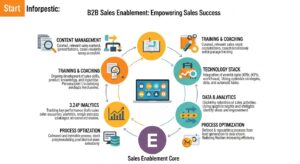
Sales enablement goes hand-in-hand with training, providing your team with the resources, tools, and content they need to sell more effectively. This encompasses:
- Content Repository: Easy access to up-to-date sales collateral, such as presentations, case studies, whitepapers, competitor battlecards, and proposal templates.
- Sales Playbooks: Detailed guides outlining best practices for various sales scenarios, from initial outreach to closing.
- Communication Tools: Platforms that facilitate seamless internal communication and collaboration between sales, marketing, and product teams.
- CRM Systems: A robust Customer Relationship Management (CRM) system is non-negotiable. It serves as the central hub for all customer data, tracks interactions, manages pipelines, forecasts sales, and provides invaluable insights into customer behavior. A well-implemented CRM ensures that no lead falls through the cracks and that every sales activity is recorded and analyzed.
Beyond tools and content, effective sales leadership is crucial. Sales managers should act as coaches and mentors, providing constructive feedback, setting clear expectations, and fostering a supportive, high-performance culture. They play a pivotal role in monitoring individual and team performance, identifying areas for improvement, and celebrating successes. Regular one-on-one meetings and team reviews are essential for alignment and motivation.
Finally, empowering your sales team means giving them autonomy within defined guidelines, trusting their judgment in client interactions, and recognizing their contributions. A motivated and well-equipped sales force is not just executing your strategy; they are actively contributing to its evolution and success. By prioritizing your people, you lay a strong foundation for a B2B sales strategy that is not only successful but also sustainable and adaptable for the challenges and opportunities leading up to 2026.
Optimizing Operations and Performance: Metrics, Technology, and Outsourcing
A successful B2B sales strategy is not static; it requires continuous optimization, driven by data, enabled by technology, and sometimes enhanced by strategic resource allocation. To ensure your sales efforts are not just effective but also efficient and scalable, a rigorous focus on performance metrics, smart technology adoption, and considering external expertise are paramount. This involves a deep dive into what truly drives results and how to streamline processes for maximum impact.
The backbone of performance optimization is the diligent tracking and analysis of Key Performance Indicators (KPIs). These metrics provide objective insights into the health of your B2B sales strategy and highlight areas needing attention. Essential sales KPIs include:
- Conversion Rates: From lead to qualified prospect, qualified prospect to opportunity, and opportunity to closed-won deal.
- Sales Cycle Length: The average time it takes to close a deal, from initial contact to contract signing. Shorter cycles often indicate greater efficiency.
- Customer Acquisition Cost (CAC): The total cost of sales and marketing efforts divided by the number of new customers acquired.
- Customer Lifetime Value (CLTV): The predicted revenue a customer will generate over their relationship with your business. Comparing CLTV to CAC is crucial for long-term profitability.
- Average Deal Size: The average revenue generated per closed deal.
- Sales Pipeline Coverage: The ratio of open opportunities to your sales target, indicating if you have enough potential deals to meet goals.
- Sales Velocity: How quickly leads move through your pipeline and generate revenue.
Regularly reviewing these KPIs allows you to identify bottlenecks in your sales process, assess the effectiveness of different lead generation channels, and fine-tune your team’s performance.
Sales forecasting is another critical operational aspect. By analyzing historical data, pipeline stages, and market trends, you can predict future sales outcomes with greater accuracy. This enables better resource planning, inventory management, and strategic decision-making across the entire business. Accurate forecasting is a hallmark of a mature and successful B2B sales strategy.
Beyond the foundational CRM system discussed earlier, leveraging a comprehensive suite of sales technology can significantly enhance operational efficiency. This might include:
- Sales Engagement Platforms: Automating and optimizing multi-channel outreach (email, calls, social) to improve prospecting efficiency.
- Sales Intelligence Tools: Providing rich data on prospects and accounts to personalize outreach and uncover buying signals.
- Configure, Price, Quote (CPQ) Software: Streamlining the proposal generation and pricing process for complex B2B offerings, reducing errors and accelerating deal closure.
- Sales Analytics and Business Intelligence Tools: Offering deeper insights into sales performance, trends, and opportunities than standard CRM reports.
Finally, considering What Is Business Process Outsourcing (BPO) can be a strategic move to optimize your sales operations. BPO involves delegating non-core business activities to third-party providers. In the context of sales, this might include:
- Lead Qualification: Outsourcing the initial vetting of leads to ensure your internal sales team focuses only on highly qualified prospects.
- Appointment Setting: Having an external team manage the scheduling of meetings for your sales representatives.
- Sales Support and Administration: Delegating tasks like data entry, CRM updates, and proposal preparation.
- Customer Service: Outsourcing post-sale support to enhance customer satisfaction and free up sales reps for new business.
By leveraging BPO for these functions, businesses can reduce operational costs, access specialized expertise, improve efficiency, and most importantly, allow their core sales team to concentrate on high-value selling activities—building relationships and closing deals. This strategic allocation of resources is a sophisticated element in how to build a successful B2B sales strategy that remains agile and competitive leading into 2026.
Strategic Alignment and Future-Proofing for 2026
Building a successful B2B sales strategy isn’t a one-time project; it’s an ongoing commitment to strategic alignment and continuous adaptation. As businesses look towards 2026 and beyond, market dynamics, technological advancements, and customer expectations will undoubtedly evolve. Therefore, a truly robust B2B sales strategy must be future-proofed, integrated seamlessly with overall business objectives, and capable of scaling with growth.
Strategic Alignment is the bedrock of long-term success. Your B2B sales strategy cannot operate in a silo. It must be intimately connected with your company’s overarching mission, vision, and growth objectives. This means:
- Sales and Marketing Integration: These two departments must function as a cohesive unit. Marketing should provide sales with qualified leads and valuable content, while sales should provide marketing with feedback on lead quality and market insights. Regular joint meetings and shared KPIs are essential.
- Product/Service Alignment: Sales teams need to clearly communicate customer needs and feedback to product development, ensuring that offerings remain relevant and competitive. Conversely, product teams must ensure sales understands new features and their value propositions.
- Customer Success Integration: The journey doesn’t end at the sale. Customer success teams play a vital role in retention, upselling, and fostering advocates, which directly impacts future sales and revenue. A seamless handover from sales to customer success is critical.
- Financial Objectives: Sales targets must be realistic and align with the company’s financial goals, including revenue projections, profitability margins, and cash flow management.
As we approach 2026, several trends will continue to shape the B2B sales landscape. Digital transformation, AI and machine learning, increased demand for personalized experiences, and a greater emphasis on social responsibility will all influence buyer behavior. A future-proofed B2B sales strategy anticipates these shifts and builds in mechanisms for adaptation. This includes:
- Embracing Digital Sales Channels: Beyond traditional methods, the reliance on virtual selling, digital platforms, and e-commerce for B2B transactions will only intensify.
- Leveraging AI and Data Analytics: Using AI for lead scoring, predictive analytics, and personalized outreach can dramatically enhance efficiency and effectiveness.
- Focusing on Customer Experience: B2B buyers increasingly expect consumer-grade experiences. Your sales process must be frictionless, transparent, and value-driven at every touchpoint.
- Agile Strategy Development: Moving away from rigid annual plans to more iterative, agile strategy cycles that allow for quick adjustments based on market feedback and performance data.
Scalability is another key consideration. As your business grows, your B2B sales strategy must be able to expand without breaking. This involves having robust processes, a scalable sales tech stack, and a clear plan for hiring and onboarding new sales talent. It also means having the infrastructure to support increased demand. This is where a broader operational perspective comes into play. For instance, understanding What Is Supply Chain Management Small Business might seem distant from sales, but in reality, efficient supply chain operations directly impact your ability to deliver products or services consistently and reliably. Delays, quality issues, or stockouts caused by a disorganized supply chain can severely damage customer trust, lead to cancellations, and ultimately undermine even the best sales efforts. For a small business, a well-managed supply chain ensures that sales promises can be kept, fostering repeat business and positive referrals, which are invaluable for a successful B2B sales strategy.
Regularly review and audit your B2B sales strategy. Are your goals still relevant? Are your tactics yielding the desired results? Are you leveraging the latest technologies and methodologies? By embedding a culture of continuous improvement and foresight, you can ensure your B2B sales strategy remains a powerful engine for growth, ready to tackle the challenges and seize the opportunities that 2026 and the future will bring. This holistic approach is the definitive answer to how to build a successful B2B sales strategy that stands the test of time.
Frequently Asked Questions
Recommended Resources
Learn more about this topic in Conversion Rate Optimization Tips at Page Release.
Learn more about this topic in Best Ways To Save Money Every Month at AssetBar.