
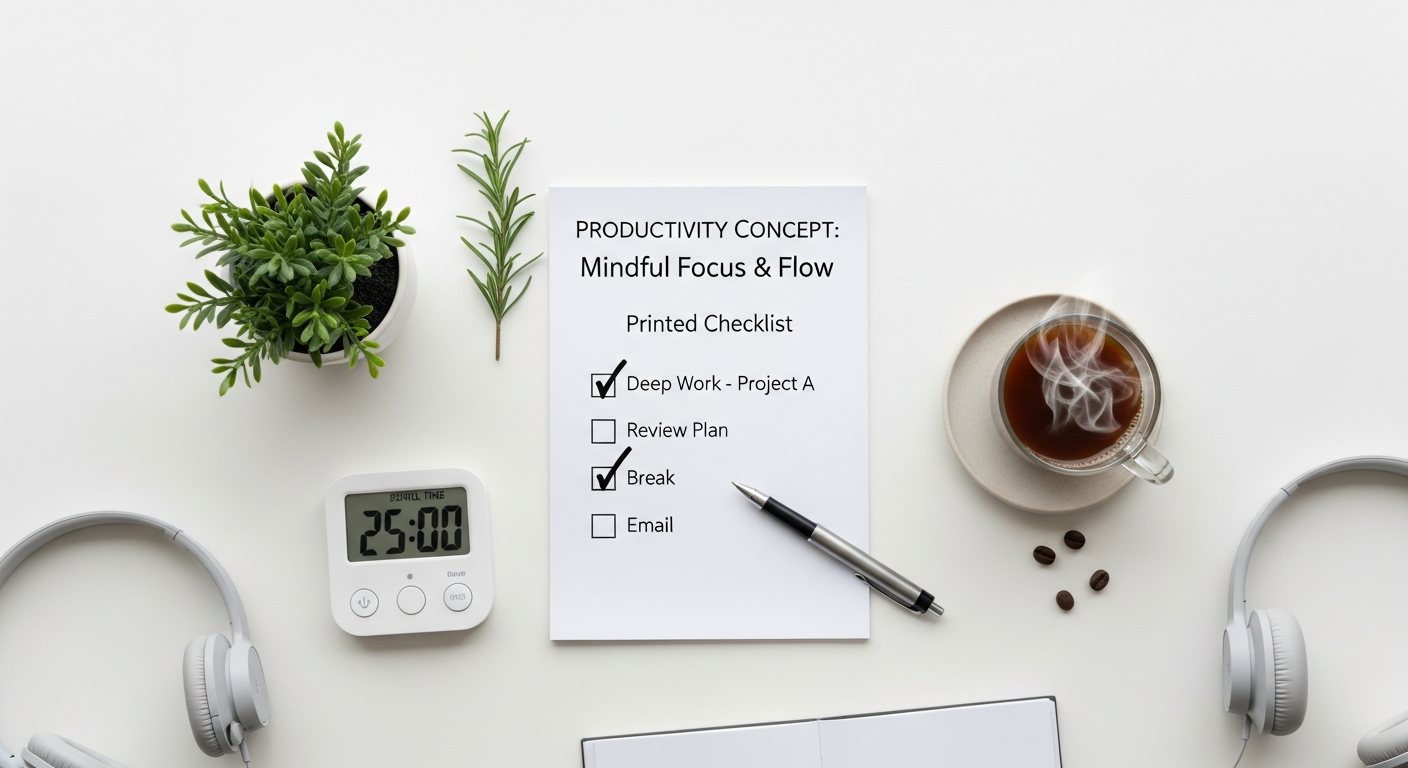
Unlocking Peak Performance: Your Comprehensive Business Productivity Guide for 2026
This comprehensive guide is engineered to serve as your senior advisor, delivering data-backed insights and actionable frameworks designed to future-proof your enterprise. We will delve into the critical shifts required to not just keep pace, but to lead. From harnessing the transformative power of AI to cultivating an empowered, high-performing workforce, and establishing agile, efficient operations, you’ll uncover real tactics over abstract theory. Prepare to redefine what productivity means for your organization and lay the groundwork for unparalleled performance in 2026 and beyond.
Redefining Productivity: Beyond Just ‘Doing More’
The traditional view of productivity—simply clocking more hours or churning out more tasks—is obsolete. For 2026, true business productivity pivots on impact, strategic alignment, and the efficient allocation of resources towards high-value outcomes. It’s about working smarter, not just harder, and ensuring every effort contributes meaningfully to overarching business objectives. This shift requires a fundamental re-evaluation of what we measure and how we define success.
Many businesses today grapple with a ‘busyness trap,’ mistaking activity for achievement. Research indicates that a significant percentage of employees feel their efforts are misaligned with company goals, leading to wasted resources and diluted impact. Our focus must move from individual output metrics to collective strategic outcomes. This means identifying and prioritizing tasks that directly contribute to revenue growth, customer satisfaction, innovation, or market expansion, and ruthlessly deprioritizing anything that doesn’t.
The Impact-Driven Productivity Matrix: A Framework for Strategic Alignment
To redefine productivity, we introduce the Impact-Driven Productivity Matrix, a framework that helps organizations filter tasks and initiatives through a strategic lens:
- Quadrant 1: High Impact, High Effort (Strategic Imperatives): These are your core projects requiring significant resources but offering substantial returns. Optimize these for efficiency and quality.
- Quadrant 2: High Impact, Low Effort (Quick Wins/Leverage Points): Identify tasks that can yield significant results with minimal investment. These are often ripe for automation or process streamlining.
- Quadrant 3: Low Impact, High Effort (Resource Sinks): These are the productivity killers. Minimize, delegate, or eliminate these tasks. They often represent inefficient processes or non-essential activities.
- Quadrant 4: Low Impact, Low Effort (Maintenance/Hygiene): Necessary routine tasks that should be automated or outsourced where possible to free up strategic bandwidth.
Leveraging AI & Automation: The Productivity Multiplier for 2026
No discussion of modern business productivity is complete without a deep dive into Artificial Intelligence (AI) and automation. These technologies are no longer futuristic concepts; they are current-day imperatives, acting as powerful multipliers for efficiency, accuracy, and innovation. Businesses that effectively integrate AI and automation into their operations are poised to gain an insurmountable lead by 2026.
The potential time savings are staggering: studies suggest that intelligent automation can free up a substantial portion of employee time currently spent on repetitive, rule-based tasks. This isn’t about replacing human workers; it’s about augmenting human capabilities, allowing teams to focus on complex problem-solving, creative endeavors, and high-value strategic initiatives that only humans can deliver.
AI/Automation Opportunity Mapping Framework
To effectively deploy AI and automation, consider this step-by-step framework:
- Identify Repetitive & Rule-Based Tasks: Look across departments – customer service queries, data entry, report generation, email sorting, content drafting, lead qualification, HR onboarding.
- Assess Impact & Feasibility: Prioritize tasks where automation can deliver the greatest time savings, reduce errors, or improve customer experience, balanced against the cost and complexity of implementation.
- Select Appropriate Tools:
- Robotic Process Automation (RPA): For automating repetitive digital tasks (e.g., UiPath, Automation Anywhere).
- AI-Powered Content Generation: For marketing copy, internal communications, code snippets (e.g., ChatGPT, Google Bard, Jasper).
- Intelligent Document Processing (IDP): For extracting data from unstructured documents (e.g., ABBYY, Hyperscience).
- AI-Driven CRM & Marketing Automation: For personalizing customer interactions, automating sales outreach, lead scoring (e.g., HubSpot, Salesforce Einstein AI).
- Workflow Automation & Integration Platforms: To connect disparate systems and automate multi-step processes (e.g., Zapier, Make).
- Pilot & Scale: Start with small, well-defined pilot projects. Measure ROI and gather feedback. Iterate and then scale successful implementations across the organization.
- Upskill Your Workforce: Train employees to work alongside AI, manage automated processes, and leverage AI tools for their roles. This ensures human-AI collaboration is seamless and productive.
By systematically identifying opportunities and deploying the right AI and automation tools, businesses can dramatically reduce operational overhead, accelerate workflows, and reallocate human talent to areas where strategic thinking and creativity are paramount.
Optimizing Human Capital: Empowering Your Workforce for Peak Performance
While technology offers immense leverage, the ultimate engine of business productivity remains its people. An empowered, engaged, and well-supported workforce is intrinsically more productive, innovative, and resilient. For 2026, optimizing human capital means moving beyond mere resource management to genuine talent development, fostering well-being, and cultivating a culture of psychological safety and high-trust collaboration.
Studies consistently show that highly engaged teams are significantly more productive and profitable. This engagement doesn’t happen by accident; it’s a deliberate outcome of strategic investment in employee experience, skill development, and creating an environment where individuals feel valued, heard, and challenged.
The Employee Empowerment & Engagement Model
This model outlines key pillars for maximizing human capital productivity:
- Clear Purpose & Vision: Ensure every employee understands the company’s mission and how their individual role contributes to it. Transparency in goals and strategy builds buy-in.
- Autonomy & Trust: Grant employees the freedom and trust to make decisions within their scope. Micro-management stifles initiative and innovation. Tools like Asana or Monday.com can provide transparency without constant oversight.
- Continuous Learning & Development: Invest in upskilling and reskilling programs, especially in areas like AI literacy, data analytics, and soft skills. Provide access to platforms like Coursera for Business or LinkedIn Learning.
- Effective Communication & Collaboration: Implement robust communication channels (e.g., Slack, Microsoft Teams) and foster practices that encourage open dialogue, feedback, and cross-functional teamwork.
- Template: Meeting Effectiveness Checklist
- Clear Objective & Agenda shared beforehand?
- Only essential attendees invited?
- Time-bound discussion points?
- Actionable outcomes & owners assigned?
- Summary of decisions & next steps distributed?
- Template: Meeting Effectiveness Checklist
- Well-being & Work-Life Integration: Support mental and physical health initiatives. Offer flexible work arrangements and encourage breaks. A healthy employee is a productive employee.
- Recognition & Feedback: Establish systems for regular, constructive feedback and public recognition of achievements. This reinforces positive behaviors and motivates continued high performance.
By prioritizing these elements, businesses don’t just retain talent; they cultivate a thriving ecosystem where individuals are motivated to bring their best selves to work, driving collective productivity and innovation.
Streamlining Processes & Workflows: The Backbone of Efficiency
Even with the most advanced technology and the most talented people, inefficient processes can create bottlenecks that cripple productivity. For 2026, a critical lever for enhancing business efficiency lies in the systematic review, optimization, and automation of internal processes and workflows. This is about eliminating waste, reducing friction, and ensuring that work flows seamlessly from one stage to the next.
Inefficient processes are often hidden costs, leading to rework, delays, frustrated employees, and ultimately, dissatisfied customers. Research suggests that businesses can realize significant cost savings and productivity gains—often upwards of 20-30%—by simply streamlining their core operational workflows. Adopting lean principles and agile methodologies can transform chaotic operations into finely tuned engines of delivery.
The Process Optimization Cycle: Analyze, Design, Implement, Monitor
This iterative framework provides a structured approach to workflow improvement:
- Analyze (Map & Identify):
- Step 1: Process Mapping: Visually document current workflows using tools like Miro or Lucidchart. Identify all steps, inputs, outputs, decision points, and responsible parties.
- Step 2: Bottleneck Identification: Pinpoint areas where work slows down, gets stuck, or requires excessive manual intervention. Look for redundant steps, unnecessary approvals, or communication breakdowns.
- Step 3: Waste Identification: Apply lean principles to identify “waste” – overproduction, waiting, unnecessary transport, over-processing, excess inventory, unnecessary motion, defects, and underutilized talent.
- Design (Reimagine & Simplify):
- Step 1: Simplify: Eliminate non-value-added steps. Can certain tasks be combined, removed, or done in parallel?
- Step 2: Standardize: Create clear, repeatable procedures for common tasks to reduce variability and errors.
- Step 3: Automate: Integrate automation tools (as discussed in H2.2) for repetitive or rule-based steps.
- Step 4: Redesign: Create the optimized workflow, ensuring clear ownership and accountability at each stage.
- Implement (Pilot & Rollout):
- Step 1: Pilot Test: Test the new process on a small scale or with a specific team. Gather feedback and identify unforeseen issues.
- Step 2: Train & Communicate: Provide thorough training to all affected employees on the new process and its benefits. Communicate changes clearly.
- Step 3: Rollout: Implement the optimized process across the relevant departments.
- Monitor (Measure & Refine):
- Step 1: Establish KPIs: Define metrics to track the performance of the new process (e.g., cycle time, error rate, resource utilization, customer satisfaction).
- Step 2: Regular Review: Continuously monitor these KPIs. Schedule regular reviews to assess effectiveness and identify further opportunities for improvement.
- Step 3: Iterate: Be prepared to make further adjustments and refinements based on ongoing performance data and feedback.
By systematically applying this cycle, businesses can create a culture of continuous improvement, ensuring their operational backbone is robust, agile, and maximally efficient for the demands of 2026.
Data-Driven Decision Making: From Insight to Action
In the quest for superior business productivity, intuition and guesswork are no longer sufficient. The ability to collect, analyze, and act upon data is paramount. For 2026, data-driven decision-making transforms productivity from a subjective aspiration into a measurable, optimized outcome. It allows organizations to identify specific bottlenecks, uncover hidden opportunities, and validate the impact of their productivity initiatives with undeniable evidence.
Companies that leverage data analytics effectively consistently outperform their peers. They can pinpoint exactly where resources are being wasted, which strategies are yielding results, and where to focus future investments for maximum return. Without data, productivity improvement efforts often become a series of hopeful experiments rather than targeted, impactful interventions.
The Productivity Analytics Loop: Collect, Analyze, Interpret, Act, Review
This framework ensures that data informs every stage of your productivity strategy:
- Collect Relevant Data:
- Operational Data: Time spent on tasks (project management tools like ClickUp, Jira), task completion rates, resource utilization.
- Financial Data: Cost per output, revenue per employee, project ROI.
- Customer Data: Customer satisfaction scores, support ticket resolution times (CRM data).
- Employee Data: Engagement survey results, training completion rates, feedback (HRIS).
- External Data: Market trends, competitor benchmarks.
- Analyze & Visualize:
- Utilize business intelligence tools like Tableau, Power BI, or Google Data Studio to consolidate and visualize data.
- Look for trends, correlations, outliers, and patterns. Identify areas of high and low performance.
- Segment data by team, project, process, or customer segment to gain granular insights.
- Interpret & Formulate Hypotheses:
- Translate raw data into meaningful insights. What story is the data telling?
- Formulate hypotheses about the root causes of productivity issues or the drivers of success. For example, “Team X has lower project completion rates due to insufficient cross-training.”
- Act on Insights:
- Based on your interpretations, design and implement targeted interventions. This could involve process changes, technology adoption, training programs, or resource reallocation.
- For instance, if data shows a bottleneck in a specific approval process, introduce automation or re-evaluate the approval hierarchy.
- Review & Iterate:
- Continuously monitor the KPIs related to your interventions. Did the changes have the desired effect?
- Compare current performance against baselines and targets.
- Use new data to refine your strategies, proving what works and discarding what doesn’t. This creates a continuous feedback loop for ongoing productivity optimization.
By embedding this data-driven approach into your organizational DNA, you transform productivity improvement from a subjective endeavor into a precise, iterative science, ensuring that every strategic decision for 2026 is backed by concrete evidence.
Cultivating a Culture of Continuous Improvement
Technology and frameworks, however powerful, are merely tools. The sustained enhancement of business productivity ultimately hinges on the organizational culture that nurtures them. For 2026, fostering a culture of continuous improvement—often inspired by the Japanese concept of Kaizen—is non-negotiable. This means instilling a mindset where every employee, at every level, is empowered and encouraged to identify inefficiencies, suggest solutions, and embrace change as an ongoing opportunity for growth.
A static organization is a dying one. The business landscape evolves too rapidly to rely on one-off initiatives. A culture of continuous improvement, characterized by psychological safety, open feedback loops, and a commitment to learning, ensures that productivity gains are not only achieved but sustained and built upon over time. Organizations with strong learning cultures are significantly more likely to lead their industries.
The Kaizen-Inspired Continuous Productivity Improvement Framework
Implement these practices to embed continuous improvement into your culture:
- Leadership Buy-In & Modeling: Productivity improvement must start at the top. Leaders must champion the values of continuous learning, experimentation, and feedback, actively participating in and supporting initiatives.
- Empowerment at the Edge: Equip frontline employees with the authority and resources to identify and solve problems within their domain. They are often closest to the inefficiencies.
- Small, Incremental Changes: Encourage a philosophy of making small, manageable improvements daily or weekly, rather than waiting for large, disruptive overhauls. These small wins accumulate into significant gains.
- Blameless Problem Solving: Create an environment where mistakes are viewed as learning opportunities, not reasons for punishment. Foster psychological safety so employees feel comfortable highlighting issues without fear of reprisal.
- Structured Feedback Loops: Implement regular channels for feedback – formal (e.g., quarterly reviews, suggestion boxes, dedicated ‘Kaizen’ meetings) and informal (e.g., daily stand-ups, open-door policies). Act on feedback transparently.
- Knowledge Sharing & Documentation: Establish systems for documenting new processes, lessons learned, and best practices. Ensure this knowledge is easily accessible to all relevant teams to prevent reinventing the wheel.
- Celebrate Improvements (Big & Small): Acknowledge and reward individuals and teams for their contributions to efficiency gains, process improvements, and innovative solutions. This reinforces the desired behaviors.
- Cross-Functional Collaboration: Break down silos and encourage teams to work together to identify and solve cross-departmental inefficiencies. Many productivity bottlenecks lie at the intersection of different functions.
By weaving these principles into the fabric of your organization, you create a self-optimizing engine that perpetually seeks out better, more efficient ways of working. This cultural foundation is the ultimate competitive differentiator for sustainable productivity in 2026.
Conclusion: The Ongoing Journey to Peak Performance in 2026
The journey to peak business productivity in 2026 is not a destination but a continuous evolution. It demands a strategic mindset that transcends mere task completion, embracing a holistic approach that integrates cutting-edge technology, empowers human potential, optimizes every process, and is relentlessly driven by data. The frameworks, tools, and insights provided in this guide are your blueprint for navigating this journey successfully.
As a senior business advisor, my counsel is direct: start today. Identify one area where you can apply an AI solution, streamline a single process, or empower a team member with new skills. Measure the impact, learn, and iterate. The businesses that will thrive in 2026 are those that view productivity not as a chore, but as their most potent strategic weapon. Embrace this transformation, and unlock a future of unparalleled performance for your enterprise.