
Understanding Marketing ROI: The Foundation of Strategic Growth
Marketing ROI, or Return on Investment, is a crucial metric that quantifies the revenue generated from marketing activities relative to the costs incurred. Simply put, it tells you how much profit your marketing efforts are bringing back into the business. While the concept seems straightforward, its application in the complex world of B2B marketing requires a nuanced understanding. It’s not enough to know what ROI is; you must grasp why it’s non-negotiable for strategic decision-making.
For B2B organizations, marketing ROI serves several vital purposes:
- Justifying Marketing Spend: In an environment where budgets are constantly scrutinized, a clear demonstration of ROI provides the evidence needed to justify continued investment in marketing initiatives. It shifts marketing from a perceived overhead to a recognized revenue generator.
- Optimizing Resource Allocation: By understanding which campaigns, channels, and strategies yield the highest returns, businesses can strategically reallocate resources. This means investing more in what works and scaling back or refining what doesn’t, ensuring maximum efficiency.
- Informing Future Strategy: Historical ROI data is a goldmine for future planning. It helps identify successful patterns, understand customer behavior, and predict the potential impact of new initiatives. This iterative process of measurement and adjustment is fundamental to continuous improvement.
- Enhancing Accountability: When marketing teams are held accountable for ROI, it fosters a culture of performance and results. It encourages a data-driven approach, moving away from subjective opinions to objective performance metrics.
- Benchmarking Performance: ROI allows businesses to compare their marketing effectiveness against industry benchmarks or internal historical performance, providing context for their achievements and areas for improvement.
The absence of robust ROI measurement can lead to significant inefficiencies. Imagine a scenario where a company invests heavily in a marketing channel without truly understanding its contribution to the bottom line. This could result in wasted budget, missed opportunities in more lucrative channels, and a general lack of clarity on the effectiveness of the entire marketing function. For businesses that consider initiatives like What Is Business Process Outsourcing to streamline operations, understanding ROI is equally critical. If marketing tasks are outsourced, measuring their ROI becomes the primary mechanism for evaluating the effectiveness and value of the BPO partnership, ensuring the external investment is truly paying off.
Moreover, the scope of marketing ROI extends beyond immediate sales. It can encompass brand building, customer loyalty, and market share growth, though these aspects often require more sophisticated measurement techniques and longer time horizons. The key is to define what success looks like for each campaign and align those definitions with measurable financial outcomes. Establishing a clear, consistent methodology for ROI calculation across all marketing activities is the first, most crucial step toward transforming your marketing efforts into a predictable, powerful engine for revenue generation and sustainable business growth. This foundational understanding sets the stage for delving into the specific metrics and processes that bring marketing ROI to life.
Key Metrics and KPIs for Measuring Marketing ROI

Accurately measuring marketing ROI requires looking beyond just the final sale. It involves tracking a hierarchy of key performance indicators (KPIs) and metrics that contribute to the overall revenue generation. Understanding and monitoring these metrics provides a granular view of performance, allowing for precise optimizations and a clearer picture of your marketing’s true impact. Here are some of the most critical metrics and KPIs to consider:
- Customer Acquisition Cost (CAC): This metric calculates the total cost associated with acquiring a new customer. It includes all marketing and sales expenses over a specific period divided by the number of new customers acquired in that same period. A high CAC can severely diminish ROI, making its reduction a priority.
- Customer Lifetime Value (CLTV or LTV): CLTV estimates the total revenue a business can reasonably expect from a single customer account throughout their relationship with the company. Comparing CLTV to CAC is fundamental for understanding long-term profitability. If your CAC is higher than your CLTV, your marketing efforts are unsustainable.
- Return on Ad Spend (ROAS): Specifically for paid advertising, ROAS measures the revenue generated for every dollar spent on ads. It’s a more immediate measure than overall ROI for specific campaigns, allowing for quick adjustments to ad creatives, targeting, and bidding strategies.
- Lead-to-Customer Conversion Rate: This KPI tracks the percentage of leads that ultimately convert into paying customers. It highlights the effectiveness of your sales funnel and the quality of leads generated by marketing. Improving this rate directly impacts ROI.
- Cost Per Lead (CPL): CPL measures how much it costs to generate one lead through a specific marketing channel or campaign. A lower CPL indicates more efficient lead generation, which can positively impact overall ROI.
- Marketing Originated Revenue: This metric identifies the percentage of your total revenue that was directly attributable to marketing efforts. It provides a strong indicator of marketing’s direct contribution to the bottom line.
- Marketing Influenced Revenue: Similar to originated revenue, this metric captures revenue where marketing played a significant, though not necessarily direct, role in nurturing a lead or influencing a purchase decision. This is especially relevant in long B2B sales cycles.
- Website Traffic and Engagement: While not directly financial, metrics like unique visitors, bounce rate, time on page, and pages per session provide insights into the effectiveness of your content and website in attracting and engaging potential customers. High engagement often correlates with higher conversion potential.
- Email Marketing Metrics: Open rates, click-through rates (CTR), conversion rates from emails, and unsubscribe rates are vital for assessing the effectiveness of email campaigns in nurturing leads and driving sales.
- Social Media Engagement: Reach, impressions, engagement rate (likes, shares, comments), and click-throughs from social media posts can indicate brand awareness and audience interest, which are precursors to lead generation and sales.
The choice of which metrics to prioritize often depends on the specific goals of a campaign and the stage of the customer journey. For example, a top-of-funnel brand awareness campaign might focus more on reach and engagement, while a bottom-of-funnel conversion campaign would prioritize CPL, conversion rates, and ROAS. Integrating these diverse metrics into a cohesive dashboard allows marketing teams to monitor performance in real-time and make agile adjustments.
Effective tracking of these metrics is also crucial for understanding How To Improve Employee Productivity within the marketing department. When marketers have clear, measurable KPIs linked to ROI, they can focus their efforts on activities that genuinely move the needle. This clarity reduces wasted time on ineffective tasks, empowers teams to self-optimize, and fosters a culture of continuous improvement. By providing transparent data and actionable insights, businesses can ensure that their marketing teams are not just busy, but productively engaged in value-generating activities.
The Step-by-Step Process of Calculating Marketing ROI
Step 1: Define Your Marketing Objectives and KPIs
Before you can measure success, you need to define what success looks like. Every marketing campaign should have clear, measurable objectives. Are you aiming to increase lead generation, improve conversion rates, boost website traffic, or directly drive sales? Based on these objectives, identify the specific KPIs (as discussed in the previous section) that will track progress. For instance, if the objective is lead generation, KPIs might include Cost Per Lead (CPL) and Lead Volume. If it’s direct sales, Customer Acquisition Cost (CAC) and Return on Ad Spend (ROAS) will be critical.
Step 2: Track All Relevant Marketing Costs
This is where many businesses falter. To get an accurate ROI, you must account for all costs associated with your marketing efforts. This includes:
- Direct Campaign Costs: Ad spend (Google Ads, LinkedIn Ads), content creation (copywriting, video production), design fees, software subscriptions for specific tools.
- Personnel Costs: A portion of your marketing team’s salaries and benefits, allocated based on the time spent on the campaign. If you’re utilizing What Is Business Process Outsourcing for certain marketing functions, include the outsourcing fees here.
- Overhead Costs: A reasonable allocation of general marketing department overheads (e.g., office space, utilities, general software licenses) if the campaign is substantial and long-term.
- Tool & Technology Costs: CRM systems, marketing automation platforms, analytics tools, SEO tools – prorate their cost over the period and campaigns they support.
Accuracy here is paramount. Underestimating costs will artificially inflate your ROI, leading to flawed decision-making.
Step 3: Accurately Track Revenue Generated
This is often the most challenging aspect, especially in B2B with longer sales cycles. You need to identify the revenue directly attributable to your marketing efforts. This can be done through:
- Direct Conversions: Tracking sales that result directly from a specific campaign link, promo code, or landing page.
- Attribution Models: These are crucial for understanding which touchpoints contributed to a sale. Common models include:
- First-Touch Attribution: Credits the first marketing interaction a customer had.
- Last-Touch Attribution: Credits the last marketing interaction before conversion.
- Linear Attribution: Gives equal credit to all touchpoints in the customer journey.
- Time Decay Attribution: Gives more credit to touchpoints closer to the conversion event.
- U-Shaped or W-Shaped Attribution: Assigns more credit to the first interaction, lead creation, and conversion, with various other touchpoints receiving some credit.
The choice of attribution model significantly impacts your reported ROI. For B2B, where Inbound Marketing Vs Outbound Marketing often work in tandem over extended periods, a multi-touch attribution model (like linear or time decay) often provides a more realistic view than single-touch models. This acknowledges the complex journey a B2B buyer takes, interacting with various content pieces, emails, and sales outreach before making a purchase. Ensure your CRM and marketing automation platforms are integrated to provide a clear view of the customer journey from lead to conversion.
Step 4: Apply the ROI Formula
Once you have your total revenue generated and total marketing costs, you can apply the standard marketing ROI formula:
Marketing ROI = (Revenue Generated by Marketing - Marketing Costs) / Marketing Costs * 100%
For example, if a campaign generated $50,000 in revenue and cost $10,000:
ROI = ($50,000 - $10,000) / $10,000 100% = ($40,000 / $10,000) 100% = 4 * 100% = 400%
A 400% ROI means that for every dollar spent, you received $4 back in profit after covering the initial investment.
Step 5: Analyze and Interpret the Results
A number alone isn’t enough. Context is key. Compare your ROI against:
- Industry benchmarks: Is your ROI competitive?
- Previous campaigns: Are you improving over time?
- Other channels: Which channels are performing best?
Analyze not just the overall ROI, but also the ROI for specific campaigns, channels, and customer segments. This granular analysis provides actionable insights into what’s working and what needs adjustment. This systematic approach ensures that your marketing ROI calculation is robust, reliable, and truly reflective of your marketing performance.
Strategies to Improve Your Marketing ROI
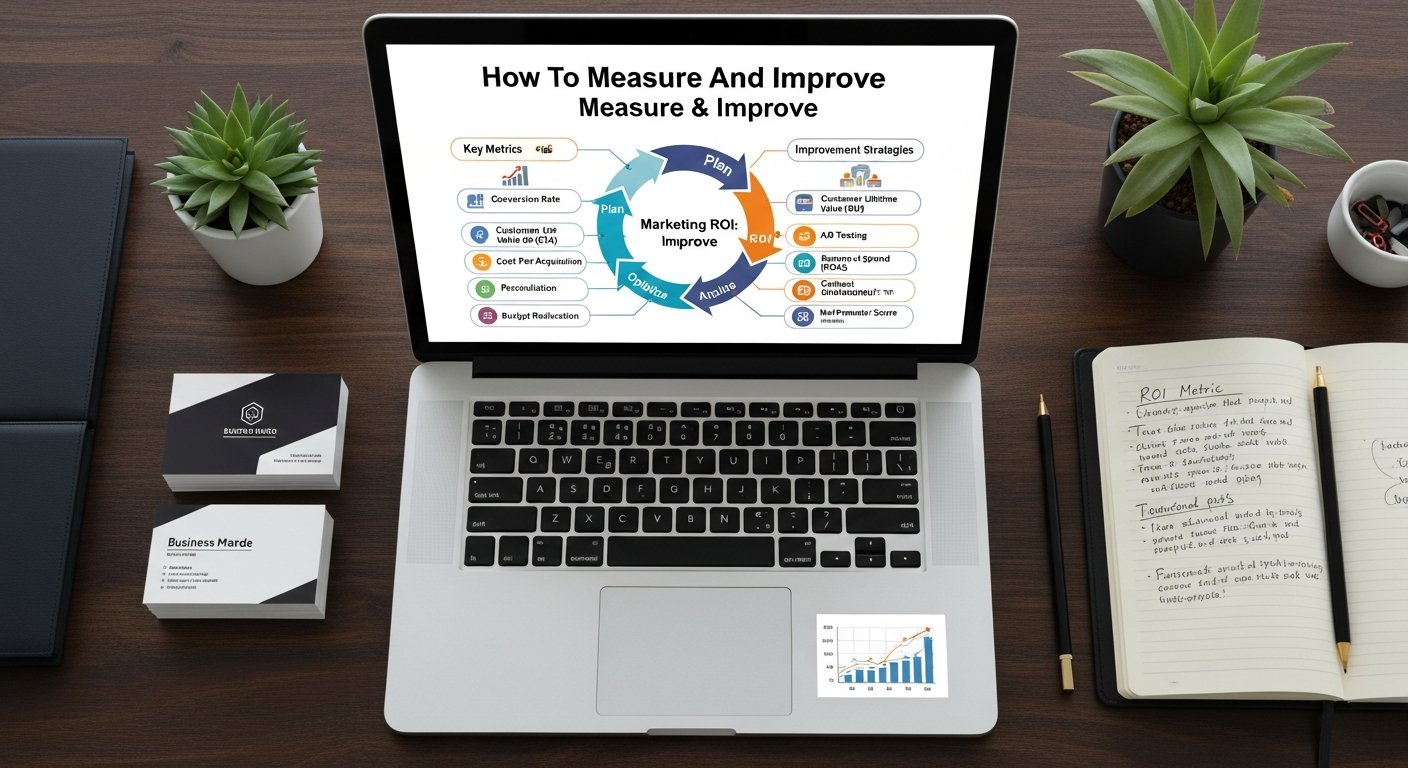
Measuring marketing ROI is only half the battle; the real value comes from using that data to drive improvements. Optimizing your marketing efforts to achieve a higher ROI is an ongoing process that requires continuous analysis, experimentation, and refinement. Here are key strategies B2B businesses can employ to boost their marketing ROI:
1. Refine Your Target Audience and Personalization
One of the most impactful ways to improve ROI is to ensure your marketing messages reach the right people. Invest in deep audience research to understand your ideal customer profiles (ICPs) and buyer personas. Leverage data analytics to segment your audience further and personalize your messaging, content, and offers. Highly relevant marketing is more likely to resonate, leading to higher engagement and conversion rates, thereby reducing wasted ad spend.
2. Optimize Your Marketing Channels
Not all channels are created equal for every business. Analyze the ROI of each marketing channel (e.g., email, social media, SEO, paid ads, content marketing, webinars). Reallocate budget from underperforming channels to those consistently delivering higher returns. For instance, if your LinkedIn campaigns consistently outperform display ads in terms of lead quality and conversion, shift more resources to LinkedIn. Continuously test new channels, but always with a clear measurement framework in place.
3. Enhance Content Strategy and Quality
High-quality, valuable content is the cornerstone of effective B2B marketing, especially for inbound strategies. Focus on creating content that addresses your audience’s pain points, answers their questions, and positions your business as a thought leader. Optimize your content for search engines (SEO) to increase organic visibility, which offers a cost-effective way to generate leads. Engaging content leads to longer website visits, more social shares, and better lead nurturing, all contributing to improved ROI. Regularly audit your existing content to refresh, repurpose, or remove underperforming assets.
4. Implement A/B Testing and Conversion Rate Optimization (CRO)
Small changes can lead to significant improvements in conversion rates. Continuously A/B test elements of your marketing campaigns, such as ad copy, landing page designs, call-to-action (CTA) buttons, email subject lines, and even website navigation. CRO isn’t just about tweaking; it’s about understanding user behavior and systematically removing friction points in the customer journey. Higher conversion rates mean more leads or sales from the same marketing spend, directly increasing ROI.
5. Streamline and Automate Processes
Manual, repetitive tasks can be a drain on resources and a hindrance to How To Improve Employee Productivity. Leverage marketing automation platforms to streamline tasks like email nurturing, lead scoring, social media scheduling, and data reporting. Automation frees up your marketing team to focus on strategic initiatives and creative endeavors that have a higher impact on ROI. Similarly, consider how What Is Business Process Outsourcing can handle non-core but essential marketing functions (e.g., data entry, content moderation, basic lead qualification), allowing your in-house experts to concentrate on high-value, ROI-driving activities.
6. Improve Lead Nurturing and Sales Alignment
In B2B, the sales cycle can be long and complex. Effective lead nurturing is critical for converting prospects into customers. Develop multi-touch nurturing campaigns that provide value at each stage of the buyer’s journey. Crucially, ensure tight alignment between your marketing and sales teams. Marketing should deliver high-quality, sales-ready leads, and sales should provide feedback on lead quality. This collaboration minimizes wasted effort and ensures that marketing efforts translate into closed deals, directly boosting ROI.
7. Leverage Retargeting and Upselling/Cross-selling
It’s often more cost-effective to market to existing customers or warm leads than to acquire completely new ones. Implement retargeting campaigns for website visitors who didn’t convert, reminding them of your value proposition. For existing customers, develop strategies for upselling and cross-selling relevant products or services. These tactics capitalize on established interest and trust, leading to higher conversion rates and lower CAC, thus significantly improving overall ROI.
By systematically applying these strategies, businesses can not only measure but actively sculpt their marketing efforts to deliver superior returns. The journey to improved ROI is continuous, requiring a commitment to data-driven decision-making and a willingness to adapt and innovate in response to performance insights.
Leveraging Technology and Data for Enhanced ROI
In the digital age, technology and data are no longer just tools; they are strategic assets that underpin every successful marketing ROI improvement initiative. The sheer volume of data generated by marketing activities, combined with advanced technological capabilities, offers unprecedented opportunities to understand customer behavior, optimize campaigns, and make truly data-driven decisions. Businesses that harness these capabilities effectively will gain a significant competitive edge well into 2026.
1. Robust CRM Systems and Marketing Automation Platforms
At the core of data-driven marketing are Customer Relationship Management (CRM) systems and marketing automation platforms. A well-implemented CRM (like Salesforce, HubSpot, or Zoho CRM) acts as the central repository for all customer data, tracking interactions across sales, marketing, and service. This unified view is essential for understanding the complete customer journey and attributing revenue accurately.
Marketing automation platforms (e.g., HubSpot, Marketo, Pardot) complement CRMs by automating repetitive marketing tasks, such as email nurturing, lead scoring, and social media posting. More importantly, they collect vast amounts of behavioral data, showing how prospects engage with your content, emails, and website. This data allows for hyper-segmentation and personalization, delivering the right message to the right person at the right time, which dramatically improves engagement and conversion rates, leading to higher ROI.
2. Advanced Analytics and Business Intelligence Tools
Beyond basic website analytics (Google Analytics), advanced analytics and business intelligence (BI) tools are crucial for deeper insights. These platforms (e.g., Tableau, Power BI, Looker) can pull data from disparate sources – CRM, marketing automation, ad platforms, social media, sales data – and synthesize it into actionable dashboards and reports. They allow marketers to:
- Identify trends and patterns that might be missed in raw data.
- Perform multi-touch attribution modeling with greater sophistication.
- Segment customers based on behavior, demographics, and value.
- Forecast future performance and optimize budget allocation.
These tools transform raw data into intelligence, enabling marketers to move beyond descriptive analytics (“what happened?”) to predictive (“what will happen?”) and prescriptive (“what should we do?”).
3. Artificial Intelligence (AI) and Machine Learning (ML)
AI and ML are revolutionizing marketing ROI by bringing unparalleled efficiency and predictive power. Their applications include:
- Predictive Analytics: AI can predict which leads are most likely to convert, allowing sales and marketing teams to prioritize their efforts on high-value prospects.
- Content Personalization: AI algorithms can analyze user behavior and preferences to dynamically serve personalized content recommendations, improving engagement and conversion.
- Chatbots and Virtual Assistants: AI-powered chatbots can handle routine inquiries, qualify leads, and provide instant support 24/7, improving customer experience and freeing up human resources.
- Ad Optimization: ML algorithms can optimize ad bidding, targeting, and creative selection in real-time across various platforms, maximizing ROAS by identifying the most effective combinations.
- Sentiment Analysis: AI can analyze customer feedback and social media mentions to gauge brand sentiment, providing early warnings about potential issues and opportunities for engagement.
By automating optimization and providing deeper insights, AI/ML tools empower marketers to make faster, more informed decisions that directly impact ROI.
4. Integrating Inbound Marketing Vs Outbound Marketing Data
Many B2B companies employ a hybrid approach, utilizing both inbound (content marketing, SEO, social media) and outbound (cold email, telemarketing, paid ads) strategies. A key technological challenge and opportunity lies in integrating the data from these diverse approaches. A unified platform or a robust BI solution can combine inbound lead data with outbound campaign performance, providing a holistic view of the customer journey. This integration helps in understanding how these strategies complement each other and which combination yields the highest ROI. For example, an outbound cold email might direct a prospect to an inbound blog post, which then converts into a lead through a form. Without integrated data, attributing the full value of this journey would be impossible.
Ultimately, leveraging technology and data effectively means creating a cohesive ecosystem where information flows freely, insights are readily available, and marketing actions are continuously optimized. This technological backbone is essential for businesses aiming to not just measure, but significantly enhance their marketing ROI in an increasingly data-driven world.
Overcoming Common Challenges in ROI Measurement
While the benefits of measuring and improving marketing ROI are clear, the process is rarely without its hurdles. B2B businesses, with their often complex sales cycles and diverse marketing landscapes, face specific challenges that can complicate accurate ROI calculation. Recognizing these obstacles and developing strategies to overcome them is crucial for success.
1. Attribution Complexity in Long Sales Cycles
One of the most significant challenges in B2B marketing is the long and multi-touch sales cycle. A customer might interact with dozens of marketing touchpoints—a blog post, a webinar, an email, a social media ad, a whitepaper download, and a sales call—before making a purchase. Deciding which of these touchpoints deserves credit for the conversion is the core of the attribution challenge. As discussed, single-touch attribution models (first-touch or last-touch) often oversimplify this journey, potentially miscrediting or undercrediting valuable interactions.
Solution: Implement multi-touch attribution models. While more complex to set up, models like linear, time decay, or custom weighted models provide a more nuanced view of the customer journey. Invest in advanced analytics platforms and ensure your CRM and marketing automation tools are integrated to capture all touchpoints. Educate your team on the chosen attribution model to ensure consistent interpretation of data.
2. Data Silos and Inconsistent Tracking
Many organizations suffer from fragmented data. Marketing data resides in one system (e.g., a marketing automation platform), sales data in another (CRM), and website analytics in a third. These “data silos” prevent a holistic view of the customer journey and make it difficult to connect marketing efforts directly to revenue outcomes. Inconsistent tracking across different campaigns or channels further compounds this issue, making comparative analysis challenging.
Solution: Prioritize data integration. Invest in a robust data warehouse or a comprehensive analytics platform that can pull data from all your marketing and sales tools into a single, unified view. Establish clear data governance policies and standardized tracking protocols across all campaigns. This ensures that data is collected consistently and is readily accessible for analysis, which in turn helps How To Improve Employee Productivity by reducing time spent on data reconciliation and increasing focus on analysis.
3. Difficulty in Quantifying Brand Building and Awareness
Not all marketing efforts directly lead to immediate sales. Brand building, thought leadership, and awareness campaigns are crucial for long-term growth but are notoriously difficult to quantify in terms of immediate financial ROI. These activities build trust and recognition, which indirectly contribute to future sales but don’t show up in a direct ROI calculation.
Solution: While direct financial ROI can be elusive, proxy metrics can be used. Track brand awareness KPIs like website traffic (direct and organic), social media mentions and engagement, brand search volume, media mentions, and survey-based brand recall. While these don’t directly show monetary return, they indicate increased brand equity, which is a precursor to future revenue. Over time, correlate these metrics with overall sales growth to demonstrate their long-term impact.
4. Lack of Alignment Between Marketing and Sales
A common friction point in B2B is the disconnect between marketing and sales. Marketing might generate leads that sales deem unqualified, or sales might not follow up effectively on marketing-qualified leads (MQLs). This misalignment leads to wasted marketing efforts and lost revenue opportunities, making accurate ROI measurement difficult as accountability becomes blurred.
Solution: Foster strong “Smarketing” alignment. Establish shared goals, common definitions for leads (e.g., MQLs, SQLs), and a unified view of the customer journey. Implement service-level agreements (SLAs) between marketing and sales. Regular communication and joint reviews of the sales pipeline and marketing performance are essential. When both teams work from the same data and toward the same revenue targets, the path from marketing investment to revenue generation becomes clearer, and ROI improves.
5. Budget Constraints and Resource Limitations
Smaller B2B businesses or those with tight budgets might struggle to invest in the advanced tools and dedicated personnel required for sophisticated ROI measurement and optimization. This can lead to reliance on basic metrics or a lack of deep analytical insight.
Solution: Start small and scale up. Even with limited resources, prioritize tracking core metrics (CAC, CLTV) and use free tools like Google Analytics. Focus on incremental improvements. Consider What Is Business Process Outsourcing for specialized analytical tasks or data entry to free up internal resources. As ROI improves, advocate for increased budget to invest in more advanced tools and expertise. The goal is to demonstrate value with existing resources to justify future investment.
By proactively addressing these common challenges, B2B businesses can build a more robust and reliable framework for measuring and improving their marketing ROI, ensuring that every marketing dollar contributes effectively to their bottom line and sets them up for success in 2026 and beyond.
Frequently Asked Questions
Recommended Resources
Explore How To Use Linkedin For Marketing for additional insights.
You might also enjoy Ecommerce Conversion Rate Optimization Guide from E-ComProfits.