What Exactly is a Service Level Agreement?
A Service Level Agreement (SLA) is a contractual document that formally defines the level of service expected from a service provider by a customer. It is a critical component of any service contract, whether between internal departments, an organization and its vendors, or a business and its clients. Fundamentally, an SLA sets clear expectations, establishes measurable metrics, and outlines the responsibilities of both parties involved, thereby minimizing disputes and ensuring a consistent quality of service delivery.
The primary purpose of an SLA is to create a shared understanding of services, priorities, and responsibilities. Without an SLA, service expectations can be ambiguous, leading to misunderstandings, dissatisfaction, and potential financial or reputational damage. It acts as a benchmark against which service performance can be measured and provides a framework for addressing deviations from agreed-upon standards.
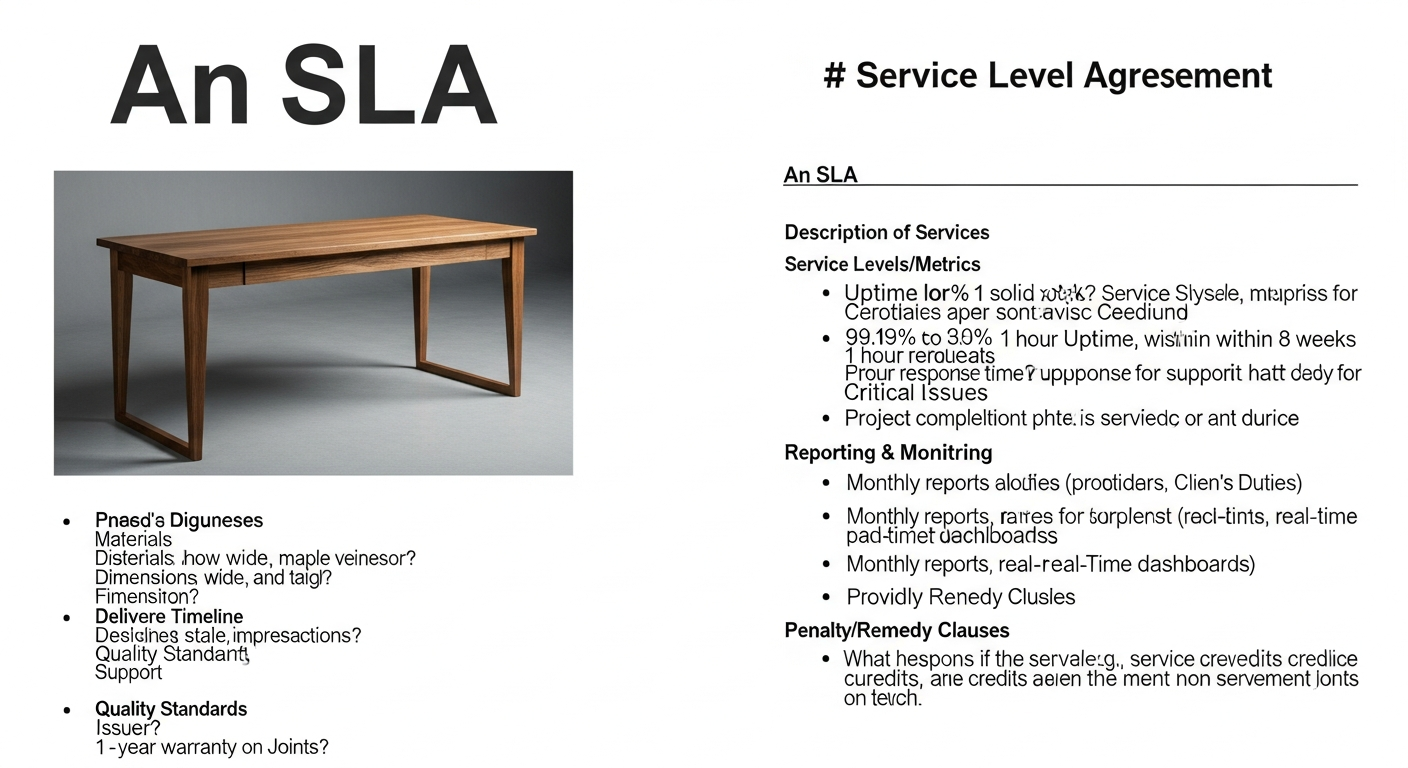
Typically, an SLA will detail:
- The services to be provided: A precise description of what the service entails.
- Service availability: Uptime guarantees, maintenance windows, and hours of operation.
- Performance metrics: Key performance indicators (KPIs) such as response times, resolution times, and error rates.
- Responsibilities of each party: What the service provider is committed to and what the customer must do to facilitate service delivery.
- Escalation procedures: The process for addressing issues that fall outside agreed service levels.
- Penalties or remedies: Consequences for failing to meet the agreed-upon service levels, which might include service credits or financial penalties.
While often associated with IT services—such as cloud computing, network uptime, or help desk support—SLAs are far more pervasive. They are integral to any B2B relationship where one party provides a service to another, from marketing agencies delivering campaigns to logistics companies managing supply chains, and even internal departments providing support functions to other divisions within the same organization. In essence, an SLA translates abstract service expectations into concrete, actionable, and measurable terms, forming the contractual backbone of service provision.
The Critical Components of an Effective SLA
An effective Service Level Agreement is far more than a simple checklist; it is a meticulously crafted document designed to cover every foreseeable aspect of a service relationship. Its robustness directly correlates with its ability to prevent disputes, ensure accountability, and promote a healthy, productive partnership. Here are the critical components that every comprehensive SLA should include:
1. Service Scope and Description
This foundational element clearly articulates the specific services being provided. It should leave no room for ambiguity, detailing what is included and, equally important, what is excluded. For example, if an IT service provider is managing servers, the scope might specify which servers, what level of monitoring, and what type of maintenance. Precision here prevents scope creep and ensures both parties have a mutual understanding of the deliverables.
2. Performance Metrics and Key Performance Indicators (KPIs)
This is where the agreement gets measurable. SLAs must define specific, quantifiable metrics against which service performance will be judged. Common KPIs include:
- Uptime/Availability: The percentage of time a service or system is operational and accessible.
- Response Time: The duration between a service request or incident report and the service provider’s initial acknowledgment.
- Resolution Time: The time taken to fully resolve an issue or complete a service request.
- Error Rate: The acceptable percentage of errors or defects in a service.
- Throughput: The volume of work processed within a given timeframe.
These metrics must be SMART: Specific, Measurable, Achievable, Relevant, and Time-bound. Vague targets like “fast response” are useless; “respond to critical incidents within 30 minutes, 99% of the time” is an effective metric.
3. Responsibilities of Both Parties
An SLA is a two-way street. While it primarily outlines the service provider’s commitments, it must also detail the customer’s obligations. This might include providing necessary access, furnishing accurate information, adhering to specific usage policies, or making timely payments. Clearly defining these responsibilities ensures that both parties understand their role in achieving the agreed-upon service levels.
4. Service Availability and Uptime Guarantees
For many digital services, this is paramount. The SLA specifies the guaranteed availability of a service (e.g., 99.9% uptime), acceptable maintenance windows, and procedures for planned outages. It also clarifies what constitutes an “outage” and how downtime is measured.
5. Escalation Procedures
When service levels are not met, or critical issues arise, a clear escalation path is essential. This section outlines who should be contacted, in what order, and through which channels (email, phone, dedicated portal) when a problem occurs. It ensures that issues are addressed promptly and by the appropriate personnel, preventing minor problems from becoming major crises.
6. Reporting and Review Mechanisms
Transparency is key to a successful long-term relationship. The SLA should specify how service performance will be reported (e.g., monthly reports, real-time dashboards), the frequency of these reports, and the metrics that will be included. It should also define a schedule for regular reviews of the SLA itself, allowing for adjustments as business needs evolve, perhaps annually or bi-annually, to ensure its continued relevance through 2026 and beyond.
7. Penalties and Remedies for Non-Compliance
What happens if the service provider fails to meet the agreed-upon service levels? This section defines the consequences, which often include service credits, financial penalties, or opportunities for the customer to terminate the agreement under specific conditions. These remedies incentivize the service provider to maintain high standards and offer recourse to the customer in case of failure.
8. Termination Clause
While ideally, an SLA fosters a lasting partnership, it must also include conditions under which either party can terminate the agreement. This covers situations such as repeated breaches of the SLA, bankruptcy, or a significant change in business circumstances, providing an exit strategy for both sides.
By meticulously crafting each of these components, businesses can establish robust SLAs that serve as living documents, guiding interactions and ensuring that service delivery consistently aligns with expectations.
Why SLAs Matter: The Unseen Backbone of Business Relationships
1. Clarity and Expectation Management
Perhaps the most immediate benefit of an SLA is its ability to eliminate ambiguity. By explicitly detailing the scope of services, performance targets, and responsibilities, both parties gain a crystal-clear understanding of what is expected. This prevents assumptions, reduces misunderstandings, and ensures that everyone is working towards a shared definition of success. Without an SLA, expectations can diverge significantly, leading to frustration and conflict.
2. Accountability and Performance Measurement
An SLA transforms abstract service promises into measurable commitments. With defined KPIs and reporting mechanisms, service providers are held accountable for their performance. This fosters a culture of reliability and continuous improvement, as there’s a clear benchmark against which their service delivery is judged. For the customer, it provides the necessary tools to objectively evaluate the provider’s performance and ensure they are receiving the value they pay for.
3. Risk Mitigation
In today’s interconnected business world, relying on external partners is common practice. When a company engages in Business Process Outsourcing (BPO), for instance, the SLA becomes the bedrock of that partnership. It explicitly outlines recovery times for critical systems, data security protocols, and operational continuity plans, significantly mitigating the risks associated with entrusting core functions to a third party. A robust SLA acts as an insurance policy, safeguarding against service disruptions, data breaches, and financial losses by outlining predefined responses and remedies.
4. Improved Communication
SLAs establish formal communication channels and reporting frequencies, ensuring that performance is regularly reviewed and discussed. This structured dialogue facilitates proactive problem-solving, allows for timely adjustments, and strengthens the overall relationship. Instead of reactive crisis management, communication becomes a strategic tool for maintaining service excellence.
5. Legal Protection and Dispute Resolution
In unfortunate circumstances where disputes arise, the SLA serves as a legally binding document that can be referenced to resolve disagreements. It provides a clear framework for mediation, arbitration, or litigation if necessary, protecting the interests of both the service provider and the customer. The predefined penalties and remedies also offer a path for recourse, preventing protracted legal battles and providing a basis for compensation for service failures.
6. Ensuring Business Continuity and Strategic Alignment
For critical services, an SLA is vital for ensuring business continuity. It guarantees that essential functions will be performed to a specified standard, preventing disruptions that could impact a company’s ability to operate, serve its customers, or generate revenue. Furthermore, by aligning service levels with strategic business objectives, an SLA helps ensure that outsourced or external services directly contribute to the organization’s overarching goals, making them not just operational necessities but strategic assets. This is particularly crucial for smaller businesses where any disruption can have a disproportionately large impact.
In essence, an SLA is not just paperwork; it is a living document that underpins successful B2B collaborations, drives performance, manages risk, and fosters the trust necessary for long-term growth and stability. Its importance will only continue to grow as businesses increasingly rely on a diverse ecosystem of specialized service providers well into 2026 and beyond.
Different Types of Service Level Agreements and Their Applications
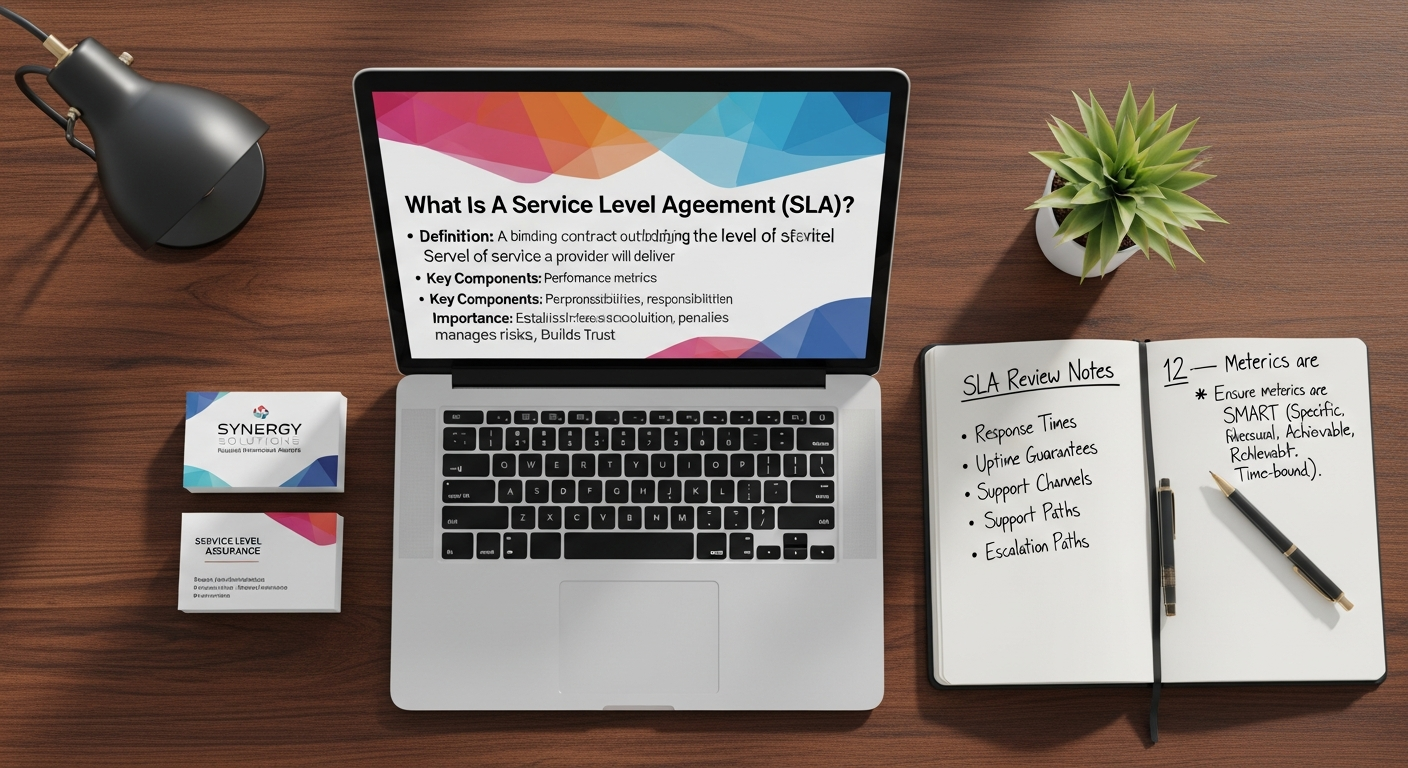
While the core concept of an SLA remains consistent—defining service expectations and responsibilities—the specific application and structure can vary significantly depending on the relationship and the services being provided. Understanding these different types is crucial for tailoring an SLA that perfectly fits the business context.
1. Customer-Based SLA
A customer-based SLA is tailored to a specific customer or customer group, encompassing all the services they consume from a particular provider. Regardless of the diverse range of services offered, this type of SLA consolidates all relevant service levels into a single document for that one client. For example, a large enterprise might have a customer-based SLA with an IT provider that covers their entire suite of services, from network management and helpdesk support to cloud hosting and cybersecurity, all under one agreement specific to their operational needs and existing infrastructure.
Application: Ideal for clients who purchase a broad range of services and prefer a single, overarching agreement that simplifies management and provides a holistic view of service commitments.
2. Service-Based SLA
In contrast, a service-based SLA defines the service levels for a specific service offered to all customers who use that particular service. This means that every customer receiving that exact service will be subject to the same SLA. For instance, a telecommunications company might have a service-based SLA for its internet broadband package, detailing uptime, speed, and support response times that apply uniformly to every subscriber of that package. Similarly, a Software-as-a-Service (SaaS) provider will typically have a service-based SLA for its platform, guaranteeing certain levels of availability and performance to all its users.
Application: Best for providers offering standardized services to a large customer base, ensuring consistency and simplified administration across many clients using the same service.
3. Multi-Level SLA
A multi-level SLA is a sophisticated approach that segments the SLA into different levels, addressing various groups within an organization or different aspects of a service. This type is particularly useful in large organizations with complex structures or when a service involves multiple internal and external parties.
- Corporate Level: Covers general service level management issues applicable to all customers across the organization. These are broad, overarching principles.
- Customer Level: Addresses specific service issues relevant to a particular customer group or department. For example, the finance department might have different requirements for system availability than the marketing department.
- Service Level: Focuses on specific services within the customer group, providing detailed metrics for each.
Application: Highly effective for large enterprises or government agencies with diverse internal departments and complex service requirements, allowing for granular control and tailored agreements where necessary.
4. Vendor/Supplier SLA
This type of SLA is critical when a business relies on third-party vendors or suppliers for components of its operations. A vendor SLA defines the expected performance and quality from external providers. For a small business navigating the complexities of supply chain management, robust SLAs with suppliers are not just beneficial; they are essential for maintaining operational continuity and delivering on customer promises. These SLAs might cover delivery times, product quality standards, inventory levels, and even ethical sourcing requirements.
Application: Indispensable for managing relationships with external parties, ensuring the quality and reliability of outsourced components or services, and mitigating risks within the supply chain. This is especially vital for ensuring that your partners meet the same high standards you promise your own customers.
5. Internal SLA
Often overlooked, internal SLAs are agreements between different departments or teams within the same organization. For example, an IT department might have an internal SLA with the sales department outlining the expected response times for technical support issues or the availability of specific applications. These agreements ensure that internal dependencies are managed effectively, promoting efficiency and preventing internal bottlenecks that could impact external customer service. While not legally binding in the same way as external SLAs, they foster accountability and structure within the organization.
Application: Enhances inter-departmental cooperation, streamlines internal processes, and ensures that internal support functions contribute effectively to the overall business objectives.
By understanding these different types, businesses can strategically apply the right SLA structure to each relationship, ensuring clarity, accountability, and ultimately, the successful delivery of services across their entire operational landscape.
Crafting a Robust SLA: Best Practices for Businesses
Developing an effective Service Level Agreement requires careful planning, collaboration, and a forward-thinking approach. A poorly constructed SLA can be as detrimental as having no agreement at all. To ensure your SLAs serve as powerful tools for success, consider these best practices:
1. Define Clear, Measurable, and Achievable Objectives
The cornerstone of any good SLA is clarity. Avoid vague language and subjective terms. Every service level, metric, and responsibility must be specific, measurable, achievable, relevant, and time-bound (SMART). Instead of “fast response time,” specify “initial response to critical incidents within 15 minutes, 95% of the time.” Ensure that the targets are realistic for both the service provider to deliver and the customer to understand.
2. Involve All Stakeholders
SLAs should not be drafted in a vacuum. Key representatives from both the service provider (e.g., operations, technical, sales) and the customer (e.g., business users, procurement, legal) should be involved in the creation process. This collaborative approach ensures that all perspectives are considered, expectations are aligned, and the agreement is practical and comprehensive. It also fosters a sense of ownership and commitment from all parties.
3. Focus on Outcomes, Not Just Inputs
While process metrics (inputs) are important, an effective SLA should primarily focus on the business outcomes that matter to the customer. For example, instead of just measuring “server uptime,” also consider “application availability” or “transaction completion rates,” which directly impact the customer’s ability to conduct business. Link service levels to tangible business benefits where possible.
4. Establish Fair and Transparent Penalties/Remedies
The consequences for failing to meet service levels should be clearly defined and equitable. Penalties, such as service credits, should be proportionate to the impact of the service failure. Crucially, the process for claiming and applying these remedies must be transparent and straightforward. This builds trust and ensures that the SLA serves as a genuine incentive for performance, not just a punitive measure.
5. Implement Robust Reporting and Monitoring
An SLA is only useful if its adherence can be consistently monitored and reported. Define the exact methods for tracking performance metrics, the frequency of reports (e.g., weekly, monthly, quarterly), and the format in which they will be delivered. Consider automated monitoring tools that provide real-time dashboards to both parties, enhancing transparency and facilitating proactive management.
6. Schedule Regular Review and Update Cycles
Business environments are dynamic. Technology evolves, customer needs change, and market conditions shift. An SLA should not be a static document. Establish a regular review cycle (e.g., annually, bi-annually) to assess its continued relevance and effectiveness. This allows for adjustments to metrics, services, and responsibilities to ensure the SLA remains aligned with evolving business objectives and technological advancements, preparing for the landscape of 2026 and beyond.
7. Include an Escalation Procedure
Despite the best intentions, issues will inevitably arise. A clear, well-defined escalation path is crucial. This section should detail who to contact for different types of issues, the order of escalation (e.g., first-line support, team lead, manager, executive), and the expected response times at each level. This ensures that problems are addressed promptly and effectively, preventing them from escalating into major conflicts.
8. Seek Legal Review
Given the contractual nature and potential legal implications, always have the SLA reviewed by legal counsel before finalization. Legal experts can ensure that the agreement is compliant with relevant laws and regulations, that all clauses are enforceable, and that both parties’ interests are adequately protected.
By adhering to these best practices, businesses can move beyond basic contractual obligations to create SLAs that genuinely foster successful, long-term partnerships, driving mutual growth and operational excellence.
SLAs in the Modern Business Landscape: Beyond Traditional IT
While Service Level Agreements originated largely within the realm of information technology, their utility and necessity have expanded dramatically across virtually every sector of the modern business landscape. Today, SLAs are crucial for managing expectations and performance in a diverse range of B2B services, extending far beyond network uptime and helpdesk tickets.
SaaS and Cloud Services
The proliferation of Software-as-a-Service (SaaS) and cloud computing has made SLAs more critical than ever. When businesses rely on third-party vendors for their core applications, data storage, and infrastructure, the SLA is the primary document guaranteeing availability, data security, performance, and disaster recovery. Cloud SLAs often include specifics on data residency, compliance certifications (e.g., GDPR, HIPAA), and the process for data retrieval upon contract termination. A robust cloud SLA ensures that essential business functions remain operational and secure, even when hosted externally.
Business Process Outsourcing (BPO)
As mentioned earlier, BPO relies heavily on SLAs. When companies outsource functions like customer service, finance and accounting, human resources, or IT support, the SLA defines the specific performance metrics, quality standards, and operational parameters for these outsourced processes. For instance, a customer service BPO SLA might specify average handle time, first-call resolution rates, customer satisfaction scores (CSAT), and agent availability. These agreements ensure that the outsourced processes integrate seamlessly with the client’s operations and meet their strategic objectives, providing a measurable framework for the successful delivery of critical business functions.
Marketing Agencies
Marketing is increasingly a service-driven industry, and SLAs are becoming standard for agency-client relationships. Whether a marketing agency specializes in inbound marketing strategies like content creation, SEO, and social media management, or outbound marketing such as direct mail and telemarketing, an SLA defines the expected deliverables, campaign performance metrics, and reporting frequencies. For inbound, it might specify website traffic growth, lead generation targets, or conversion rates. For outbound, it could detail call volumes, response rates, or cost-per-acquisition. An SLA ensures transparency and accountability for the investment made in marketing services.
Logistics and Supply Chain
In the complex world of logistics and supply chain management, SLAs are vital for coordinating activities among multiple partners. For a small business navigating the complexities of supply chain management, an SLA with a warehousing provider might specify inventory accuracy, order fulfillment rates, and turnaround times for shipping. With transportation carriers, it could outline on-time delivery percentages, damage rates, and temperature control requirements. These agreements ensure that goods move efficiently and reliably from production to the end customer, minimizing delays and disruptions that can be particularly damaging to smaller operations.
Customer Service and Support
Beyond BPO, any company providing direct customer service can benefit from internal or external SLAs. An internal SLA for a customer support team might define targets for ticket resolution times, customer satisfaction scores, or adherence to scripting for different service tiers. Externally, an SLA might guarantee specific response times for premium support subscribers. These agreements are instrumental in maintaining high standards of customer experience and fostering loyalty.
The expansion of SLAs into these diverse areas underscores their fundamental role in modern business: providing structure, accountability, and clarity wherever services are exchanged. As businesses continue to specialize and rely on a network of partners, the meticulous crafting and management of SLAs will remain a cornerstone of successful B2B collaboration, influencing operations and strategic decisions through 2026 and well into the future.
The Future of SLAs: Adaptation and Agility
As the business world continues its rapid evolution, driven by technological advancements, shifting market dynamics, and increasing customer expectations, the Service Level Agreement is also adapting. The future of SLAs will be characterized by greater dynamism, intelligence, and a heightened focus on adaptability and measurable business impact, moving beyond static documents to become living, breathing components of strategic partnerships.
Dynamic and Flexible SLAs
Traditional SLAs, once negotiated and signed, often remain largely unchanged for the duration of a contract. However, the agility demanded by today’s markets necessitates more flexible agreements. Future SLAs will likely incorporate mechanisms for more frequent, perhaps even automated, adjustments to service levels based on real-time business needs, seasonal fluctuations, or changes in technology. This could involve tiered service levels that automatically scale based on usage or demand, ensuring that the agreement remains relevant and responsive to evolving operational realities for all parties through 2026 and beyond.
AI and Automation in Monitoring and Reporting
The manual monitoring and reporting of SLA metrics can be time-consuming and prone to human error. The future will see a greater integration of Artificial Intelligence (AI) and automation tools for continuous, real-time SLA monitoring. AI-powered platforms will not only track performance against KPIs but also predict potential breaches, identify root causes of service failures, and even suggest proactive interventions. This shift will enable faster issue resolution, enhance transparency, and free up human resources to focus on strategic improvements rather than manual data collection.
Focus on Business Outcomes and Value-Based SLAs
While current SLAs often focus on technical metrics (e.g., uptime, response time), the future will see a stronger emphasis on business outcomes. Value-based SLAs will tie service provider compensation and penalties directly to the achievement of specific business results for the customer, such as revenue growth, customer retention rates, or cost savings. This shifts the focus from merely delivering a service to actively contributing to the client’s strategic success, fostering deeper partnerships and aligning incentives more closely.
Blockchain for Enhanced Trust and Transparency
Blockchain technology holds significant promise for the future of SLAs. Smart contracts, built on blockchain, could automatically execute actions (like issuing service credits) when predefined conditions (like an SLA breach) are met, without human intervention. This would introduce an unprecedented level of trust, transparency, and immutability to SLA enforcement, reducing disputes and ensuring fair and immediate recourse when service levels are not met.
Customer Experience (CX) and Employee Experience (EX) Metrics
Beyond technical performance, future SLAs will increasingly incorporate metrics related to Customer Experience (CX) and Employee Experience (EX). For customer-facing services, this might include Net Promoter Score (NPS), Customer Effort Score (CES), or specific feedback mechanisms. For internal services, it could involve employee satisfaction with IT support or HR services. This holistic approach recognizes that the quality of service delivery has a profound impact on human-centric outcomes, which are critical for overall business success.
The evolution of SLAs reflects the broader trend towards more agile, data-driven, and outcome-oriented business relationships. As businesses navigate increasingly complex and dynamic environments, the SLA will continue to adapt, serving as a vital tool for ensuring performance, managing risk, and fostering collaborative growth in the digital age.
Frequently Asked Questions
Recommended Resources
For more on what is a, see 50 30 20 Budget Rule Guide on Fin3go.
Explore Influencer Marketing Strategy Guide for additional insights.
SLA, SLO, and SLI: The Complete Framework
SLI, SLO, and SLA: The Layered Hierarchy
The SLA ecosystem operates on three nested levels — a framework popularized by Google’s Site Reliability Engineering (SRE) book (Beyer, Jones, Petoff, Murphy, 2016):
- SLI (Service Level Indicator) — The actual measurement. A quantitative metric that reflects the service’s real-world performance. Examples: request success rate (non-5xx responses / total requests), latency (proportion of requests completed in <200ms), availability (uptime minutes / total minutes in period). SLIs are the raw data that SLOs and SLAs are based on.
- SLO (Service Level Objective) — The internal target. The desired value or range for an SLI, set by the engineering/operations team. SLOs are typically stricter than SLAs — if the SLA guarantees 99.9% availability, the SLO might be set at 99.95% to create a buffer. SLOs are operational targets, not contractual commitments.
- SLA (Service Level Agreement) — The contractual commitment. The formal agreement between provider and customer, specifying the SLI target (derived from SLOs) and the consequences (service credits, remedies) if the target is not met. The SLA is the customer-facing document; the SLO is the internal engineering target.
Practical example (cloud database service): SLI = measured availability percentage this month; SLO = internal target of 99.95% monthly availability; SLA = contractual commitment of 99.9% availability, with 10% service credit if violated.
Error Budget
The error budget is the permissible amount of unreliability within an SLO period — popularized by Google SRE and now standard in DevOps/SRE practice. If the SLO is 99.9% availability per month (30-day month = 43,200 minutes total), the error budget is 0.1% × 43,200 = 43.2 minutes of allowed downtime per month. When the error budget is healthy (plenty remaining), engineering teams can release new features rapidly. When the error budget is nearly exhausted, releases are paused to prioritize reliability. Error budgets align product velocity with reliability commitments and make SLA compliance a shared responsibility between engineering and business teams.
Reliability Metrics: MTTF, MTTR, and MTTD
- MTTF (Mean Time to Failure) — Average time a system or component operates before it fails. MTTF = Total operating time / Number of failures. Used for hardware components and systems that are replaced (not repaired) on failure. Higher MTTF = more reliable system.
- MTTD (Mean Time to Detect) — Average time between a failure occurring and the operations team detecting/being alerted to it. Modern APM tools (Datadog, Dynatrace, New Relic) reduce MTTD from hours to seconds through automated alerting. Unmeasured MTTD is a hidden reliability risk — failures begin causing user impact long before humans notice without automated monitoring.
- MTTR (Mean Time to Repair/Restore) — Average time to restore service after a failure is detected. MTTR encompasses time to diagnose, fix, and verify restoration. High MTTR indicates insufficient runbooks, poor observability, or complex system dependencies. Target for critical services: MTTR <15 minutes for P1 incidents; <4 hours for P2. Many SLAs implicitly tie to MTTR through their resolution time commitments.
IT Service Management Standards: ITIL 4 and ISO/IEC 20000
- ITIL 4 SLA Framework: ITIL (Information Technology Infrastructure Library) v4 defines SLAs within its Service Level Management practice. ITIL 4 recommends a shift from traditional “watermelon SLAs” (green on the outside, red on the inside — metrics technically met but customer dissatisfied) to XLAs (Experience Level Agreements) that measure actual user experience rather than infrastructure metrics. ITIL 4 also introduces OLAs and Underpinning Contracts as supporting agreements:
- OLA (Operational Level Agreement): An internal agreement between IT groups that support the delivery of the external-facing SLA. Example: the network team commits to resolving network issues within 1 hour (OLA) to enable the helpdesk to meet its 4-hour SLA with the business.
- UC (Underpinning Contract): A legally binding contract with an external supplier (e.g., a data center provider or telecom carrier) that underpins the IT department’s ability to deliver its SLA. If the UC fails (e.g., carrier downtime), it cascades to SLA failure.
- ISO/IEC 20000-1:2018 (IT Service Management Standard): The international standard for IT service management systems — defines requirements for an ITSM system including SLA definition, service level management processes, and continual improvement. ISO/IEC 20000 certification is frequently required for government IT contracts and enterprise B2B supplier qualification. Often paired with ISO/IEC 27001 (information security). Over 10,000 organizations globally certified.
Cloud Provider SLA Examples
Understanding how major cloud providers structure their SLAs helps in crafting equivalent agreements for your own services:
- Amazon Web Services (AWS): AWS offers service-specific SLAs. EC2 SLA: 99.99% monthly uptime (= 52.6 minutes allowed downtime/month). AWS Lambda: 99.95%. AWS RDS Multi-AZ: 99.95%. If availability falls below the threshold: 10% service credit for 99.0-99.95% availability, 25% credit for 95.0-99.0%. AWS defines “monthly uptime percentage” based on error rates (not just binary up/down).
- Microsoft Azure: Azure SQL Database (General Purpose): 99.99% SLA. Azure Kubernetes Service (AKS, with Availability Zones): 99.95%. Azure Virtual Machines with Premium SSD: 99.9% single-instance, 99.99% availability sets. Service credits: 10-25% depending on downtime threshold breached.
- Google Cloud Platform (GCP): GKE (Google Kubernetes Engine) Zonal: 99.5%; Regional (multi-zone): 99.95%. Cloud SQL: 99.95%. These SLAs are contractually documented in GCP’s Service Level Agreement documentation and form the baseline for any application SLA built on GCP infrastructure.
SLA Monitoring Tools
Monitoring SLA compliance requires purpose-built tooling:
- ServiceNow — The leading enterprise ITSM platform includes native SLA management: automatic SLA timers triggered on incident/change tickets, breach warning notifications (typically at 50%, 75%, 100% of SLA clock), SLA breach reporting, and dashboards. ServiceNow’s SLA Management module allows defining multiple concurrent SLAs on the same ticket with different conditions. Used by 85% of Fortune 500 companies.
- Datadog — Infrastructure and APM monitoring platform with SLO tracking: define SLOs directly in Datadog based on any metric or monitor. Real-time error budget burn rate alerts (e.g., “error budget will be exhausted in 6 hours at current rate”). Integrates with PagerDuty for on-call alerting when SLI drops below SLO. 27,000+ customers.
- PagerDuty — On-call and incident management platform — when a Datadog/New Relic alert fires, PagerDuty routes to the correct on-call engineer based on escalation policies, reducing MTTD and MTTR. PagerDuty’s Analytics module tracks MTTD, MTTR, and incident frequency trends against SLA targets.
- Zendesk — Customer support platform with built-in SLA management: ticket SLA policies define response time and resolution time targets by ticket priority. Automatic escalation when SLA breach is approaching. Zendesk SLA reporting shows compliance rates, breach counts, and average resolution times. Standard for SMB and mid-market customer service SLAs.
- Freshservice (Freshworks) — ITSM platform with ITIL-aligned SLA management. SLA policies can be configured by ticket category, priority, and customer segment. Auto-escalation and SLA breach notifications. Particularly popular in mid-market as a more affordable ServiceNow alternative.
Service Credit Calculation: Worked Example
Most cloud and SaaS SLAs use a tiered service credit structure based on the degree of SLA breach:
Example SLA: 99.9% monthly availability commitment (= 43.8 minutes allowed downtime in a 30-day month).
Service credit tiers (illustrative):
- Availability 99.0% – 99.9%: 10% service credit on monthly fee
- Availability 95.0% – 99.0%: 25% service credit
- Availability <95.0%: 50% service credit
Worked calculation: If a $10,000/month service had 3 hours of downtime in a 30-day month:
- Actual availability = (43,200 – 180) / 43,200 = 99.583% (within 99.0-99.9% tier)
- Service credit = 10% × $10,000 = $1,000
Critical SLA drafting note: define “downtime” precisely. AWS defines it as error rate above threshold (not binary up/down), which is far more favorable than simple binary availability. “Scheduled maintenance windows” are typically excluded from downtime calculations — specify maintenance window rules explicitly to avoid credit disputes.
SLI Measurement: Prometheus, Grafana & OpenTelemetry
Prometheus: The de facto open-source monitoring system for cloud-native infrastructure — time-series database with pull-based metrics collection, PromQL query language, and native Kubernetes integration. CNCF graduated project. Used by 86% of organizations surveyed using Kubernetes (CNCF Survey 2024). Prometheus natively measures SLIs: availability (up metric), latency (histogram_quantile for p95/p99), and error rate (rate of 5xx / total requests).
PromQL example for availability SLI:
# % of successful requests over 5-minute window
sum(rate(http_requests_total{status!~"5.."}[5m])) /
sum(rate(http_requests_total[5m])) * 100
Grafana: Open-source visualization and alerting platform — the standard frontend for Prometheus data. Grafana dashboards display real-time SLI values, SLO burn rates, and error budget consumption. Grafana SLO plugin (2024) enables native SLO definition and burn-rate alerting within Grafana Cloud. 20M+ users globally. Grafana Labs raised $240M Series D (2022) at $6B valuation.
OpenTelemetry (OTel): CNCF project standardizing observability instrumentation (traces, metrics, logs) across languages and platforms. OpenTelemetry Collector acts as a vendor-neutral pipeline — data can be sent to Prometheus, Datadog, Jaeger, or any backend. OTel is now the industry standard replacing proprietary vendor SDKs. Supports SLI instrumentation via semantic conventions (HTTP server duration, gRPC error rates). Backed by Google, Microsoft, Splunk, and all major observability vendors.
SLO Industry Benchmarks by Service Type
Setting realistic SLOs requires industry context. Common availability SLO targets by service category:
| Service Type | Typical SLO | Allowed downtime/month | Key SLIs |
|---|---|---|---|
| E-commerce platform | 99.9% | 43.2 min | Availability, checkout success rate, p99 latency |
| SaaS application (B2B) | 99.5–99.9% | 3.6h–43.2 min | Request success rate, error rate, p95 response time |
| B2B API (payment/fintech) | 99.95% | 21.6 min | Transaction success rate, latency p99 <500ms |
| Internal business application | 99.0–99.5% | 7.2h–3.6h | Availability during business hours, help desk response |
| Cloud infrastructure (IaaS) | 99.99% | 4.3 min | Instance/VM availability, network packet loss |
Legal enforceability considerations for SLAs:
- Governing law and jurisdiction: Always specify which country/state law governs the SLA and which courts have jurisdiction. Mismatches between SLA law and contract law can render credit clauses unenforceable.
- Dispute resolution: Include a tiered dispute resolution clause — (1) escalation to senior management within 10 business days, (2) structured mediation (JAMS/ICC), (3) binding arbitration before litigation. Arbitration is faster and cheaper for SLA credit disputes under $500k.
- SOC 2 Type II + ISO 27001: Cloud SLAs should require the provider to maintain current SOC 2 Type II (security/availability/confidentiality) and ISO/IEC 27001:2022 (information security management) certifications. These attestations underpin the provider’s ability to deliver on uptime and data protection commitments in the SLA. Request updated reports annually — certificates expire every 3 years (ISO 27001) or are issued for 12-month audit periods (SOC 2 Type II).
- Force majeure carve-outs: Most cloud SLAs exclude “acts of God,” cyberattacks on upstream internet infrastructure, and government-ordered shutdowns from downtime calculations. Review these carve-outs carefully — broad force majeure language can nullify most SLA remedies.